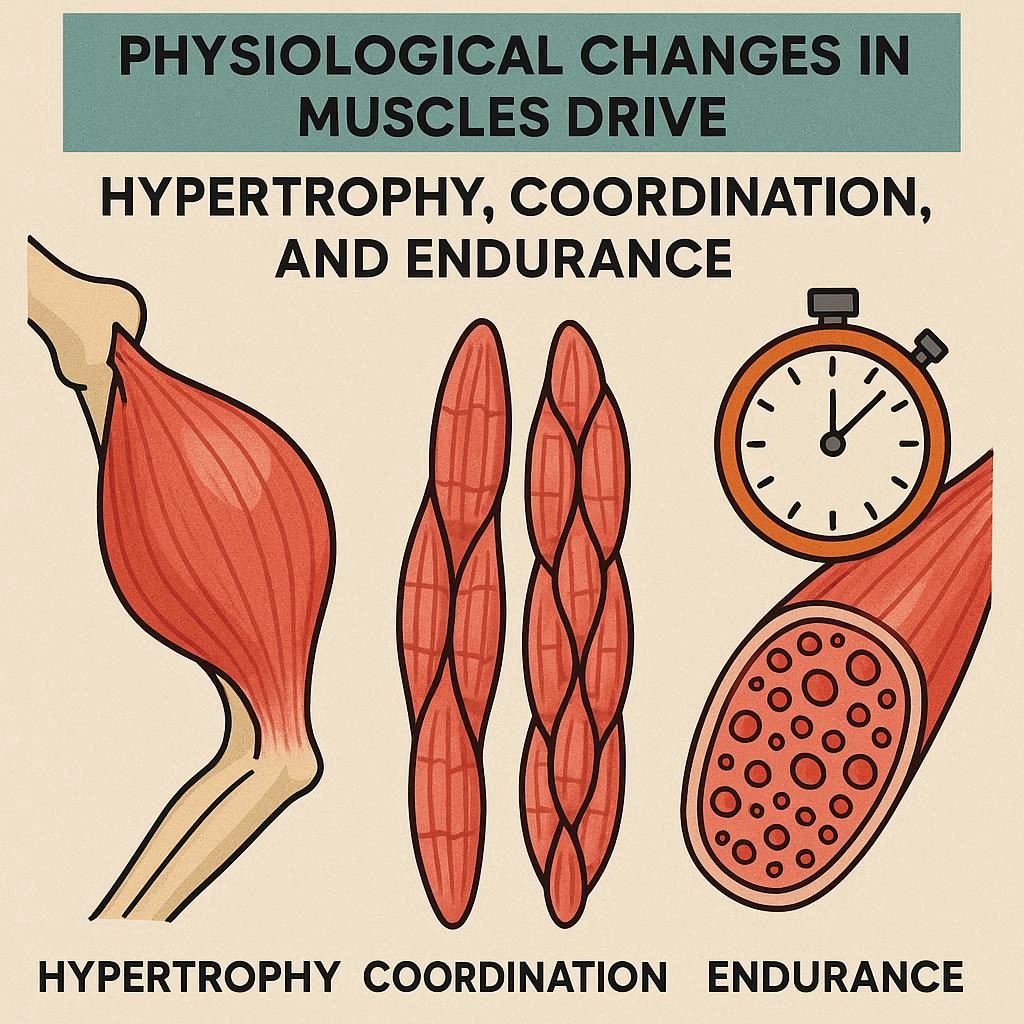
Strength training has been known to be the best method of attaining physical fitness, performance, and long-term health. Although most individuals view strength training as the process of making muscles big and strong, the changes involved are much deeper than that. Regular resistance exercises initiate a sequential physiological transformation process in muscles that enhances strength, coordination and endurance.
The changes take time gradually with the body adjusting to repeated stress of the muscles through training. Every exercise puts a strain on the muscles to do more than it is capable of at that moment that sets biological processes that would result in growth and better performance. These adaptations enable people to be able to move heavier weights, repeat more of the exercises, and maintain physical activity more efficiently with time.
Knowing the effects of strength training on the body gives a good insight into the importance of constant training and the correct methods of training. It is through the study of the processes occurring during muscle adaptation, that people can gain a greater appreciation of the role played by organized exercise regimens in enhancing muscular performance in the long-term.
Learning about Muscle Adaptation to Strength Training
Human body is very flexible and it adapts to physical needs that it makes adjustments to enhance performance. When resistance exercises including weightlifting are exposed to the muscles they cause mechanical stress and microscopic damage. This stress is a sign that makes the body repair and build the muscle tissue more resilient.
Adaptation is a process, which entails various physiological changes of the muscles such as structural, neural, and metabolic modifications. These alterations come about as a result of recurrent training and enable the muscles to work with the rising workloads with the course of time.
To begin with, the neural adaptation is often the cause of strength improvement and not muscle development. The nervous system is more effective at stimulating muscle fibers enhancing control and coordination. Muscle hypertrophy is one of the structural changes that are made more apparent as training is progressed.
This process of adaptation underscores the fact that consistency in strength training is important. The body does not need to keep or improve muscle performance without frequent stimulation and the gains would decrease over time.
Muscle Hypertrophy: The Increase of Muscle Fibers
Among the most famous outcomes of strength training is muscle hypertrophy, which is the growth of the muscle size. Hypertrophy is the enlargement of the muscle fibres due to the repetition of resistance training.
When in an exercising state, the muscles undergo minor damages. The body responds to this by undertaking a repair mechanism that makes these fibers tougher and more dense than it used to be. The consequence of this process is observable physiological modifications of muscles such as an increased cross-sectional area and enhancement of force production.

Training intensity, volume and frequency are some of the factors that affect hypertrophy. Moderate to heavy resistance exercises with multiple reps are in effect the best exercises to stimulate muscle growth.
The strength training that results in physiological alterations in muscles and hypertrophy.
With time the hypertrophy will be constant and lead to increased strength and physical performance. Nevertheless, it is not the only adaptation that takes place during strength training.
Neuromuscular Co-ordination and Strength Training
Besides alteration of the structure, strength training improves the communication between the muscle and the nervous system. This is what is referred to as neuromuscular coordination and enables the body to work with more efficiency on the muscle fibers.
When an individual engages in a resistance exercise, the brain sends its signals via motor neurons to create muscle contraction. Through practice, the nervous system is more efficient in recruiting the right muscle fibers and coordination of their action.
These neural activities are one of the constituents of physiological changes that takes place in muscle during strength training. Better coordination enables one to produce more force using the same mass of the muscle resulting in greater strength.
The neuromuscular gains are also significant at the beginning of training when the trainee can experience a significant improvement in strength despite when the muscle development is not noticeable. This is the reason why first-time trainers tend to achieve high performance upgrades in the initial weeks of training.
Improved Muscular Endurance
Strength training does not merely increase muscle size and strength but it also increases muscular endurance. Endurance is a muscular capacity to maintain repetitive contractions with time without muscle fatigue.
The muscles grow to be more efficient in the production of energy as well as in management of fatigue as they develop resistance training. Such adaptations encompass augmented density of the mitochondria, augmented blood flow and augmented metabolism. These changes are combined to make them more enduring and overall better performers.
Another issue, which is worth considering, in regard to the physiological changes of muscles is the development of endurance. Those who exercise regularly on strength training, get to realize that they are able to do more repetitions and they can stay active longer without feeling tired.
This means that greater endurance is not only useful in sporting practice but in daily tasks. Manual work, climbing stairs, carrying groceries, etc. It becomes easier to handle tasks that require a greater amount of muscular stamina.
The Effect of Progressive Overload
A progressive overload is one of the main principles of strength training in which the demands on the muscles are raised gradually. This may be done through augmenting the weight to be lifted, the quantity of repetitions or the intensity of the exercise.
In the absence of progressive overload, the body and its adaptations adjust to a particular amount of stress and cease further enhancements. Progressive overload helps to maintain the continued occurrence of physiological changes in muscles by continually challenging the muscles.
As an illustration, when one always performs an equal amount of weight without varying intensity, the muscles will ultimately stabilize. By introducing heavier weights or stronger exercises the muscles adapt further and cause further growth and strength development.
Gradual overload has to be implemented in a cautious manner to prevent harm. Slow increments in intensity of training enable the body to safely adapt to the new changes and reduce chances of overworking it or straining it.
The Significance of Organized Training Plans
The success of the training process demands a systematic training program to reveal the similar and sustainable outcome. This kind of programs offers a logical approach to exercise which makes sure that all the body major muscle groups can be trained well and that the improvement is tracked after some time.
The main principles included in the structured programs are progressive overload, variation, and recovery. All these factors combine to facilitate the continued physiological adaptations in muscles to increase the performance.
The training plans can encompass both a mix of compound exercises, e.g. squats and deadlifts, and isolated exercises that can be used to target particular muscle groups. This moderate exercise assists in the creation of total strength, as well as correcting the muscle discrepancies.
structured program which facilitates physiological alterations in muscles and strength gains.
The element of consistency is important in a training program. Routine exercises make the muscles constantly active whereby adaptations are made with time.
Recovery and Recovery and Its Role in Muscle Development
Rest is also a very necessary component of exercising. Exercise is the stimulus of change but it is rest that makes the body fix and build muscle tissue.
Proper rest enables the body to undertake the repair processes that bring about changes in physiological aspects in the muscles. Lack of rest can also result in incomplete recovery by muscles and thereby increasing the chances of injury as well as the performance gains.
All these factors (sleep, nutrition and hydration) are critical in recovery. Protein and carbohydrates replenish muscles and energy stores respectively. Hydration assists in the smooth functioning of the muscles and lessens fatigue.
Training and rest will provide the body with the opportunity to adapt to any exercise and proceed with improvement with time.
Strength training has long-term benefits that are beneficial
Strength training has a lot more benefits than the immediate growth in muscle mass and strength. The beneficial overall health and physical performance is attributed to cumulative changes of muscles which occur over time.
There is greater muscle strength which means stability of the joints and prevents injuries. Better coordination will increase the effectiveness of movement that will facilitate day-to-day activities with ease and safety. Greater stamina enables one to stay active longer without getting tired.
Strength training also helps in maintaining metabolic health in that it helps in building muscle mass which contributes in energy dissipation. These are long term advantages that show the need to include resistance exercise in an exercise routine.
Conclusion
Strength training is an effective method of enhancing performance and better health. Stressing on regular resistance exercise, the body experiences the chain of physiological changes in muscles leading to increased strength, coordination, and endurance.
These involve hypertrophy of the muscle, enhanced neuromuscular coordination and enhanced metabolic efficiency. The two of them enable people to do physical work more efficiently and easily. The concept of progressive overload is the one that keeps these changes going, whereas well-organized training regimens can offer a guideline to the attainment of the same outcomes each time.
The other significant factor is recovery that enables the body to restore and build up muscle tissue. The best way to maximize the benefits of strength training is by ensuring an appropriate balance between training intensity and rest and proper nutrition.
Finally, the knowledge of the impact of strength training on the body is informative about the significance of consistency and a suitable technique. Using these principles, one can attain sustainable enhancement in muscular performance and be physically fit over long-term.