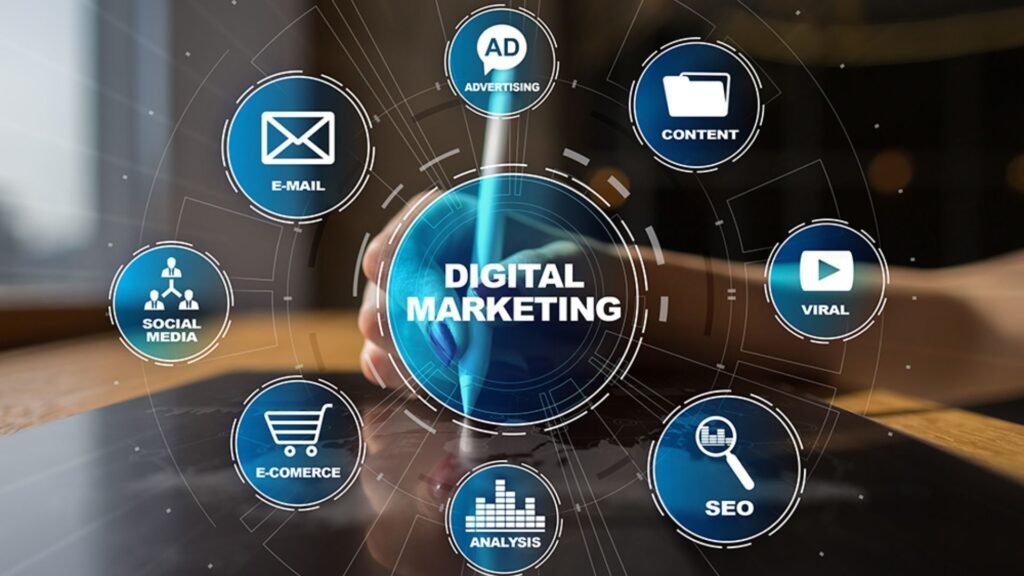
By 2025, marketing technology will no longer be a category on the CMO’s budget sheet; rather, it will be the operating system of modern marketing.
The global marketing technology market is estimated to be around $0.58 trillion in 2025, and it is projected to nearly double by 2030, reflecting a sustained double-digit compound annual growth rate (CAGR). Meanwhile, AI marketing spending is skyrocketing, with estimates suggesting that the AI marketing market will more than triple between 2020 and 2028.
Behind these numbers lies a simple reality: Data, automation, and personalization now define digital success. As cookies disappear, channels multiply, and customer expectations rise, brands are rebuilding their systems around first-party data, AI-driven decision-making, and omnichannel orchestration.
For many organizations this is not a “tool selection” problem; it’s a transformation challenge. Off-the-shelf platforms alone rarely match complex data, legacy systems, and unique workflows. That’s why an increasing number of enterprises and fast-growing startups are working with an experienced MarTech development company to build custom MarTech platforms, connect fragmented systems, and turn data into real revenue.
The State of MarTech in 2025: What’s Driving Adoption?
The MarTech landscape has never been more crowded – over 15,000 solutions in 2025, a 100X increase since 2011. Yet despite “tool fatigue,” investment continues because several structural forces are reshaping marketing:
- AI-powered personalization moves from experiment to default. Around half of marketers now use AI tools, especially for analytics, content, and workflow automation. AI decisioning engines add a layer on top of existing channels to pick who should see what message where and when in real time.
- Cookie deprecation pushes first-party data strategies. Privacy regulations and browser changes make third-party targeting unreliable. Customer data platforms (CDPs) and clean rooms become critical marketing technology solutions for connecting owned data across web, app, CRM, and offline sources.
- Hyperautomation in marketing workflows. Marketing automation software is forecast to grow from about $7.2B in 2025 to more than $16B by 2032 as teams automate nurture flows, lead routing, and reporting.
- Omnichannel engagement is now table stakes. Customers expect a continuous journey from social and search to site, app, email, retail, and support. Deloitte highlights omnichannel experiences and AI-driven automation as core marketing trends for 2025.
In this context, marketing technology solutions are less about “owning the latest tool” and more about building a coherent, composable stack that can keep up with customers and regulators.
Key MarTech Capabilities Every Modern Business Needs
Regardless of industry, most high-performing marketing organizations converge on a common set of capabilities – often delivered through marketing automation tools and connected data systems.
1. Real-time customer analytics
Marketers need live visibility into behavior across channels: campaign responses, product usage, browsing, purchases, churn signals. Real-time dashboards, cohort analysis, and attribution modeling shift decision-making from “last quarter’s report” to “this morning’s data.”
2. Automated segmentation and audience building
Static lists are out; dynamic, rule- or AI-based segments are in. Modern stacks continuously update audiences (for example, “high-value customers at churn risk” or “first-time buyers ready for an upsell”) based on events and propensity scores.
3. Journey mapping and orchestration
Visual journey builders allow marketers to map onboarding, lifecycle, and win-back flows, then orchestrate touchpoints across email, push, in-app, SMS, and ads. This is where omnichannel marketing technology proves its value: one logic, many channels.
4. Predictive recommendations and next-best action
Recommendation engines use historical and behavioral data to surface the most relevant content, offer, or product. In B2C, that may mean dynamic product grids; in B2B, next-best content or outreach for each account.
5. Lead scoring and pipeline intelligence
AI-enhanced lead scoring systems combine firmographics, intent data, and behavior to prioritize sales outreach and reduce friction between marketing and sales. In mature stacks, scores feed directly into CRM routing, SLAs, and forecasting.
6. Content production and distribution automation
From AI-assisted copy to automated testing and syndication, content workflows are increasingly automated. Marketing teams rely on templates, modular content, and integrated DAM (digital asset management) to scale creation without losing brand control.
Taken together, these capabilities transform MarTech from a set of disconnected tools into a custom MarTech platform that orchestrates data and decisions end-to-end.
Custom MarTech Platforms vs. Off-the-Shelf Tools
Standard SaaS tools are an excellent starting point. But as organizations scale, they often hit the limits of generic feature sets and rigid data models.
You likely need MarTech software development and customization when:
- Reporting requirements are unique. Global brands, marketplaces, or multi-brand groups often need custom attribution, LTV, cohort, and margin reporting that off-the-shelf dashboards can’t provide.
- Integrations are complex. Connecting MarTech to CRM, ERP, data warehouses, billing, logistics, or bespoke ecommerce systems often requires custom APIs, middleware, or event-driven architectures.
- Personalization models go beyond rules. When you want real-time decisioning based on reinforcement learning, propensity modeling, or marketing mix models, you’re quickly in “build or heavily extend” territory.
- Workflows are non-standard. Franchise networks, multi-market organizations, and regulated industries usually need tailored approval flows, role-based views, and local-global governance.
- Scale and cost control matter. Owning key components (for example, your own decisioning engine or event pipeline) can be more economical at high scale than licensing multiple point solutions.
This is where a specialized MarTech development company can help design and build a composable architecture – blending off-the-shelf platforms where they fit and custom components where they don’t.
Customer Data Platforms (CDPs): The Heart of Modern Marketing
In 2025, customer data platforms (CDPs) have become the nervous system of digital marketing.
Modern CDPs:
- Ingest and unify fragmented data from web, app, POS, CRM, email, ads, and support into privacy-compliant, ID-resolved profiles.
- Power first-party data strategies as third-party cookies vanish and regulations tighten.
- Feed AI models with clean, structured data for predictive segmentation, recommendations, and churn scores.
- Help with compliance by centralizing consent, preferences, and data lineage across channels.
The shift is from basic “unified profile” to AI-enhanced decision hubs that inform every activation system – email, ad platforms, web personalization, call centers, and beyond. For many organizations, investing in a robust CDP and the data pipelines around it is the single highest-leverage MarTech decision they can make.
The Role of AI in Next-Generation MarTech
If CDPs are the nervous system, AI is the decision-making brain.
Modern AI in marketing touches almost every part of the stack:
- Predictive customer insights. Models forecast churn, next best product, likelihood to convert, and optimal discount, driving smarter campaigns and pricing.
- AI-generated content. GenAI tools help teams create and localize copy, images, and video variations at scale, then feed them into testing frameworks. Many marketers already use AI primarily for content repurposing and analytics.
- Intelligent ad optimization. Bid strategies, budget allocation, and creative rotation are increasingly governed by machine learning rather than static rules.
- Behavioral modeling and segmentation. Clustering and sequence models uncover micro-segments and journey patterns that human analysts would never find.
- AI-powered lead scoring. Going beyond points-based systems, AI models synthesize hundreds of signals to prioritize sales outreach.
- Real-time personalization engines. AI decisioning layers sit on top of channels, dynamically deciding which message, offer, or experience to serve in milliseconds.
To make this work, brands need solid MarTech integration services: clean, timely data flows between CDPs, AI models, and activation platforms – and governance to ensure AI remains transparent, ethical, and aligned with brand strategy.
Implementation: What It Takes to Build Effective MarTech Systems
Buying tools is easy. Building an effective MarTech ecosystem is hard. Typically, successful implementations follow a structured path:
- Strategy & architecture design
Start with objectives: revenue, CAC, retention, NPS, marketing efficiency. From there, design an architecture that maps data sources, decisioning layers, and activation channels – including which pieces will be custom vs. bought. - Data unification and pipelines
Implement event tracking, data contracts, and ETL/ELT pipelines into your CDP and/or warehouse. This is the foundation for everything else; if data quality is poor, AI and automation will simply scale the wrong things. - API-led integration with existing tools
Connect MarTech to CRM, ecommerce, billing, ads, and analytics using APIs, webhooks, and message queues. This is where experienced MarTech integration services make a big difference in reliability and latency. - Model training & analytics setup
Define metrics, build dashboards, and train initial predictive models. Start simple – churn prediction, product recommendations – then evolve toward more advanced AI decisioning. - QA, security, and compliance
Test data flows, permissions, and failover scenarios. Ensure customer data is protected across systems and that consent and privacy preferences are honored everywhere. - Continuous optimization
Once live, use experimentation frameworks (A/B and multivariate tests) and monitoring to refine journeys, content, and models continuously.
Because this requires cross-functional expertise, companies often partner with a MarTech development company that can deliver end-to-end engineering, integration, and ongoing optimization.
Real-World Examples of MarTech in Action
To make this concrete, here are a few common patterns we see in 2025:
Retail personalization engines
A fashion retailer plugs ecommerce, app, and in-store data into a CDP and builds AI-driven recommendation widgets on web and app. Triggered campaigns use custom MarTech platforms to send personalized lookbooks based on browsing, returns behavior, and store visits, increasing repeat purchase and AOV.
AI-driven content automation
A B2B SaaS company uses AI to generate email and ad variants for each persona and lifecycle stage. A central orchestration layer automatically spins up tests, promotes winning variants, and pauses underperformers, freeing marketers to focus on strategy rather than manual optimization.
Predictive churn analysis and save plays
A subscription brand scores customers weekly based on usage, support tickets, and payment behavior. When risk crosses a threshold, playbooks are triggered – personalized offers, concierge outreach, or educational content – delivered across email, in-app, and call center scripts.
Automated campaign orchestration
A marketplace configures “mission control” flows: new sellers and buyers get their own multi-step journeys across multiple channels. When certain behaviors occur (first listing, first purchase, stalled activity), automation sequences adjust in real time.
Cross-channel customer journey mapping
A financial institution can use MarTech integration services to connect web, app, branch, and call-center interactions into a single view of the customer journey. This allows them to identify drop-off points, coordinate follow-ups, and create omnichannel experiences that feel like one continuous conversation.
The business value doesn’t come from any individual tool, but rather from how data, decision-making, and activation are integrated.
How to Choose the Right MarTech Partner
Given the complexity, choosing the right partner is critical. When evaluating a MarTech development company, look for:
- Proven expertise in custom MarTech software development. Ask for case studies that resemble your stack and industry.
- Deep integration capabilities. They should be comfortable integrating with major CRMs, ecommerce platforms, ad networks, analytics tools, and data warehouses.
- Understanding of marketing workflows. Engineers should be able to talk about lifecycle journeys, attribution, and experimentation – not just APIs.
- Experience with AI personalization. Check their track record with recommendation engines, propensity models, or AI-driven segmentation.
- Transparent delivery model. Clear timelines, agile processes, and measurable milestones.
- Scalability and long-term support. Can they help you evolve from MVP to global deployment without re-platforming?
Conclusion: Turning MarTech into a Growth Engine
In 2025, MarTech is no longer about “keeping up with digital.” It is the engine that powers modern growth:
- Data unified in CDPs and warehouses
- AI embedded in decisioning and content
- Automation orchestrating journeys across every channel
- Custom MarTech platforms tying it all together in a way that matches your business, not a vendor’s template
For CMOs, growth leaders, and founders, the priority is clear: move beyond tool shopping and architect a coherent, future-proof stack. With the right MarTech development company at your side, you can turn fragmented data and disconnected tools into a scalable system that continuously improves customer experience – and your bottom line.