The software development industry has always sought innovation to make the development process more efficient. From punch cards to cloud-native platforms and everything in between, developers have devised innovations to reduce the friction between intent and executable code. The introduction of AI agents is the latest installment in this trajectory.
Contrary to other AI tools that only respond to direct prompts or perform narrow tasks, AI agents can reason, plan, execute actions and collaborate with humans and other agents over extended workflows. In software development, this autonomy allows them to understand goals, manage tasks, make decisions, and change as projects progress through different phases. This is a significant upgrade from previous AI tools that were limited to completing code or correcting syntax.
This article explores the intricacies of AI agent dev. It explains what AI agents are, how they are different from traditional tools, where they are being applied across the software lifecycle, the benefits and challenges of using them, and how they can change the future of software development.
Understanding AI Agents in Software Development
Without a clear understanding of what AI agents are and how they operate, it will be difficult to appreciate their impact in the software development process.
What are AI agents?
AI agents are systems that can perceive their environments, make goal-oriented decisions and take the required actions to achieve these goals. This is particularly impressive considering that they can accomplish these with little to no human intervention. In contrast, traditional development tools are reactive. For example, compilers only compile codes when instructed, similarly, testing frameworks run tests only when triggered.
Even modern AI-powered tools like code autocompletion engines only respond when prompted by a developer. These tools, while innovative, come with narrow boundaries. AI agents redefine the software development process, shifting humans from execution-heavy roles to higher-level creative and strategic functions. For a general tech audience they may sound abstract or futuristic, but they are being used as we speak to reshape software planning, building, testing, deployment and maintenance.
Core Capabilities of AI Agents
AI agents in software development typically combine several capabilities:
- Reasoning and planning – AI agents have the capacity to analyze problems, understand constraints and plan a sequence of actions.
- Memory and context awareness – AI agents can retain details about the codebase, past decisions, and history of a project.
- Tool Use – AI agents can interact with APOs, repositories, CI/CD pipelines, databases, and cloud services.
- Autonomy – AI agents can operate within defined boundaries without human intervention.
- Collaboration – AI agents can collaborate with humans and other agents to coordinate a task.
Using these capabilities, AI agents can function more like a digital teammate rather than a mere assistant.
The Traditional Software Development Workflow: A Brief Overview
To understand how revolutionary AI agent software development is, we need to first examine the conventional software development lifecycle. Even though there are different methodologies (waterfall, agile, DevOps) the core stages are mostly similar:
Requirements Gathering and Planning
- Design and Architecture
- Development and Implementation
- Testing and Quality Assurance
- Deployment and Release
- Monitoring and Maintenance
In traditional workflows, these stages are manually coordinated, and where automation exists, they are often rule-based and are limited by scope. In these workflows, developers write code, testers check to see that they work properly, DevOps engineers oversee deployment, and product managers handle planning and prioritization.
In contrast, AI agents blur the boundaries between these stages, making development workflows more continuous and self-optimizing. It does this by introducing intelligence and adaptability into each stage of the development process.
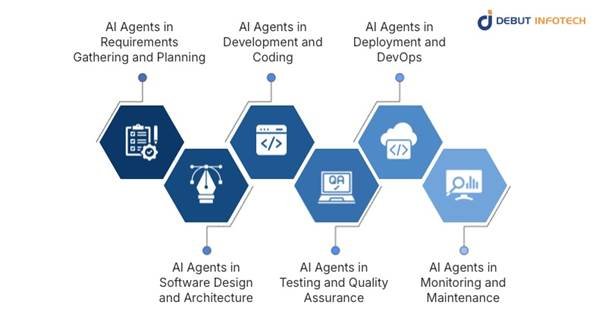
AI Agents in Requirements Gathering and Planning
One of the earliest points of friction in the software development process is translating human needs into technical requirements. Miscommunication at this stage can lead to scope creep, rework and missed expectations. With AI software agents, developers can augment human interpretations offering a more robust understanding of technical requirements. These agents analyze stakeholders inputs such as documents, emails, meeting transcripts and user feedback to extract structured requirements. Thus, they identify patterns, ambiguities, and inconsistencies in requirements before development begins.
For example, an AI agent can:
- Summarize user stories
- Identify conflicting requirements
- Suggest missing edge cases
- Map requirements to existing system capabilities
Once the requirements for the project are clearly defined, AI software agents can help in planning by estimating effort, identifying dependencies and suggesting timelines. This way, agents can re-evaluate plans in real-time as requirements change or obstacles emerge.
This approach ensures a more flexible plan that can adapt to changing circumstances—unlike traditional planning that is more rigid—and reduces the administrative burden on project managers.
AI Agents in Software Design and Architecture
In the development process, design and architecture significantly influence the scalability, maintainability, security, and long-term performance of software systems. When architectural decisions are misaligned with business objectives or growth expectations, the consequences can include technical debt, integration bottlenecks, and costly rework. For this reason, these decisions are traditionally entrusted to senior engineers who bring the necessary experience and architectural intuition.
However, even seasoned professionals can face limitations when navigating increasingly complex, distributed, and data-intensive environments. To reduce risk and improve decision accuracy, many organizations are now incorporating AI-driven agents into their design and architecture workflows. These intelligent systems analyze project requirements, technical constraints, historical system data, and performance benchmarks to recommend optimized architectural patterns.
When businesses hire AI agent developers with expertise in system architecture and intelligent automation, they gain access to solutions that go beyond conventional engineering judgment. AI-powered design assistants can support decisions related to microservices vs. monolith structures, database selection, messaging frameworks, cloud architecture, security controls, and performance optimization strategies.
Importantly, these AI agents do not replace human expertise. Instead, they augment it — providing a data-informed foundation that enables engineering teams to make faster, more strategic, and lower-risk architectural decisions. The result is a development process that is aligned with scalability, resilience, and long-term business growth.
Design Consistency and Documentation
When dealing with large systems, developers are confronted with the challenge of maintaining consistency across the system. With the help of AI agents, this task becomes a lot more manageable. These agents can monitor design artifacts and code to ensure that they align with architectural guidelines.
Additionally, these agents can generate and update documentation automatically as the system evolves. This reduces knowledge gaps within a development team.
AI Agents in Development and Coding
AI development agents are particularly useful in the coding phase. However, unlike traditional tools that are limited to code suggestions, AI agents, when given a defined task, can generate complete code modules, integrate them into existing repositories, and even create supporting tests. This is possible because these agents consider existing coding standards, dependencies, and architectural constraints. Their ability to understand context is what sets them apart from traditional code generators.
AI agents can also act as perpetual code reviewers that analyze codes for bugs and logical errors, security vulnerabilities, performance bottlenecks and style and consistency issues. This way, they reduce review backlogs and free up human reviewers to focus on higher-level concerns.
Furthermore, AI agents can help reduce frictions among team members by tracking who is working on what. This reduces duplication of effort and guarantees a more cohesive work experience.
AI Agents in Testing and Quality Assurance
While testing is central to the development process, it is also time consuming. Using AI agents for quality assurance reduces effort and ensures that the process is a lot more effective and comprehensive.
AI agents make it possible to trigger tests dynamically based on risk assessment. For example, a small UI change may require limited testing, while a core logic update may prompt a full regression suite
Upon detecting defects, AI agents can analyze logs, reproduce issues, and suggest fixes. In some cases, they can even implement and validate fixes without human intervention. This reduces mean time to resolution significantly.
AI Agents in Deployment and DevOps
As deployment pipelines become more complex, AI development companies are using AI agents to simplify DevOps practices. Today, AI agents can optimize continuous integration and deployment pipelines by prioritizing builds and tests, detecting pipeline failures early and adjusting resource allocation dynamically.
AI Agents in Monitoring and Maintenance
The software development lifecycle does not stop at deployment. Even after deployment developers need to monitor and maintain the software. AI agents enable predictive monitoring by analyzing telemetry to detect anomalies early. This allows teams to prevent failures through proactive maintenance.
Benefits of AI Assisted Workflows
Incorporating AI-assisted workflows into software development offers the following benefits:
- Increased productivity – Development teams that incorporate AI agents spend less time on mundane tasks, so they can focus on more creative and problem-solving tasks.
- Improved quality – using AI agents to test, review and monitor codes reduces defects and technical debts.
- Faster time to market – AI assisted workflows speeds up delivery cycles, and reduces time to market.
- Better decision-making – with AI agents, development teams can access data-driven insights to support more informed architectural and planning choices.
- Scalability – with AI agents, teams can better manage growing codebases and infrastructure without proportional increase in effort.
Challenges and Ethical Considerations
While they offer a number of benefits, incorporating AI agents into the development process comes with the following challenges:
- Trust and challenges: AI agents are prone to making opaque decisions. This may discourage developers from trusting and incorporating them into their workflow.
- Security and governance: AI agents often have access to sensitive systems and data. This may be a cause for concern among developers.
- Workforce impact: with AI agents taking on routine tasks, developers need to evolve or become obsolete. As AI agents gain wider adoption across the development process, developers will need to reskill to ensure they remain useful.
Conclusion: Simplify the development process by partnering with AI consultants
Integrating AI agents to software development introduces autonomy, intelligence and flexibility across the development lifecycle. These agents improve productivity, quality and scalability by enhancing planning, coding, testing, deployment and maintenance.
Debut Infotech Pvt Ltd is an AI agent development company backed by experienced AI engineers, solution architects, and technology consultants who understand both technical depth and real-world implementation. With a proven portfolio spanning enterprise AI agents, intelligent chatbots, workflow automation systems, and advanced AI integrations, the company focuses on delivering practical, production-ready solutions designed for measurable impact.