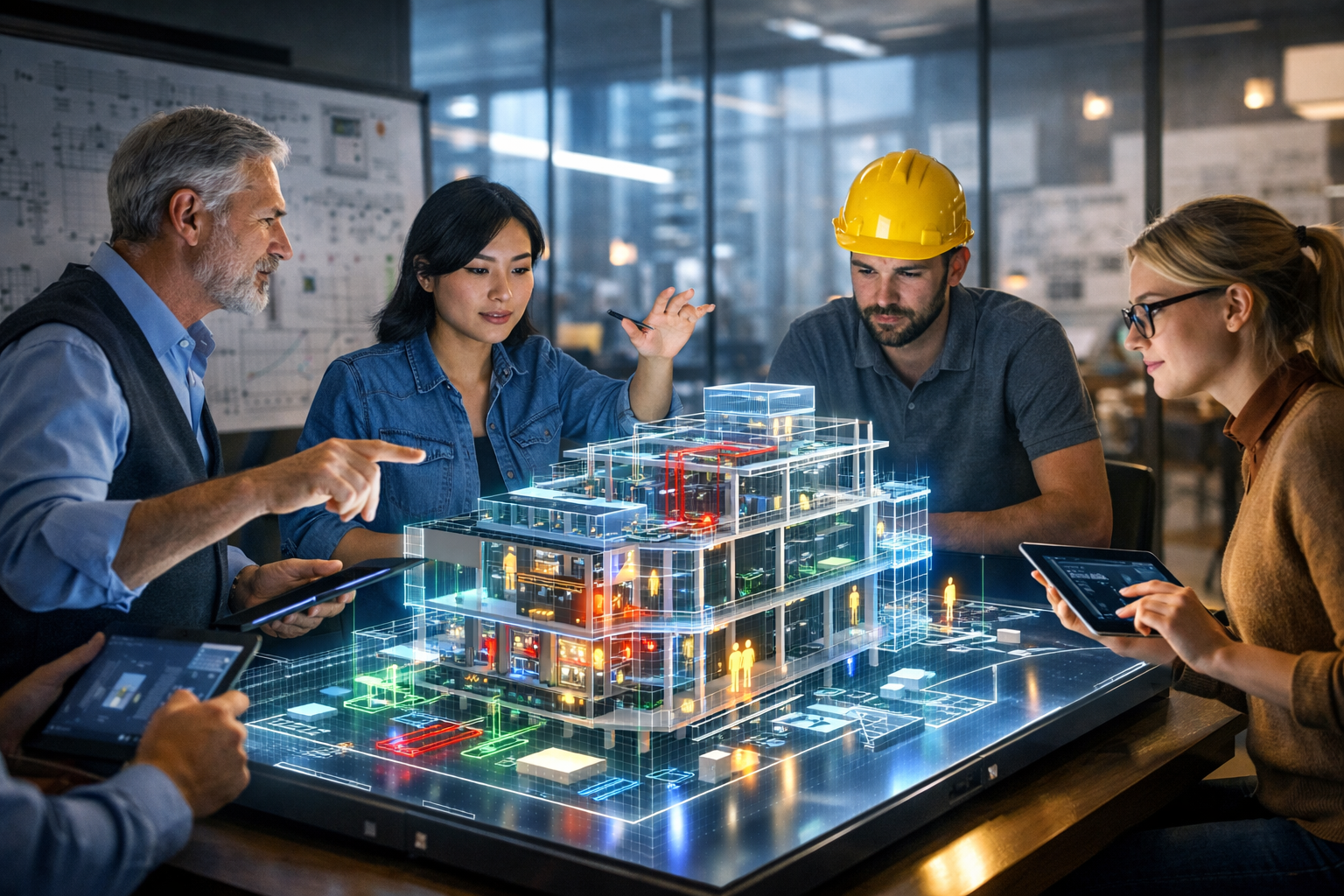
The modern design and engineering environment is becoming more and more complex, and it may need the contribution of various experts. Architecture, product development, city planning, and high-level manufacturing all require proper communication between multidisciplinary teams. Delays, misinterpretations and design conflicts are quite frequent when it comes to the traditional methods like the use of a static drawing or paper-based documentation.
Geometric modeling offers a radical solution, which allows communal, interactive digital models, which enhance communication, minimize errors, and speed up project schedules. Geometric modeling guarantees all the stakeholders remain on track during the project because it enables the teams to visualize, modify, and analyze the designs together.
Knowing Geometric Modeling.
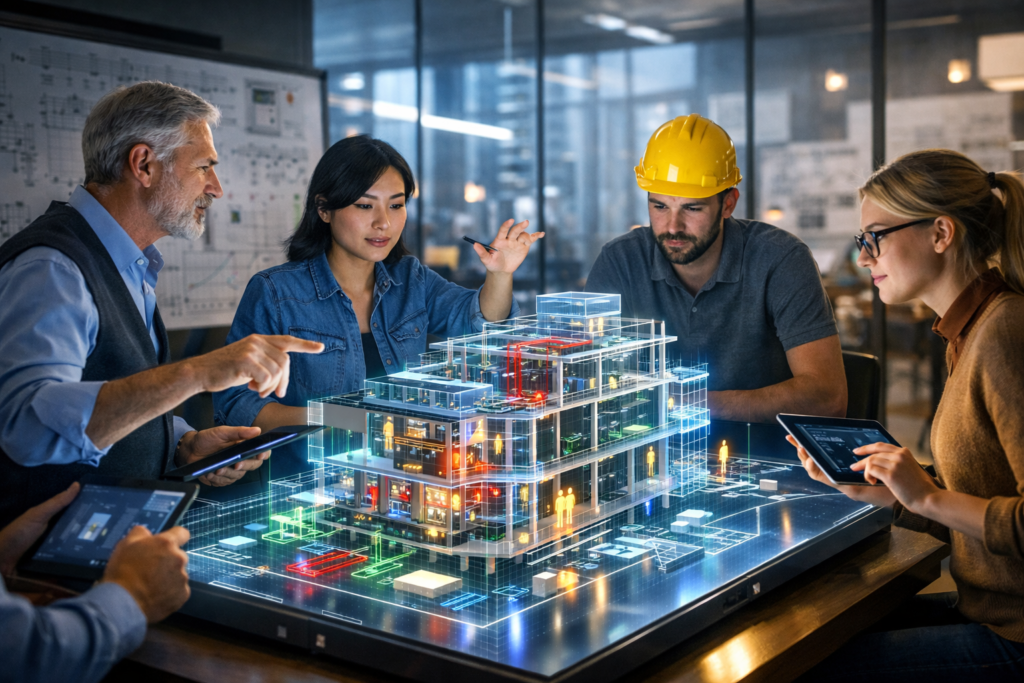
Geometric modeling is the computation or the development of digital representations of physical objects or systems, through computational techniques. These paradigms include the 2D sketches to 3D parametric designs used to establish the relationships between components.
Geometric models are used as a common language in a collaborative environment, to separate the gap between experts of various expertise. The emphasis of architects is put on the aesthetic of spaces; engineers on structural integrity; and product designers on usability. Digital geometric models enable everyone in the team to be able to see the intent of the designs in a visual manner and eliminating miscommunication that is eminent in case of a stuck drawing.
The conventional methods of communication usually require reviews and document exchanges in a sequence, which may slow down the feedback process and introduce errors. In comparison, the contemporary platform of geometric modeling offers interactive experiences where the updated state can be seen in real-time and keeps the teams in tune.
Real-Time Visualization and its significance.
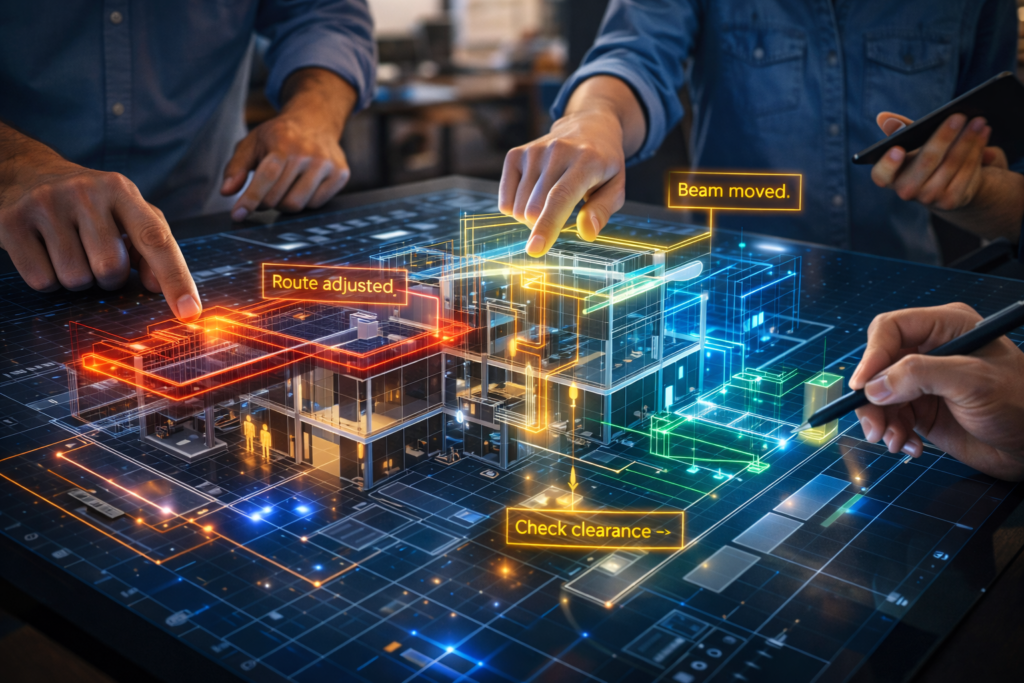
Geometric modeling platforms are characterised by real-time visualisation. This feature enables the members of a team to observe model modifications immediately. The designers and engineers will be able to assess the effects of changes immediately and detect conflicts, as well as offer feedback and eliminate miscommunication and mistakes.
As an illustration, during house construction, architects are able to manipulate the floor plans and structural engineers can view the impact of the modification to the load. HVAC or electrical layouts can also be altered by mechanical engineers at the same time. Interior designers do not have to wait before the functionality and aesthetics of the space can be checked. The real moment visualization also makes sure that all people work with the newest design, there is no delays and also enhances cooperation.
Also benefiting are the stakeholders like clients or investors. They are able to engage with the model directly and have an intuitive knowledge about the project without having technical knowledge. This mutual visibility will result in improved decision-making and enhance communication on every level.
Collaborative Geometric Modeling Systems.
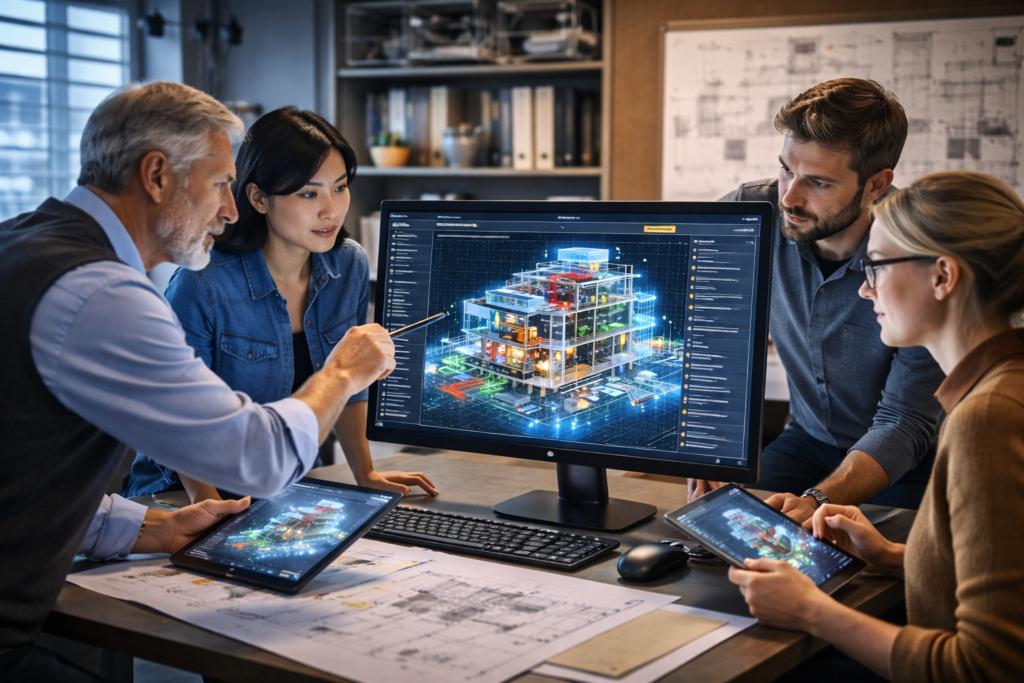
There are a number of platforms that aid in shared geometric modeling:
Autodesk Revit: Revit is used in architecture, engineering, and construction (AEC), and provides the ability to collaborate in the cloud using structural, design, and mechanical integration.
SolidWorks: It is applied in product design and allows parametric modeling, assembly and simulations to engineers and manufacturers.
Rhino with Grasshopper: employment in architecture and industrial design as a surface engineering and parametric control model.
Onshape: It is a complete cloud application that provides real-time collaboration, version control, and concurrent editing.
These systems do not only show models, but they also have annotations, version histories and conflict detection. Centralized models can guarantee that all the team activities are carried out on the most recent design and that there is no misalignment as well as redundancy.
Empowering Multidisciplinary Collaboration.
Different technical languages are frequent in multidisciplinary projects where specialists are involved. Geometric modeling creates a common platform in which ideas can be exchanged effectively and easily among teams.
With the centralization of design information, teams are able to test other solutions together. Parametric models automatically keep associated elements in pace as one of their elements is altered, so it is easier to observe the implications of design choices. This team building practice promotes innovativeness and reduces mistakes.
Lessening the number of errors through interactivity.
Geometric modeling is characterized by enormous interactive feedback. Models can be annotated, draw attention to problems, and offer improvements right in the common digital environment. These comments are in context and understandable unlike the traditional email or document based communication.
Automated tools also promote the prevention of errors:
Collision detection: Pickings in 3D assemblies.
Lockouts: Notify users about elements which are contravening design requirements.
Simulation feedback: Tests result in real time of structural, thermal or performance.
The early identification of problems allows correction of problems in the construction or manufacturing process to be done cheaply and saves time and risk.
Bypassing Project Schedules.
Shared geometric models greatly reduce the project timelines. Conventional sequential processes have one team completing the work then the other starts. Parallelograms of work can be performed in collaborative modeling where changes are reflected in time.
In one case, when structural engineers are engaged in the work on the frame of a building, MEP teams may deal with systems at the same time. Modifications in a given discipline are automatically transferred to all others to save the time and effort of conducting a meeting and a prolonged review process. The outcome is more coordinated project completion and faster.
Case Study Collaborative Product Design.
These advantages are demonstrated in a consumer electronics team that produces a new smartphone. Members of the team are the industrial designers, mechanical engineers, software developers and the supply chain specialists.
Step 1: Conceptual design – An industrial designer goes on generating the original shape in 3D.
Step 2: Engineering integration – It is mechanical engineers who make sure that the structure is sound.
Step 3: Software and hardware integration – Engineers are the one who combine electronics and layout parts.
Step 4: Continuous improvement – Model is refined whenever changes are made in any area and any changes in the model are reflected instantly to every member of the team.
This streamlines the number of errors, cuts down the number of reviews and makes sure that the product is functional, aesthetics, and manufacturability. Shared geometric modelling enhances decision making and makes the product reach the market at a faster rate. Besides the Team Communication.
The geometric models also boost communications to the client, the regulatory bodies and the contractors. Technical drawings cannot be understood easily as the visual and interactive models that will help in approval and presentations.
The stakeholders can experience the designs, which is made possible by using a virtual reality (VR) and augmented reality (AR). Clients can be granted the capacity of virtually touring the building before it is constructed and can see the building in a model and installations can be overlaid on real life places by contractors in order that the installations can be accurate. These tools improve team building, which is not part of the team that is core and enhance transparency.
The Future of Collaborative Modelling.
Geometric model is still being modeled using new technologies:
Artificial Intelligence (AI): “Anticipates conflicts, proposes optimization and simplifies design processes.
Generative design: Provides several different design options that are based on the performance requirements.
It is cloud-based cooperation: It enables the work of the groups that are not at the same places and time zones.
Integrated simulations: This is a test design that makes use of realistic conditions and no physical prototype.
This type of inventions will enable to make the team-based design work more productive, realistic and foresight and establish fresh norms of multidisciplinary projects.
Best practices that would be effective in the implementation process.
In order to gain the advantages of a geometric modeling, the following best practices can be observed by teams:
Training: (Make sure that all the members are familiar with the platform that is selected).
Data management: Data of large model should be preserved and stored in a proper manner.
Standards: have standard nomenclature and conventions of parameters.
Workflow integration: Alter modeling tools to the existing project processes.
The practices will see the process of adherence being embraced where it operates efficiently and effectively and delivers the best project deliverables.
Conclusion
The collaborative form of design communication has assumed another form that is through the geometric modeling. The multidisciplinary team can cut down the errors, enhance the decision making and minimize the project schedule due to the interactive and shared models offered which has the visualization in real time. The collaboration is improved by the automated testing, the annotated platforms, and the collaboration platform based on the cloud, and the latest technologies, including the AI, VR, and inbuilt simulation, could be even more productive.
Again, in a world where precision, speed and coordination are valued aspects, the geometric modeling is not just a designing tool, it can facilitate a strategy that can in turn be followed by innovation, reduction of risks and better outcomes in a project.