Introduction
The incorporation of epidemiologic concepts into oral health education is necessary in training future dental practitioners to deal with the complicated population health issues. The oral diseases include dental caries, periodontal disease and oral cancers among others which are not only clinical but also a public health problem which is affected by the social, behavioral and environmental factors. Thus, it is not possible to teach epidemiology efficiently without in-the-field teaching, but only through practice.
This paper discusses the methods that can be applied in educating epidemiologic principles in oral health by use of lectures, discussions, readings, and exercises. It also emphasizes the role of teachers in reducing the gap between classroom knowledge and community-based practice in preparing the students with skills that would be useful in research, clinical decision-making, and community interventions that promote health. (OUP Academic)
Knowledge of Epidemiologic Principles in Oral Health Education.
Epidemiology offers the basis of the comprehension of the distribution of diseases, their causative factors, and the methods of preventing diseases. These concepts assist the students in oral health by:
- Determine oral disease patterns among populations.
- Examine the risk factors (diet, hygiene and socioeconomic status).
- Consider preventive measures such as screening regimes and fluoridation.
- Implement evidence-based decision-making within the clinical practice.
A thorough grasp of these notions will start in the classroom but will have to go beyond it in case of meaningful learning results.
To find more academic material on this issue, students may refer to this basic material on.
oral health epidemiologic principles, which offer specific theoretical and practical knowledge.
Lectures as the means of developing the background knowledge
Content Organized Presentation of Fundamental Ideas
One of the major teaching techniques in oral health education is lectures. They work exceptionally well in presenting the major epidemiologic concepts like:
- Incidence and prevalence
- Design of the study (cross-sectional, cohort, case-control).
- Association (risk ratios, odds ratios)
- Prejudice and confounding variables.
Properly organized lectures give students a good system through which they comprehend complicated concepts in an organized manner.
Improving Interaction During Lectures
In order to enhance effectiveness, lectures need to include:
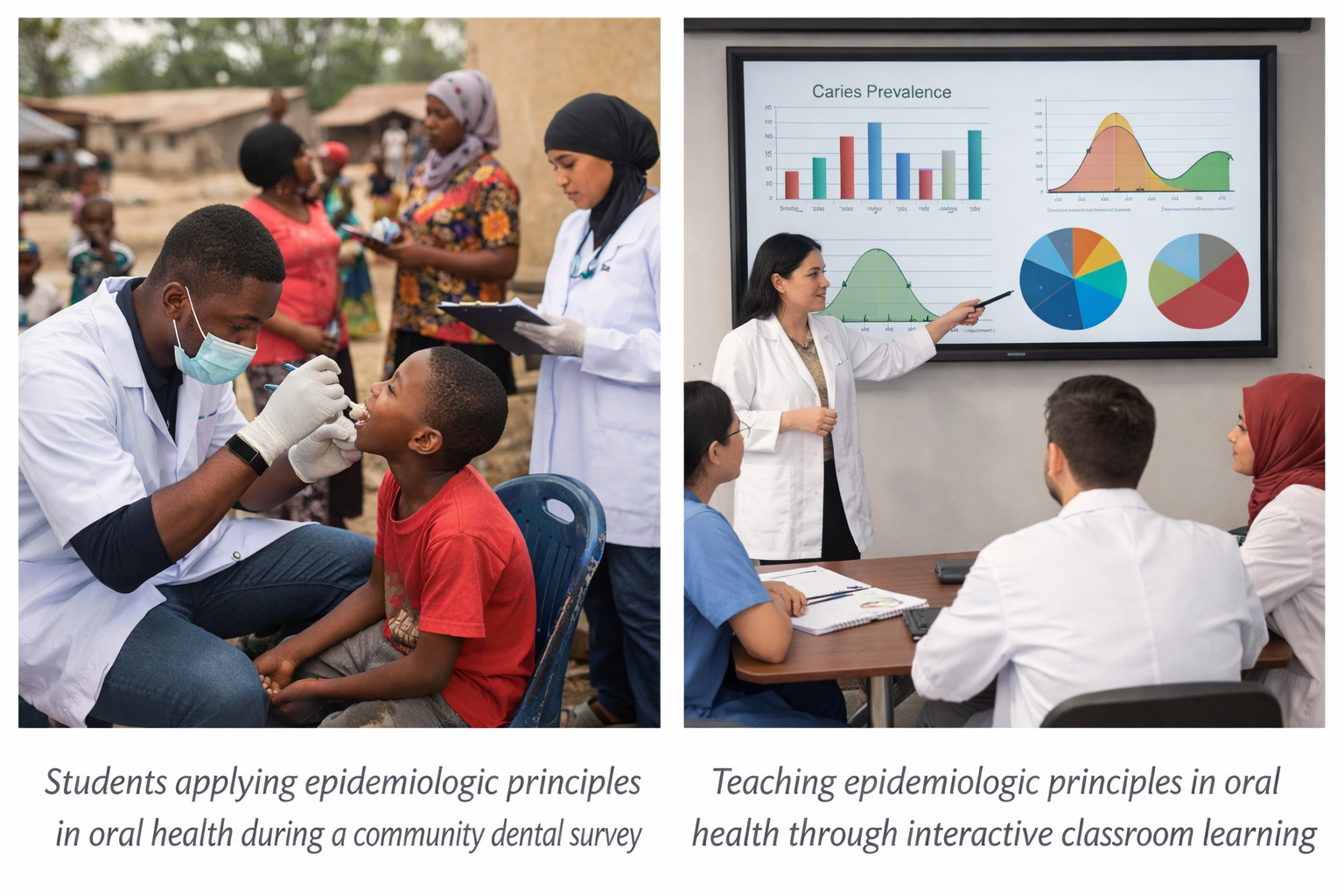
- Presentation aids like graphs and charts.
- Real life instances of oral disease outbreak or interventions.
- Interactive questioning procedures.
To illustrate, students can be offered data on the prevalence of dental caries in various communities to see mismatches and realize the necessity of epidemiologic analysis.
Engaging Discussions: The Art of Critical Thinking
Promoting Student Engagement
Discussions enable the students to participate actively in the field of epidemiology and not passively receive the information. By facilitated discussions, students are able to:
- Make sense of epidemiologic data.
- Discuss the efficiency of interventions in the field of public health.
- Discover moral implications of oral health research.
Case-Based Learning
Case studies are especially good in the discussion. As an example, the students could examine a case of high prevalence of periodontal disease in a rural community and suggest measures based on epidemiologic evidence.
This method assists students in being able to think critically and apply theoretical information into a real-world context.
The Worth of Readings in Enriching Knowledge
Experience with Research and Evidence
Systematic readings, such as textbooks, journal articles, and reports, help the students get a more comprehensive picture of the basics of epidemiology in oral health. The materials subject the students to:
- Current research findings
- The methodology of the epidemiologic studies.
- Oral health interventions evidence-based recommendations.
Training Analytical Skills
Reading activities must be accompanied by the following analysis activities:
- Summarizing key findings
- Critiquing study designs
- Determining the strengths and weaknesses of research.
This does not only enhance learning but also equips the students to research and practice in the field.
Practical Exercises: Theory, Theory and Practice
Hands-On Data Analysis
Hands-on training is necessary to provide the knowledge acquired in theory to practical skills. The activities that students can involve themselves in include:
- Gathering and reporting oral health at the data level.
- Incidence and prevalence rates calculation.
- Interpretation of epidemiologic results.
Such exercises will allow students to learn how epidemiologic information can be used to make decisions related to oral health.
Fieldwork and Community Interactive
Field experiences offer priceless experiences to students where they are able to put epidemiologic principles into practice. Activities may include:
- Undertaking oral health surveys at the community level.
- Attending dental programs at school.
- Evaluating risks in a particular population.
These experiences enable the students to witness the direct effect of epidemiology on population health.
Using Technology in Epidemiologic Education
Online Resources and Simulations
The epidemiologic principles are taught in a better way using modern technology, which offers interactive learning. Tools such as:
- Data analysis software
- Disease outbreak simulations Web-based.
- Virtual case studies
allow students to make use of epidemiologic techniques within a controlled setting.
Access to Online Resources
Online platforms are also a source of a large variety of education, such as:
- E-books and research databases.
- Lectures and webinars on the internet.
- Health information repositories.
These materials allow the on-going education and assist students address the latest trends in oral health epidemiology.
Application of Classroom Knowledge to Clinical Practice
Evidence Based Decision Making
Preparation of students to practice evidence-based oral health is one of the main purposes of teaching the epidemiologic principles. Clinicians must be able to:
- Evaluate research evidence
- Generalize research to patient care.
- Make interventions responsive to the population.
Indicatively, the knowledge of the epidemiology of dental caries can be used to inform decisions on preventive measures like fluoride application.
Patient Care Risk Assessment.
Through epidemiologic training, students can help in risk assessment of the individual patient as per a population data. This includes:
- Determining high-risk populations.
- Individualizing preventive measures.
- Following up disease development.
These are the skills needed to provide effective and personalized oral healthcare.
Practice in Community Health
Developing Public Health Interventions
Epidemiology principles play a critical role in coming up with oral health programs at a community level. Students learn to:
- Determine what communities require based on an analysis of data.
- Planned specific interventions.
- Measure effectiveness of programs.
Examples include:
- Fluoridation of water of the community.
- Education campaigns by mouth.
- Examination and prevention programs.
The Way forward on Health Inequalities
The oral health disparity is among the key social health issues. Learning epidemiology assists students to learn:
- Social determinants of health.
- Difficulties with dental care.
- Gestures of mitigating inequalities.
Using this knowledge, the future professionals will be able to make the health care systems more equal.
Training Research Careers in students
Developing Competence in Building Research
Oral health research is founded on epidemiologic education. Students gain skills in:
- Designing studies
- Gathering and processing information.
- Interpreting results
These competencies will be critical in the development of knowledge in the field as well as enhancement of oral health outcomes.
Encouraging Innovation
With the help of research training, students can learn to investigate new methods of preventive and curative care of diseases. This helps in building innovation and also helps in the creation of more effective oral health strategies.
Epidemiologic principles are difficult to teach
Complexity of Concepts
Epidemiology ranks among the fields that are challenging to learn since it consists of complex statistics and methods. Educators must:
- Make explanations simpler but at the same time accurate.
- Provide working examples to explain things.
- Give constant assistance and feedback.
Scarcity of Practical Opportunities
The fieldwork and real-life experiences might be scarce in certain environments. To overcome this, a teacher can:
- Simulations and virtual exercises Use simulations and virtual exercises.
- collaborate with the local communities and organizations.
- Apply project based learning.
Efforts towards Effective Teaching
Blended Learning Approach
A mixture of lectures, discussions, readings, and practical exercises make up a very wholesome learning experience. This approach:
- Fulfills the needs of various learning styles.
- Strengthens knowledge in various ways.
- Increases student interaction.
Continuous Assessment
Frequent tests are used to evaluate student progress and see where something can be done to improve it. These may include:
- Quizzes and exams
- Group projects
- Practical assignments
Collaboration and Teamwork
Group work is encouraged so that the students learn to communicate and work as a team, which are very necessary in a clinical and public health environment.
Conclusion
Epidemiologic principles in oral health education must be taught in a multifaceted way which cannot be solely taught in the classroom. The combination of lectures, discussions, readings, and practical exercises can help educators build a dynamic learning environment that can promote knowledge and the application.
It is important to bridge the gap between classroom and the community to get the students prepared to tackle real life oral health challenges. The skills required to apply epidemiologic reasoning in different settings are developed through hands-on experiences, evidence-based practice, and by engaging with the community.
Finally, successful education in epidemiology would enable future oral health professionals to better health outcomes in populations, lessen the disease burden, and build more just healthcare structures.