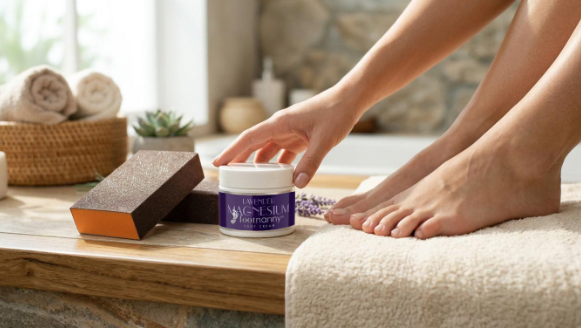
Sandal season has a funny way of exposing every foot-care decision you avoided all winter. One day, your feet are safely hidden in socks. The next, you are staring at your heels in open-toe shoes wondering when they started looking like they have been through negotiations.
Most people reach for polish first. Some grab a cream and hope for the best. But if rough skin, dry buildup, or calloused areas are sitting on the bottoms of your feet, moisturizer alone may not be the best place to start.
That is where the Footnanny Rescue Dry Buffer earns its name. It is the prep step before the pretty step, the practical little tool that helps smooth rough areas before you rinse, soak, or add cream.
Why Sandal-Season Foot Care Starts Before Moisturizer
Cream is important, but cream is not magic. If your feet have dry surface buildup, rough patches, or heels that look like they have been emotionally unavailable since October, moisturizer has to work around all of that.
The switch to sandals makes this more noticeable. Dry heels and peeling skin can hide in boots and sneakers, but open shoes are not nearly as forgiving. They reveal things. Rudely, but honestly.
Getting ahead of that does not require a complicated foot-care ceremony. It starts with a simple question: have you prepped the skin before adding moisture?
What the Footnanny Rescue Dry Buffer Does
The Footnanny Rescue Dry Buffer is designed as a fast, simple way to help smooth dry and calloused skin on the bottoms of the feet and targeted rough areas. The product page mentions dry skin, callouses, cracked-looking heels, peeling skin, and corns as areas it is meant to address, and it also works on rough hands.
The key detail is in the name: it is used dry. You do not soak first. You do not wet the buffer. You dry buff before rinsing or soaking, which makes this different from a shower scrub or pumice stone routine.
That dry-first approach also connects to the story behind the product. Gloria Williams, Footnanny’s founder and Oprah Winfrey’s longtime personal pedicurist, shares that she used to see her father use an old-fashioned dry scrub brush on her mother’s feet at night before soaking them in salt water.
That is the kind of detail that makes the product feel very Footnanny. It is not trying to be futuristic or fussy. It is old-fashioned common sense, cleaned up for modern bathrooms.
The Three-Step Prep Sequence
The routine around the Rescue Dry Buffer is beautifully uncomplicated, which is good because feet already have enough going on.
• Step 1: Dry buff both feet with the Footnanny Rescue Dry Buffer, focusing on the bottoms of the feet and any targeted rough areas.
• Step 2: Rinse or soak your feet.
• Step 3: Apply Footnanny Foot Cream or Footnanny Foot Balm to both feet.
That is it. No mystery. No twelve-step ritual. No standing in the bathroom wondering whether you were supposed to exfoliate before or after the soak while your towel slowly gives up on you.
The buffer can also be rinsed to remove foot dust as needed, which is a practical detail nobody wants to think about until they absolutely have to.
Why It Pairs Well With Footnanny Creams
The Rescue Buffer is not a replacement for moisturizer. It is the thing that helps make the moisturizing step feel more useful.
After dry buffing and rinsing, a cream or balm has a cleaner starting point. That is where Footnanny’s product pairings make sense.
Footnanny Eucalyptus Foot Cream is a strong follow-up if you want something that feels fresh after the prep step. Footnanny Protein Unscented Foot and Heel Cream works well for people who want a low-scent option for dry feet and rough-feeling heels. Footnanny MAN Unscented Cream keeps things simple for people who do not want fragrance to be the main event.
If you want the most straightforward pairing, The ONE Pedicure Cream also fits naturally after buffing. And once cream is applied, Footnanny Cotton Socks can help make the final step feel more complete, especially if you like handling foot care before bed.
The logic is simple: buffer first, cream after, socks if you want to finish strong. Look at that, a routine that does not need a flowchart.
The Famly-Member Detail That Actually Makes Sense
Footnanny suggests buying different buffer colors for each family member to avoid mix-ups. For a product used on feet, this is basic household survival.
Each buffer lasts around 30 to 50 uses, depending on foot size and how often it is used. That makes color-coding a practical idea for households where more than one person wants smoother feet without starting a small domestic incident.
Why This Works as an Easy Entry Product
If you have looked at Footnanny’s full product range and felt unsure where to begin, the Rescue Dry Buffer is one of the simplest entry points. It is one tool with one job, and that job is easy to understand.
It also happens to be one of the brand’s more accessible products, which makes it easier to try before building a fuller Footnanny setup. You can start with the buffer and a cream, then add socks, a balm, or the 1-2-3 Starter Kit later if you want a more complete system.
That makes the Rescue Buffer useful for people who are curious about Footnanny but not ready to commit to a bigger set. It gives them a practical first step, and in foot care, that is usually the step people keep skipping.
Before the Sandals Come Out
Sandal season does not need to involve panic, denial, or a last-minute polish job over feet that clearly wanted help weeks ago.
The Footnanny Rescue Dry Buffer gives dry, rough areas a place to start. Use it before rinsing or soaking, follow with a Footnanny cream or balm, and let the rest of your sandal-season prep become a little less dramatic.
Your feet do not need a personality overhaul. They just need prep before the spotlight hits.