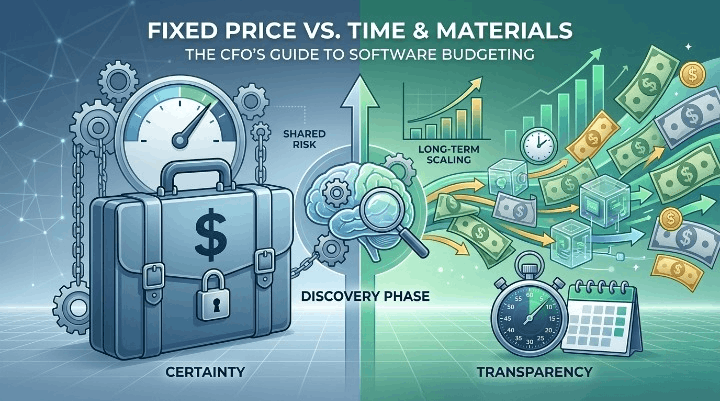
For a Chief Financial Officer, software development often feels like a “black box” of expenditures. You are presented with a vision, a timeline, and a price tag—but the path from investment to ROI is rarely a straight line. When choosing a software development agency, the first hurdle isn’t the technology stack; it’s the financial engagement model.
Choosing between Fixed Price (FP) and Time & Materials (T&M) is more than a procurement detail; it is a strategic decision that dictates how risk is shared and how innovation is incentivized.
When “Fixed Price” is a Trap for Innovation
At first glance, the Fixed Price model is a CFO’s dream. It offers a predictable number for the balance sheet and shifts the risk of overruns to the agency. However, in the world of complex metaverse app development or custom enterprise software, “predictable” can quickly become “restrictive.”
· The Rigidity Tax: Fixed Price models require an exhaustive, unchanging scope of work. In a fast-moving market, if a new competitor launches a feature mid-development, pivoting under a Fixed Price contract requires a grueling “Change Request” process that stalls momentum.
· The “Safety Buffer” Inflation: Agencies aren’t charities. To protect themselves against the unknown, they often bake a 20-30% “risk premium” into the quote. You are essentially paying for a safety net that you might not even use.
· Quality vs. Deadlines: If the project hits technical snags, an agency on a fixed budget may be incentivized to cut corners on code quality or testing to stay within their margin.
The Transparency of “Time & Materials” for Long-Term Scaling
For projects involving cutting-edge tech—like spatial computing or AI-driven platforms—the Time & Materials model is increasingly the preferred choice for sophisticated financial leaders.
Why T&M works for ROI:
1. Agility and Pivot-Ability: You only pay for the work performed. If user testing reveals that a specific feature isn’t working, you can stop development immediately and reallocate those funds to a higher-value feature without renegotiating the entire contract.
2. Full Visibility: A reputable software development agency will provide granular reporting. You see exactly how many hours were spent on UI design, API integration, or QA testing.
3. Incentivizing Excellence: Instead of racing to finish a static list of tasks, the team is incentivized to build the right product that achieves the business objective.
CFO Insight: T&M allows software to be treated as an evolving asset rather than a one-time purchase, aligning development with actual market performance.
Managing Project Scope Creep through “Discovery Phases”
The biggest fear associated with T&M is the “runaway budget.” This is where a Discovery Phase becomes your most powerful financial tool.
Before a single line of code is written, a Discovery Phase defines the technical architecture, user journeys, and a realistic “Product Roadmap.” This phase provides:
· A “High-Confidence” Estimate: Not a guess, but a data-driven projection of costs.
· Risk Mitigation: Identifying technical hurdles (like legacy system integration) early when they are cheap to solve.
· Staged Funding: You can release budget in “Sprints,” ensuring that each investment milestone delivers a functional piece of software.
Frequently Asked Questions (FAQs)
1. Which model is better for a MVP (Minimum Viable Product)?
If the scope is extremely small and well-defined, Fixed Price can work. However, for most MVPs, T&M is better because the goal is to learn from users and iterate quickly.
2. How do I prevent T&M costs from spiraling?
Set “Not-to-Exceed” (NTE) thresholds and insist on weekly burn-rate reports. A professional agency will have a project manager who tracks budget consumption against feature progress.
3. Does “Time & Materials” mean the project has no end date?
No. Every T&M project should have a roadmap with estimated milestones. The difference is that the roadmap is a living document that adapts to reality.
4. Can we switch models mid-project?
Yes. Many companies start with a Fixed Price Discovery Phase and then transition to T&M for the actual development once the requirements are clear.
5. Why is Metaverse development usually T&M?
The metaverse app development landscape involves emerging technologies where standard “blueprints” don’t exist yet. T&M provides the flexibility to solve unique spatial and hardware challenges as they arise.
The Bottom Line
A Fixed Price contract provides the illusion of certainty, while Time & Materials provides the reality of transparency. For the modern CFO, the goal isn’t just to spend less; it’s to ensure that every dollar spent contributes to a scalable, high-performance digital product.
Looking for a partner who values your bottom line as much as your code? Whether you need a full-scale software development agency or a specialized team for metaverse app development, NEXT CODERZ prioritizes financial transparency and technical excellence.