Introduction
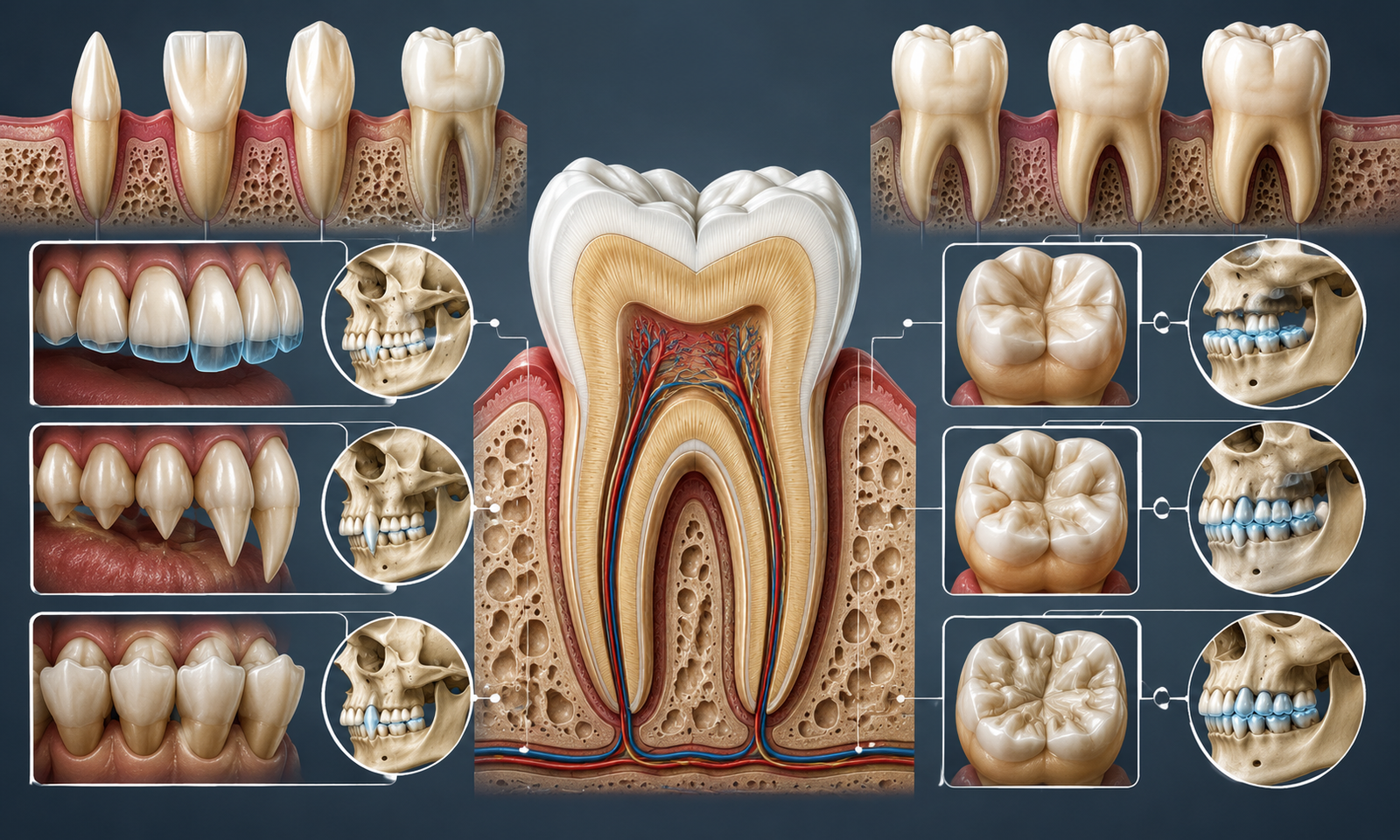
The extrinsic appearance of dental crowns has a central place in the world of dentistry as far as it directly affects the operation of teeth in the process of the mastication, the aid of speech and aesthetic features of the face. The crown- this is the part of a tooth that is above the gum line and outer features of the crown are uniquely designed so as to be effective in the oral setting.
Knowledge of the anatomy of the crown is both crucial to students of dental sciences as well as clinicians working in the field of restorative, prosthodontic and preventive dentistry. Each and every ridge, cusp, groove, and contact area must have a purpose: relative mechanical strength, functionality, and biological compatibility.
The article contains a comprehensive anatomy of dental crowns, focusing on the areas of the external shape reinforcing the use of these crowns in terms of occlusion, periodontal health, and general oral functionality.
Describing External Crown Morphology.
The outer edge of a dental crown is made of a number of anatomy structures which combine to achieve important oral functions. These include:
- Cusps
- Ridges
- Fossae
- Grooves
- Contact areas
- Embrasures
All of these components add to the capabilities of the tooth to chew food, keep in place in the dental arch, and safeguard the supporting tissues as a way of avoiding trauma or disease.
The external appearance of dental crowns is also important in making the design of the restorations including crowns, braces as well as fillings where it will be necessary to reproduce the natural appearance as long as success will be achieved over time.
Cusps: Useful Heights of Occlusion.
Cusps refer to the sharped or rounded protrusions mostly present on the premolar and the molars. They form some of the key structures in occlusion since they constitute the main grinding and crushing organs in the process of mastication.
Functional use of Cusps.
The functions of cusps are to:
- Shred and tear food pieces in the process of chewing.
- Direct the mandibular movements at an occlusion.
- Maintain interarch stability by having accurate contact relationships.
The arrangement of the cusps helps them to evenly distribute forces of occlusion throughout the length of the dental arch and eliminate stress in local areas that might harm the teeth or supporting structures.
The acute cusp ends would be more efficient in the cutting process, whereas the blunt ones would be more efficient in the grinding and the crushing of food.
Ridges: Structural Support and direction.
The top of the crown has ridges that run over the surface of the crown, but they serve to shape the crown as well as aid its structural integrity.
Types of Ridges
Marginal ridges: These are on the periphery of anterior and posterior teeth on the mesial and distal sides.
- Triangular ridges: Extending down the tips of the cusps, to the midpoint of the occlusal surface.
- Transverse ridges: Made by the combination of two triangular ridges.
Functional Importance
Ridges have a number of important purposes:
- Build up the power of the crown structure.
- Direct food during chewing towards central grooves and fossae.
- Assist to keep the teeth in place.
In the event that the ridges are not formed, then food impaction and inefficient chewing can develop causing periodontal stress and occlusal imbalance.
Fossae: Occlusal harmonicity Depressions.
Fossae are depressions that exist on the lingual surface of anterior teeth and on the occlusives of the posterior teeth.
Types of Fossae
- Central fossa: Occurs in molars.
- Triangular fossae: These are found in the vicinity of marginal ridges.
- Lingual fossae: Could be found in incisors and canines.
Opposing cusps in occluding are received in the fossae where interlocking of teeth in the mastication is efficiently done.
Functional Role
Fossae help:
- Comforting conflicting cusps when biting.
- Lessen stress on enamel surfaces.
- Enhance the performance of grinding movements.
Their form and depth play a crucial role in the effectiveness of the relationships of occlusals.
Grooves: Occlusiveness Movement Pathways.
The grooves are linear in nature and separate the cusps, and direct food during mastication. They play a vital role in the occlusal anatomy.
Types of Grooves
- Development grooves: Reflect a tooth developmental fusion groove.
- Supplemental grooves: Grooves that are not as regular and distinct on the occlusal surface.
- Central grooves: Smears the middle of molars and premolars.
Functional Role
Grooves serve as:
- Areas to chew food.
- Cusp movement guides on the cusp during occlusion.
- Natural fissures to improve flexibility of the crown under stress.
The formation of the groove improperly or blocked may result in retained food that may cause caries and periodontal disease.
Contact Areas and Embrasure: To sustain Dental integrity.
Contact Areas
Contact areas: These points are where teeth in the same arch are touching each other. These will be necessary in keeping the teeth stable.
Contact Areas Areas Functions
- Do not allow food to be lodged in teeth.
- Keep teeth in the arch straight.
- Fix the dental arch against rotating or drifting.
When the teeth are properly contacted, they enable the teeth to act as a coordinating unit, as opposed to where the teeth are not in contact.
Embrasures
The spaces between the teeth are V shaped which leads to the passage of food and accommodation of the gingival tissues; these are called embrasures.
Types of Embrasures
- Facial (labial/buccal) embrasures
- Lingual embrasures
- Occlusal/incisal embrasures
- Gingival embrasures
Embrasures are protective as they help to direct the food away from the gingiva but enable the natural self-cleaning process.
Significance of Crown Morphology in Clinics.
The anatomy of the crown is a critical topic in clinical dentistry since a slight change of the normal morphology may have serious implications.
Restorative Dentistry
In filling teeth with fillings or crowns, it is important to recreate anatomy. Poorly-shaped restorations may cause:
Occlusal interference
- Abnormal wear patterns
- Food impaction
- Gingival inflammation
Bioform with a thorough knowledge on the form of the crowns will give restorations that blend in with the natural dentition.
Occlusion, Biomechanical Efficiency.
The upper and lower teeth being in touch with each other is known as occlusion. The effectiveness of operation of such a system depends on the external formation of crowns.
An adequately designed occlusal surface will make sure that:
- Equal Distribution of biting forces.
- Smooth mandibular movement
- Less possibility of temporomandibular joint strain.
The interplay between cusps and ridges and fossae result in a biomechanically stable system that promotes oral health in the long term.
To go deeper scientifically in understanding our occlusal anatomy and anatomy:
https://pmc.ncbi.nlm.nih.gov/articles/PMC5582099
Extra-Contact Crown Morphology and Periodontal Health.
The type of shape of the crown has a direct effect on the gingivial tissues around the crown. Sufficient contouring is useful in keeping the periodontal health in check because:
- Enabling good movement of plaque.
- Preventing food stagnation
- Helping to adapt the natural gingiva.
Examples include over-contoured restorations which may cause traps in plaque that cause gingivitis, periodontal breakdown. Poorly-controlled restorations, however, run the risk of exposing root surfaces to sensitivity.
Therefore, the accurate anatomy rejuvenation becomes critical in ensuring a healthy mouth condition.
Role in Mastication, Phonetics and Esthetics.
Mastication
The external design of the crown is to maximize the effectiveness of chewing. Cusps grind food, grooves direct movement and fossae stabilize the occupational contact.
Phonetics
Anterior teeth, and in particular incisors are very important in speech production. Their articulation of the sounds, including the sounds like s and th, depend on their shape and alignment.
Esthetics
The crown that is visible adds a lot of features to the face. Symmetry, proportion and surface contour are also some of the factors that determine the naturalness and attractiveness of a smile.
Dentists have thus needed to strike a balance between the functionality and esthetics of the tooth during restoration or alteration of the tooth structures.
Conclusion
Dental crowns and the external morphology is a highly designed system that sustains diverse vital functionalities, which include mastication, speech, esthetics and periodontal health. Cusps, ridges, fossae, grooves and areas of contact structures are in concurrence to provide effective occlusion and oral stability in the long term.
An in depth knowledge of the anatomy of the crowns enables dental practitioners not just to produce restorations that are well constructed but also biologically and functionally active. Clinicians can enhance the results of treatment and maintain oral health better by valuing the connection between how it is and what it should do.
Simply, the crown is more than a mere tooth appearance; it is an extremely specialized biomechanical unit that is precise, durable, and in harmony with the whole oral cavity.