Abstract
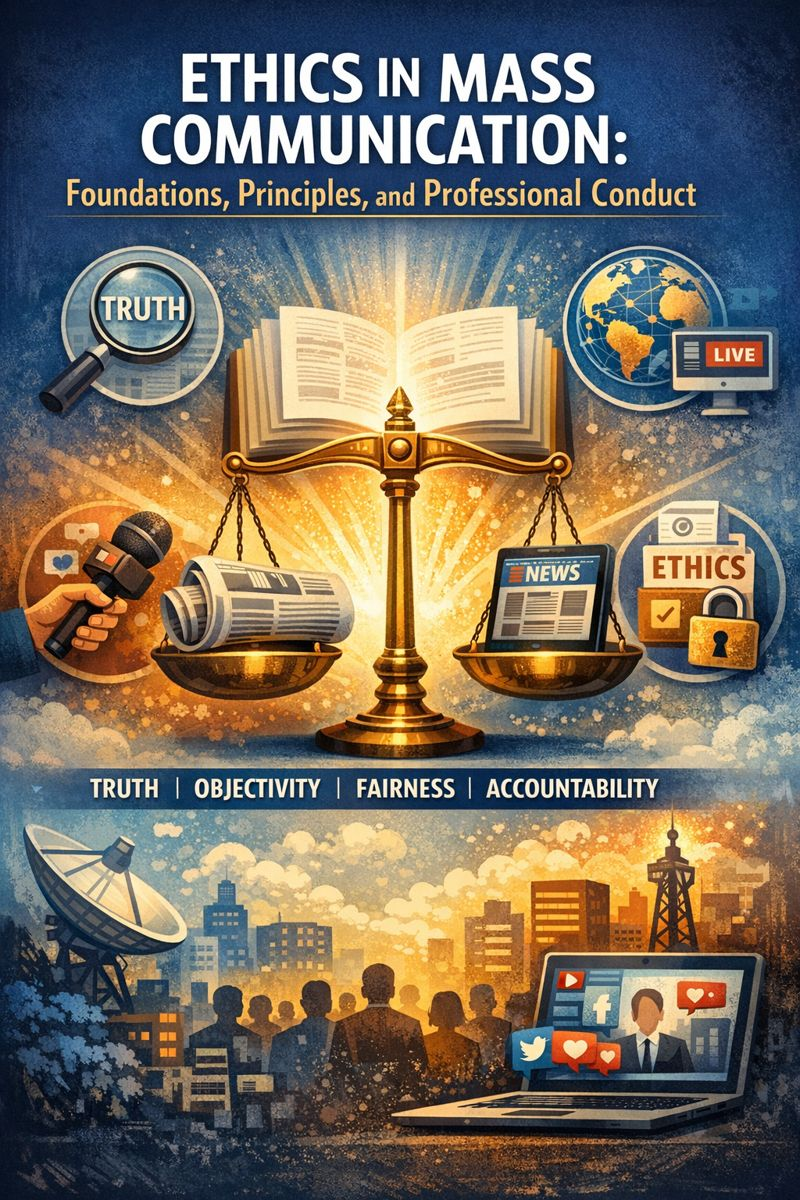
Ethics has been at the core of responsible mass communication, which determines the way information is collected, generated, and communicated to the citizenry. The current digital change, media convergence and high levels of public scrutiny have required ethical standards more than ever before to ensure credibility and trust in the media. In this paper, I will review the guiding principles of ethics in mass communication that involve being truthful, objective, fair, and accountable. With the use of ethical theory and the literature available on the topic, the study will examine the potential impact of these principles on the decision-making process of a professional based on both traditional and digital media platforms. The paper also addresses the issues facing ethical practice in modern media spaces and the importance of ethical behavior in ensuring that the masses trust the mass communication organizations.
Keywords: Media ethics, Professional media conduct, Ethical journalism, Mass communication practices, Media accountability
Introduction
Mass communication has a critical role in influencing the opinion of the masses, social values and democracy. The media is a major source of information to individuals and societies through newspapers, broadcast media and the internet. Due to this effect, mass communication ethical behaviour is fundamental to protect the integrity of the discourse by the masses (McQuail, 2010).
The increasing nature of the mass communication practices, especially in the digital media setups, has aggravated ethical issues associated with misinformation, bias, sensationalism and accountability. Through the growing role of media as a reliable and timely information source, compliance with the ethical principles is becoming a hallmark of maintaining the trust of people and organizational reputability (Christians et al., 2016).
Theoretical and Conceptual Foundations of Media Ethics
Ethics and Mass Communication
Media ethics is anchored on classical theories of ethics that can be used to explain the moral responsibility and the conduct of the profession. Deontological ethics focuses on the ethical commitments of duty, i.e. telling the truth, respect towards privacy and avoiding harm irrespective of outcomes (Kant, 1993). This view supports the fact that journalists are morally obliged to observe ethical principles in every situation.
Utilitarian ethics, in its turn, is concerned with the consequences of media decision-making, and it promotes activities that give the greatest benefit to society and the least harm (Mill, 2001). Virtue ethics also adds to media ethics by emphasizing the moral characterization of honesty, integrity, and fairness, which are fundamental to responsible journalism (Christians et al., 2016).
Normative Theory of the Press
The press has normative theories that give a perspective on how the media institutions are socially responsible. The idea of social responsibility theory is that though the media has the freedom of the press, it should act in a manner that fulfills social interest, enhances informed citizenship and not hurt the people (Siebert, Peterson, and Schramm, 1956). This theoretical basis highlights the moral imperatives that are inherent in mass communication practices.
Is an overview of related literature
Ample evidence has revealed that ethical media behavior is closely linked to the level of trust. The research findings show that people tend to believe media organizations that regularly have shown accuracy, fairness, and transparency in their reports (Kovach and Rosenstiel, 2014). On the contrary, fabrication, plagiarism and biased reporting are some of the ethical breaches that destroy the trust of the people to a great extent.
Professional codes of ethics have also been discussed as a significant way of controlling journalistic conduct by scholars. Ethical codes created by journalism organizations offer the guidelines of accuracy, impartiality, and responsibility, which can serve as a useful basis in making ethical decisions in the journalism profession, particularly under the pressure of digital news settings (Ward, 2015).
Basic Ethical Concepts of Mass Communication

Truthfulness and Accuracy
Honesty is generally noted as the ethical principle of mass communication. The journalists are supposed to check facts, use reliable sources, and correct any mistakes in a timely manner to be precise (Kovach and Rosenstiel, 2014). An absence of devotion to truth basically diminishes the media as an informer and watchdog.
The requirement to maintain accuracy is even more pressing in digital media settings where the dissemination of information is multifarious and very fast. Ethical journalism involves withstanding the urge to act under time, rivalry, and audience counts that can result in loss of factual integrity.
Impartiality and Objectivity
Objectivity is one of the key ethical principles in mass communication, and the journalist has to deliver data in a fair and unbiased manner. Even though the impartiality might not be easily obtained, ethically reporting attempts to reflect diverse opinions and seek a contextual balance (McQuail, 2010).
The aspect of impartiality is especially important in political communication and reporting of conflicts in which biased reporting may misrepresent the public’s knowledge and undermine the democratic processes.
Judicial Equity and Civility to Human Dignity
Fairness entails treating people and groups respectfully and not being judgmental or sensational about them. Ethical mass communication focuses on human dignity and privacy, as well as cultural diversity, in particular, when vulnerable groups are reported on (Christians et al., 2016).
This concept also encompasses the right to reply and is described as the right to have those who are subjects of the media coverage reply to the allegations or criticism.
Accountability and Transparency
Responsibility involves media organizations and the appropriateness to take responsibility of their actions and content. The accountability in ethics means that editorial operations are transparent, the origin of the sources is revealed, and that mistakes are corrected quickly (Ward, 2015).
The transparency in the digital era also entails the ability to separate news, opinion, advertisement and sponsored content to avoid misleading the audience.
Making ethical decisions in the media practice
Ethics in News Gathering
Journalists follow the ethical principles that determine the method of obtaining information, focusing on informed consent, attention to privacy and prevention of deceptive measures. News gathering ethics consider the interests of the masses and limit the harm done to other people and communities (Kovach and Rosenstiel, 2014).
Ethics in Content Creation and Dissemination
The issues of ethics affect framing, words, pictures, and headlines in the process of content production and dissemination. Responsible use of algorithms, not misinformation and not misleading clickbait are also considered a part of ethical dissemination in digital media (Ward, 2015).
Findings and Discussion
The analysis of ethics shows that ethics can never be apart from professional mass communication. Responsibility, honesty, impartiality, reasonableness, and accountability are attributes that form responsible media conduct and trust among citizens. These principles provide the media organizations with the best chance to accomplish their democratic duties when upheld.
Nevertheless, new ethical concerns thrive through digital spaces, such as misinformation, the loss of editorial control, and economic forces, in the modern digital world. The solution to such challenges is constant ethical training, institutional backing, and a professional environment.
Conclusion
The basis of responsible mass communication and professional media behavior is based on ethical principles. Media practitioners can ensure that the people trust and have credibility by exercising truthfulness, objectivity, fairness, and accountability. The ethical requirements in media communication are critical given the dynamic nature of media technologies, whereby media should be used with integrity and responsibility in the interest of the people.
In addition, ethical practices in mass communication are not only a professional requirement but also a social need which has direct impacts on the democratic stability and social cohesion. When the media houses follow the ethical standards, they help in producing an educated population that can think critically and effectively engage in the activities of society. Ethical mass communication helps in upholding transparency in governance, accountability to the institutions of the people and helps to reduce the spread of harmful misinformation that may tend to destabilize societies.
Moreover, codes of ethics can be used as a reference point by media professionals in dealing with challenging moral issues, especially in a setting that is influenced by technological innovation and commercialization. With the ever-growing environment of digital platforms simultaneously increasing the scope and velocity of information sharing, the implications of unethical media practice are even more significant and extensive. Ethical awareness will therefore provide journalists and content creators with the ability to balance freedom of expression and social responsibility.
Institutional commitment to maintain ethical mass communication is also achieved by training, the enforcement of professional codes, and constant review of media practices. Media companies that invest in ethical development enhance their long-term credibility and relevance. Finally, ethics in mass communication is employed to make the media a reliable social institution that serves the common good, safeguarding human dignity, and upholding the values that are vital to a functional and democratic state.
References
Christians, C. G., Fackler, M., Richardson, K., Kreshel, P. J., & Woods, R. H. (2016). Media ethics: Cases and moral reasoning (10th ed.). Routledge.
Kant, I. (1993). Grounding for the metaphysics of morals (J. W. Ellington, Trans.). Hackett Publishing. (Original work published 1785)
Kovach, B., & Rosenstiel, T. (2014). The elements of journalism: What newspeople should know and the public should expect (3rd ed.). Three Rivers Press.
McQuail, D. (2010). McQuail’s mass communication theory (6th ed.). Sage Publications.
Mill, J. S. (2001). Utilitarianism. Hackett Publishing. (Original work published 1863)
Siebert, F. S., Peterson, T., & Schramm, W. (1956). Four theories of the press. University of Illinois Press.
Ward, S. J. A. (2015). The invention of journalism ethics: The path to objectivity and beyond (2nd ed.). McGill-Queen’s University Press.