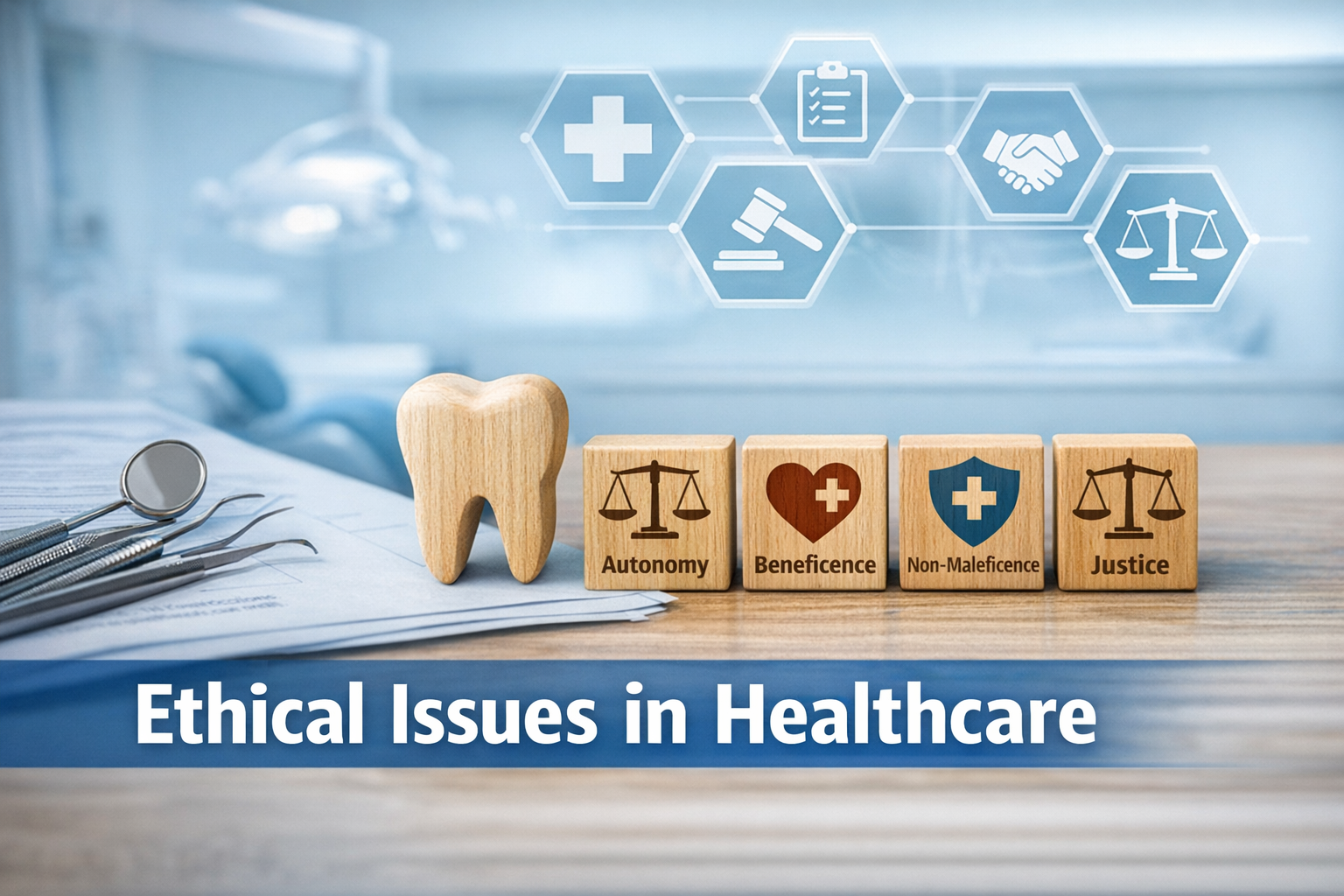
Medical and dental practice is based on ethical concerns in healthcare. To dental students, learning these foundational concepts is a key ingredient to academic achievement as well as the ability to build the professional attitude of patronizing patient welfare, integrity, and social responsibility. Although dental education is aimed at teaching clinical skills and scientific knowledge, ethical consciousness guarantees future professionals that deal with complex situations in a responsible and humane way. This paper will cover general ethical standards and how they are specifically applied to the field of dentistry and give practical advice to students joining the field.
Ethical Issues in Healthcare
Ethical concerns in healthcare have a broad spectrum of moral problems that emerge in patient care, research and professional practice. The problems are not exclusive to medical intervention but they permeate the interactions with the patients, the informed consent, patient confidentiality, resource allocation and decision-making in cases of uncertainty. Identifying these issues at a young dental student age would make the students acquire critical thinking skills and a powerful ethical code that would be used throughout their careers.
Ethical issues in healthcare, is one of the all-encompassing sources of the exploration of these issues, which offers examples, case studies, and practical suggestions applicable to all areas of healthcare, including dentistry.
Key Ethical Standards in Healthcare
Ethical practice in the health care system is based on four universal principles; autonomy, beneficence, non-maleficence and justice. The knowledge and practical skills on these principles make dental students make quality and ethical decisions.
Autonomy
Autonomy is a right of a patient to make informed choices concerning his or her health. Autonomy involves the recognition of the patient as an active member in his/her care and not just as a passive receiver of care. This is a very important principle in the field of dentistry when the treatment options, risks and results are discussed. In a case in point, a dentist should make sure that patients are informed of the implications of various procedures – e.g. root canal therapy or extraction – prior to consenting.
In the case of dental students, the process of learning to respect patient autonomy implies communication and active listening, as well as cultural and personal values sensitivity. It is also entailed with the identification of the instances in which the decision of the patient could be contrary to the professional judgment and careful ethical consideration is needed.
Beneficence
The principle of beneficence is that of doing good and in the best interests of the patient. Beneficence in dental practice includes prevention, treatment planning, and delivering treatments to enhance the oral health and well-being. A dentist who exercises beneficence will focus on maximizing the benefit of a patient whilst taking into account the overall outcomes.
In the case of students, this principle emphasizes the necessity of prioritizing both technical skills and the willingness to be concerned about the patient. It urges the prospective professionals to promote oral health education, preventive efforts and interventions that may improve quality of life.
Non-Maleficence
Non-maleficence, which is closely related to beneficence, makes healthcare professionals avoid inflicting harm. The traditional principle of medicine, first, does no harm, helps dentists to reduce the risks that can be caused by the procedure, medication and treatment decisions.
Non-maleficence in dental practice is not merely physical harm prevention, but also protecting the dignity of patients, efficiently controlling pain and senseless surgeries. In the case of dental students, the principle of knowing this fact highlights the moral duty to be more critical to assess interventions and predict their possible adverse results.
Justice
Justice in healthcare focuses on treating fairness and equality. This principle puts dental professionals to the task of thinking about how the resources, services and care opportunities are allocated to patients, whether they are socioeconomic, ethnic, or otherwise.
Justice in the dental practice setting can be understanding that vulnerable groups like children, the elderly, or disabled people receive fair treatment. This principle also helps students to be aware of societal problems beyond themselves, such as the policies of a community on its health, access to care, and community oral health programs.
Dental Education Ethical Dilemmas
Ethical dilemma is an issue that dental students are facing regularly when they are training. Such circumstances can occur in practice, research, and dealing with colleagues and faculty. Common dilemmas include:
- Informed Consent: This is to make certain the patients have complete knowledge on procedures and risks in cases where minors or patients with cognitive impairments are involved.
- Treatment Planning Conflicts: Medical professionals need to balance patient wishes with professional judgments whenever patients demand unnecessary or harmful treatments.
- Confidentiality: The safety of confidential patient data in educational and clinical practice.
- Resource Allocation: Making decisions about resource allocation in high traffic clinics or social health programs with scarce resources.
These dilemmas can only be managed with a solid background of ethical ideas, critical thinking and reflective practices. Dental schools have case discussions, role-playing and mentorship programs where students learn to use these principles in real life experiences.
Using the Ethical Principles in Future Dental Practice
Being a student, the change to a practicing dentist comes with new ethical challenges. Implementing fundamental ethical principles would keep the decisions of the professionals always on the same side of the patient and the society.
Patient Communication
Ethical practice revolves around effective communication. Dentists should be able to present complex information in a way that is easy to understand, address the concerns of the patients and honor their preferences. Ethical communication strengthens autonomy, establishes trust and minimizes misunderstanding that may undermine care.
Professional Integrity
Honesty, transparency, and professional standards are part of integrity. In the case of dental professionals, integrity means having records that are correctly kept, reported clinical outcomes that are truthful, and adherence to evidence-based practices. Being honest makes the relationship between the patient and the dentist stronger and the image of the profession is maintained.
Proceeding with Ethical Reflection
Ethical issues change along with the new technology, the treatment approaches, and social customs. Dentists have to consider a lifelong learning process and never-ending ethical thought. The practices incorporated here are being aware of updated regulations, engaging in professional development, and consulting peers when faced with difficult ethical choices.
Special Issues in Dental Ethics
Some areas of dentistry are particularly associated with moral dilemmas that a student in dentistry should expect:
- Cosmetic Dentistry: There is a possibility that an ethical conflict of interest can be created between the patient’s wishes and the professional judgment about unnecessary or even harmful procedures.
- Pediatric Dentistry: There is a need to bring a balance between parental consent, child assent and best-interest decisions, which means an ethical reasoning is necessary.
- Geriatric Dentistry: Consent, Cognitive decline, and end-of-life care: The given issue requires sensitivity and vision of ethics.
- Public Health Dentistry: Resource allocation, preventive programs, and care access are among the areas where the concept of justice is applied.
Knowing these contexts prepares students to help them to overcome professional challenges in a responsible, empathetic way.
Introduction of Ethics into Dental Education
The school of dental is the most important in equipping students to handle ethical questions effectively. Some approaches to inclusion of ethics within the curriculum are:
- Case-Based Learning: The critical thinking and practical application of ethical principles are promoted by analyzing real or simulated scenarios.
- Ethics Seminars and Workshops: Participatory dialogue, perspective-taking and problem-solving skills.
- Mentorship and Role modeling: Ethical behavior amongst the professionals who are experienced gives strength to theoretical learning.
- Reflective Practice: The advocacy of reflecting and recording of ethical dilemmas among the students encourages moral growth and personal self-understanding.
Integrating ethics into the learning process, dental programs ensure that graduates are committed to the welfare of the patients, are trustworthy in society, and not confused when faced with challenging ethical dilemmas.
Conclusion
The field of healthcare is one of the areas where ethical concerns are a core part of career building among dental professionals. The knowledge and practice of the principles of autonomy, beneficence, non-maleficence, and justice would help the dentists deliver morally responsible, patient-centered, and socially conscious care. In the case of dental students, the ethical framework that should be built in the course of training must be strengthened to ensure proper clinical practice, professional ethics, and lifelong dedication to the health of patients.
Students trained to handle the complexities of contemporary dentistry by working with principles of ethics, contemplating dilemmas and undergoing facilitated learning can be ready for the multidimensional nature of contemporary dentistry. Ethical competence is not only an academic need, but it is a feature of a competent, caring, and reliable dental practitioner.