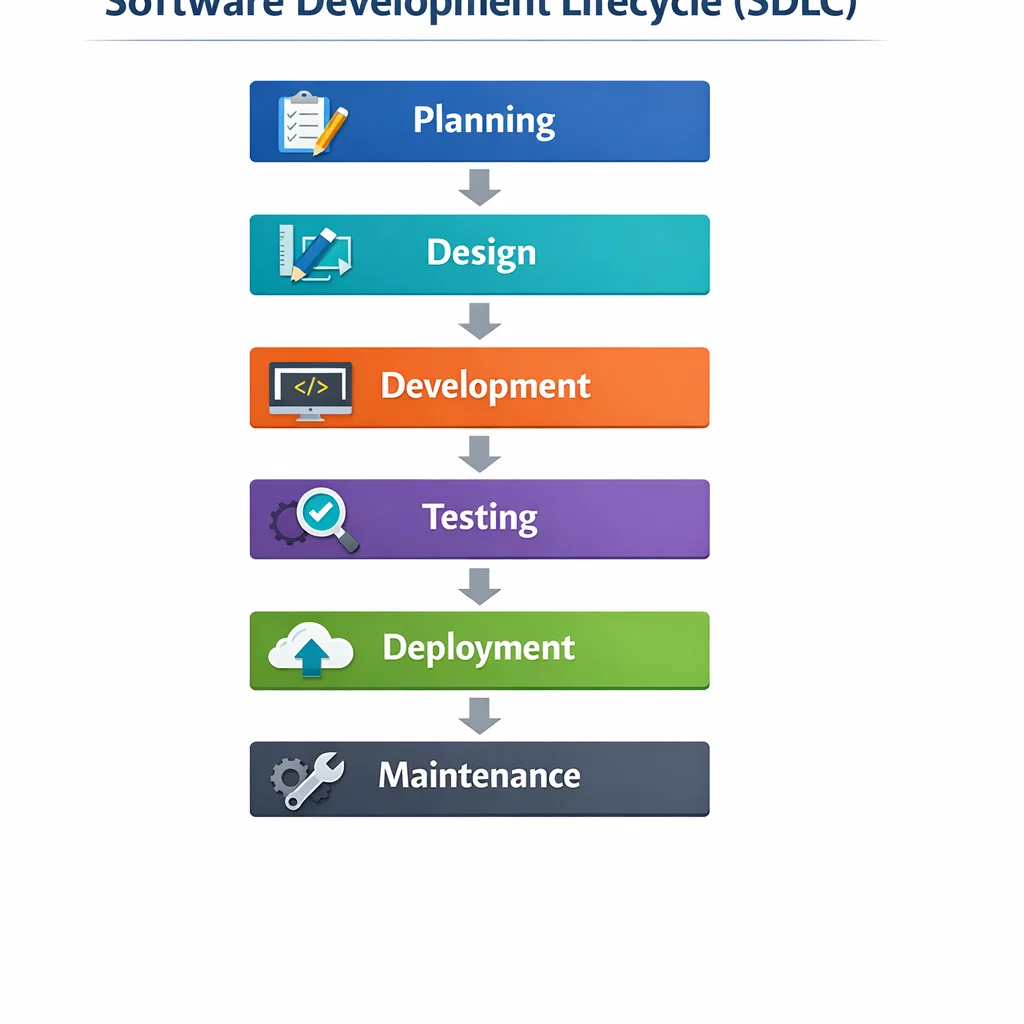
The software development lifecycle (SDLC) is a systematic process that helps software projects to be done through initial ideas up to delivery and maintenance. Nevertheless, during such a lifecycle, developers and managers have to struggle with a lot of ethical issues, which may affect the choices and the overall impact of the final product on the people and the society. The issue of ethical decision making in software engineering projects is very imperative because it determines the quality of the software produced besides its social and cultural effects. This paper discusses the impact of ethical considerations on the SDLC, especially on the safety of users, transparency, accessibility, and social impact. It will also give a clue on how the ethical risks can be identified and ethical frameworks can be used to ensure the decisions reached in the real world projects are ethical.
The Role of Ethics in Software Development Lifecycle
The ethical issues are important at all phases of the SDLC, starting with the requirement gathering phase, continuing through the application of software and its maintenance. Project managers and developers are faced with hard to make decisions that are long term in nature. In this regard, ethical decision-making is to ensure that the rights, safety, and well-being of the users are taken into account and the wider societal effects of the software.
Including ethics in SDLC will aid in making sure that the software is not just technically sound, but also in its duties, accessible, and helpful to all the stakeholders. Ethical software is user-friendly, clear, and also corresponds to the laws and ethics. Some of the negative consequences that accompany the disregard of ethical risks include data breaches, misappropriation of user data, barriers to access, and negative effects on society.
SDLC Ethical Problems
SDLC is a complicated process, and several factors need to be considered closely, and ethical dilemmas occur at many points. The challenges include the following:
a) User Safety and Privacy
One of the main issues in software engineering is the safety of the users. The security of user data should be a priority of the developers, particularly in the world where cyberattacks, data breaches, and privacy violations are becoming even more frequent. Design systems ought to be structured in such a manner that the sensitive information is secured and the users are able to control the usage of their data.
As an example, the software should have robust encryption, multi-factor authentication, as well as anonymization of the data. Ethical decision-making must be geared towards safeguarding the users, in case they are harmed because of vulnerabilities or misuse of data.
b) Accountability and Transparency
Another ethical issue that emanates in the SDLC is transparency. Software systems are very likely to be black boxes, in which case users and even the developers may not have a complete understanding of how decisions are arrived at. Both a recommendation algorithm and an AI-driven feature, transparency is essential to making the users trust the system.
It is expected that ethical decision-making necessitates software engineers to be responsible. This is in terms of being open on the algorithms in place, the data being gathered, and the decision-making mechanisms embedded within the system. As an example, the developers must be capable of expressing the limitations and biases of AI systems in a clear way so that users can make informed decisions.
c) Accessibility to a Wide Audience
Inclusion should be factored into the software. The term accessibility means that the software should be available to all users regardless of their physical capabilities or technical skills. The issue of ethics requires that accessibility be central in the system design, particularly those applications with a wide and broad user base.
Software developers need to adhere to web accessibility standards (like WCAG) during the SDLC in order to create accessible interfaces for people with disabilities. This incorporates such features as screen reader support, color contrast controls, and keyboard navigation that enable all users of the system to have equal access.
d) Social Software System Impact
There is the wider social implication of software that cannot be overlooked. Developers should put in place how the software that they develop impacts society in general. Indicatively, in the case of social media platforms, misinformation and control of the opinion of the masses have also been subjects of questioning. Equally, the emergence of autonomous systems and AI introduces new ethical challenges related to job displacement, bias, and autonomy in making decisions.
Moral decision-making in SDLC entails measuring the possible effects of the software on society, whether it is its effect on the environment or its effects on human behavior. It is a consideration that will force developers to critically think about how their work will influence the world and work to develop software that makes a positive impact on society.
Detecting Ethical Software Project Risks
Ethical Risks
It is important to detect and eliminate the occurrence of ethical risks during the software development process. The ethical risks can be described as possible negative consequences or the damages which are likely to prompt up due to the design, implementation, or use of the software. The ethical risks that are common include:
- Bias and Discrimination: This may be introduced unconsciously into software systems, particularly in AI models trained on biased data. This may lead to discriminatory consequences, including preference for a particular group of people.
- Data Misuse: User data may be misused by unethical ways of storing information, including making unauthorized purchases, selling the data, or not securing privacy, and this could cause real damage.
- Inaccessibility: When software systems are not made available to every user, it may marginalize and cause digital inequality.
- Environmental Impact: Certain software systems, in particular those that demand large quantities of data processing, may have a large environmental impact both in terms of energy consumption and e-waste.
a) Ethical Risk Identifying Tools
The following tools and techniques are applicable in finding the ethical risks in the SDLC:
- Ethical Audits: These audits entail considering the ethical concerns of a system in different stages of its development. They will be able to assist in detecting possible dangers concerning user privacy, accessibility, and equity.
- Bias Detection Tools: In machine learning and AI projects, artificial intelligence can be used to see and minimize bias in datasets and algorithms with the help of bias-sensitive machine learning models and data auditing software.
- Stakeholder Consultation: Consultation with different groups of stakeholders such as users, advocacy groups, and subject matter experts can assist developers in realizing the possible ethical issues which can be raised during the development process.
Using Ethical Frameworks to Make Decisions
Developers and project managers might face an ethical dilemma at some point; therefore, a framework to consult during their decision-making process is convenient. The software engineering projects can be addressed by the following ethical frameworks:
a) The Utilitarian Approach
The utilitarian approach is concerned with maximizing the benefit to society. In ethical decision-making, the user of this approach would strive to develop software that would benefit as many other people as possible and cause minimal harm.
As an illustration, developers of a health app may focus on functionality that will help patients and enhance their well-being, ignoring certain levels of user convenience. When dealing with user data, they may also choose the safest and most confidential data practices in order to avoid damage.
b) The Deontological Approach
The deontological ethics emphasize duties and principles rather than consequences. Designers of this framework would be concerned with observing the rules, regulations, and standards of morality irrespective of the consequences. This strategy will make sure that the basic rights of the user like privacy and security are never compromised.
As an example, a software developer who adheres to deontological principles would make sure that data of all users is processed in a manner that would not violate legal provisions, including GDPR, and would not jeopardize privacy even at the expense of postponing the project.
c) Virtue Ethics
Virtue ethics is concerned with the personality and values of the decision-makers. Virtue ethics would encourage developers to develop such virtues as honesty, transparency, and empathy in their work. This strategy makes software engineers make decisions on matters that will support their moral character and professional integrity.
Practically, a developer using virtue ethics could focus on user-friendly design and ethical code-writing and transparent communication of the software features and restrictions.
Conclusion
The process of making ethical decisions is a necessary part of the software development lifecycle and ought to be incorporated in all project phases. Solving such problems as user safety, transparency, accessibility, and social impact, developers are able to design software that not only satisfies technical needs but also complies with ethical principles. These ethical risks can be detected and ethical frameworks can be used to help the developers and managers to make ethical decisions that will result in software systems that are responsible, inclusive, and advantageous to society. Through adopting ethics during the SDLC, software engineers can help in producing technology that enhances living conditions and that which benefits the greater good.