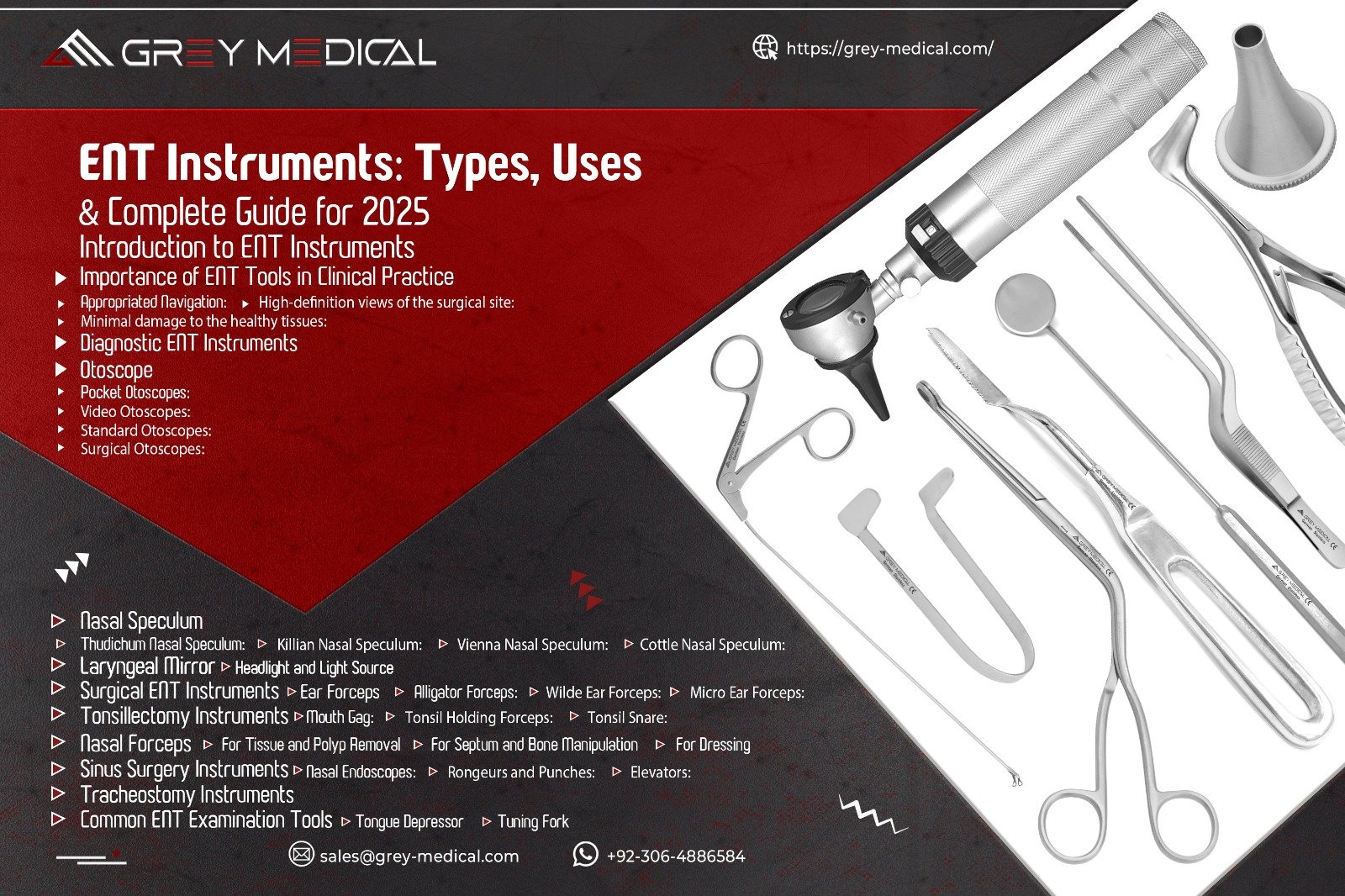
ENT instruments help analyse and treat conditions of the neck and head region. Typically, there are specialised medical tools and ENT sets to assist surgeons in navigating through this area. Surgical supply stores acknowledge the needs and offer dedicated tools. Grey Medical believes in keeping your ENT surgical sets always equipped with quality medical tools. Therefore, we offer a range of quality OT instruments at an affordable price.
This complete guide for 2025 on ENT instruments will walk you through its different types and uses. Furthermore, their features and applications will also be covered. Stay tuned!
Introduction to ENT Instruments
Otolaryngologists, the practitioners dealing with the conditions of the nose, ear, and throat, use dedicated medical tools known as the ENT instruments. These tools feature a specialised structure in a narrow configuration to access the larynx, the nasal passage, and the ear canal. The range includes tools like ENT forceps, nasal specula, mirrors, and otoscopes, among others.
Importance of ENT Tools in Clinical Practice
Using ENT tools in clinical practice can be important as following, precisely:
- Appropriated Navigation: The anatomical structures around the neck and the head are narrow. Typically, medical tools with narrow structures and lean configurations are preferred. Therefore, ENT tools assist in easy navigation with enhanced patient outcomes.
- High-definition views of the surgical site: Most areas affected by ENT conditions can’t be seen with the naked eye. Therefore, there are ENT sets and tools like otoscopes, nasal specula, and advanced endoscopes that provide clear and high-definition pictures of the concerned areas.
- Minimal damage to the healthy tissues: ENT instruments do not harm the healthy tissues. They are made minimally invasive for maximum safety.
Diagnostic ENT Instruments
Firstly, there is a need to examine the ear, nose, and throat prior to treatment. For this purpose, specialised diagnostic ENT instruments and ENT sets are used. These diagnostic instruments have an illuminating and magnifying source to light up and zoom in on the concerned area, respectively.
The following diagnostic ENT instruments should be used for smooth diagnosis, such as:
Otoscope
The eardrum and ear canal are examined with the help of an otoscope. An otoscope has a holding handle, a light source, and an ear speculum in a cone shape. Typically, this visualising tool helps see and picture the insides of the ear canal for a better understanding of the issue. Furthermore, the image can be illuminated and magnified to capture a detailed image.
There are different types of otoscopes, such as:
- Pocket Otoscopes: On-the-go examinations can be facilitated with the help of pocket otoscopes. These can be carried anywhere conveniently.
- Video Otoscopes: These otoscopes help document and record the visuals from the ear canal in high quality.
- Standard Otoscopes: Usually, these are available in a range of sizes and assist with normal to serious situations.
- Surgical Otoscopes: These otoscopes allow the doctor to insert high-quality medical tools in the ear canal for surgical manipulation.
Nasal Speculum
The anterior part of the nasal cavity should be widened for examination. Therefore, nasal specula help widen the nostrils and the inner part for a clear view. Each nasal speculum is categorised according to its handle design. Note the following examples:
- Thudichum Nasal Speculum: OPDs use the Thudichum nasal speculum. These specula can be manipulated with the index and thumb fingers. Moreover, they are great for anterior rhinoscopy.
- Killian Nasal Speculum: These are self-retaining. Usually, the Killian nasal speculum comes in handy for turbinate reduction surgeries, septoplasty, and polypectomy.
- Vienna Nasal Speculum: Typically, it is self-retaining with a spring mechanism. Vienna nasal specula are great for minor surgical manipulations.
- Cottle Nasal Speculum: Cottle nasal septum specula are greatly preferred for plastic surgeries.
Laryngeal Mirror
A laryngeal mirror is a great visual aid. It features a small mirror which is attached to a long handle. Once introduced into the throat, it helps visualise the insides, which otherwise would not have been possible to see. Typically, it is autoclavable and can be used again and again. Also, the laryngeal mirror is first warmed before administration. This helps prevent fogging during diagnosis.
Headlight and Light Source
In ENT practice, surgeons deal with narrow surgical sites. Therefore, there are specialised headlights to wear and light sources to handle for better visualisation. The examples include LED headlights, halogen headlights, and fibre optic headlights. Each has its own mechanism to generate light. They are equally efficient and used as per the needs of the surgical site.
Surgical ENT Instruments
During surgical manipulations, the ENT surgical site uses specialised medical tools. Each ENT tool is designed to assist the various anatomical needs of the nose, ear, and throat. Whether the practitioner is performing complex sinus treatments or microsurgery, surgical ENT instruments help them navigate with ease.
The following list covers the major surgical ENT instruments for better understanding, such as:
Ear Forceps
Otology, the study of the ear canal and related structures, requires accessing ENT tools. These tools assist the surgeons in introducing and removing objects from the ear canal. Therefore, ear forceps are used. They feature a long, narrow shaft made out of surgical stainless steel. The common list of ear forceps includes the following:
- Alligator Forceps: These forceps have a strong clutching ability. They can be used to remove objects, such as beads, from the ear canal. Furthermore, they assist surgeons in removing earwax and inserting ear tubes known as grommets.
- Wilde Ear Forceps: These Wilde ear forceps are angled for great accessibility. They can be introduced to pack gauze inside the ear canal during surgeries.
- Micro Ear Forceps: Intricate ENT surgical procedures feature the use of micro ear forceps. These are extremely delicate and have a long, slender shaft for easy entry. Mostly, they are used in eardrum repair and cosmetic procedures.
Tonsillectomy Instruments
These ENT tools cover a range of functions for Tonsillectomy, which is the removal of tonsils. There are different Tonsillectomy instruments, such as:
Mouth Gag: During examination and treatment, the patient’s mouth must remain open. Therefore, mouth gags and tongue depressors are used. These help press the tongue down for better visualisation of the tonsils. For instance, Davis Boyle Mouth Gag.
Tonsil Holding Forceps: During the removal of the tonsils, there is a need for strong gripping medical tools like tonsil holding forceps.
Tonsil Snare: These allow the surgeons to cut off the already loose tonsils. Once the tonsil detaches, the bleeding gets controlled. For example, the Beck-Schenck tonsil snare.
Additionally, our supply store provides suction tubes with different ENT suction tips,hurd dissector and a pilar retractor, and tonsil knives, among others. These tools keep the tonsil set ready for every challenge!
Nasal Forceps
Nasal passages are sensitive and prone to accidental damage. Therefore, long and slender medical tools known as nasal forceps are used to take out any foreign object from the nasal passage. Furthermore, nasal forceps help remove tissues and bone fragments during surgical procedures. Interestingly, nasal forceps have a bayonet shape to assist the surgeon in grabbing the instrument without any added discomfort.
The following nasal forceps are sorted according to their functions, precisely:
For Tissue and Polyp Removal
- Blakesley Nasal Forceps: These Blakesley nasal forceps have fenestrated jaws, usually in a cup shape. Further on, there are different configurations available, such as down-bite, up-bite, and straight.
- Gruenwald Nasal Punch Forceps: They work on tough tissues and bone segments located in the sinus region, particularly near the septum.
For Septum and Bone Manipulation
- Walsham Septum Straightening Forceps: During reduction procedures for nasal fractures, nasal bones are straightened with the help of these forceps.
- Asch Septum Forceps: These Asch septum straightening forceps work together with Walsham forceps. Particularly, to straighten up the nasal bone internally.
For Dressing
- Bayonet Forceps: During surgical interventions, bayonet forceps work to pack gauze and other absorbing material into the nasal cavity. This prevents nosebleeds.
Sinus Surgery Instruments
Functional Endoscopic Sinus Surgery (FESS) makes use of specialised ENT tools to ventilate the sinuses in case of any malfunction. Although practitioners require endoscopes for the purpose of visualisation, sinus surgery instruments are usually paired with these devices.
Given is a quick wrap-up for general know-how:
Nasal Endoscopes: Sinus and nasal cavities can be comprehensively analysed with the help of chief visualising devices known as the endoscopes. These feature a thin, long tube with a light source and a high-definition probing camera.
Rongeurs and Punches: Usually, in the ethmoid or sphenoid sinuses, it is necessary to cut the bones. Rongeurs and punches come in handy during this time.
Elevators: These tools help detach cartilage or bone from the mucosal lining. Usually, Cottle Septum Nasal Elevators and Freer punches are used.
Along with these, curettes, seekers, and Frazier Suction Tubes are also used.
Tracheostomy Instruments
Tracheostomy is a procedure to create an opening in the front of a patient’s neck. For this purpose, specialised tracheostomy instruments are used. These tools include the Tracheal Hook for elevating the trachea, Tracheal Dilators for enlarging the stoma, and Tracheostomy Tube for maintaining the airway, among others.
Common ENT Examination Tools
The common ENT examination tools help ENT specialists to analyse and examine the problems in detail. Furthermore, they enhance visibility and allow the surgeons to access the surgical site.
Given are some of the common ENT examination tools every ENT set should have, such as:
Tongue Depressor
For examination, it is important to have a clear view of the throat, mouth, and tonsils. For this purpose, tongue depressors are used. With their flat surface, they press down the tongue to have an unobstructed view. Resultantly, diagnosis becomes easy.
Tuning Fork
This examination tool works to check for hearing loss in patients. It is a two-prong metal instrument which, once struck, produces vibrations and sound. Usually, patients with hearing loss are checked with tuning forks.
FAQs
Q1: What are some of the major ENT forceps?
ENT forceps help hold and manipulate surgical material like foreign bodies, tissues, bones, and dressings. For example, Tilley’s dressing forceps, which help pack gauze, Negus artery forceps, which facilitate tonsillectomy, and Luc’s forceps, which allow surgeons to navigate nasal and sinus surgeries with ease.
Q2: What is the purpose of ENT suction tips?
ENT suction tips help draw out fluid, blood, phlegm, and other liquids from the ear, nose, and throat.
Enhance Surgical Excellence with Grey Medical’s Affordable ENT Instruments
The quality of OT instruments and ENT instruments sets determines the success of surgery. We make sure your surgical sets remain equipped with essential medical tools. Moreover, all our medical instruments are CE and FDA-approved. We use top-grade surgical stainless steel, which doesn’t wear despite repeated usage. If you are looking for high-grade ENT instruments, contact us now!