
Visualization of complex data is more important than ever before in the fast changed environment of scientific research. Whether in molecular biology or in geology, scientists are usually faced with data sets which are multidimensional, complex, and difficult to analyze with conventional techniques. Geometric modeling is one of the most powerful instruments of overcoming these challenges. With the ability of converting abstract scientific data into specific geometric structure, researchers are able to gain better clarity, clearer analytical interpretation and resulting communication of findings. This paper will discuss the purpose of using geometry as a means of scientific visualization and how it has been used in various fields.

A Characteristics of Geometric Modeling
The mathematical and computation representation of objects as geometric constructions is called geometric modeling. It offers a system of representation of the form, dimensions and space relationship of the intricate structures. These models are applicable in scientific research where scientists are able to create very precise visual representations of objects that are too small, too large or too complicated to be viewed by the naked eye.
Geometric modeling is interactive and can be explored in three dimensions (3D) unlike traditional 2D illustrations. The models can be rotated, scaled or even simulated to show patterns and relationships which would not be seen otherwise by scientists. This feature is especially appreciated in the fields that require accuracy and specifics.
Molecular Visualization Geometric Modeling
Molecular biology is one of the oldest and most notable areas of use of geometric modeling. Knowledge of the structure of molecules is essential in areas like biochemistry, pharmacology and genetics. Molecules are made of atoms in particular spatial arrangements and any slight alterations in the structure may have a dramatic impact on their activity.
Molecular Structures and Folding of Proteins
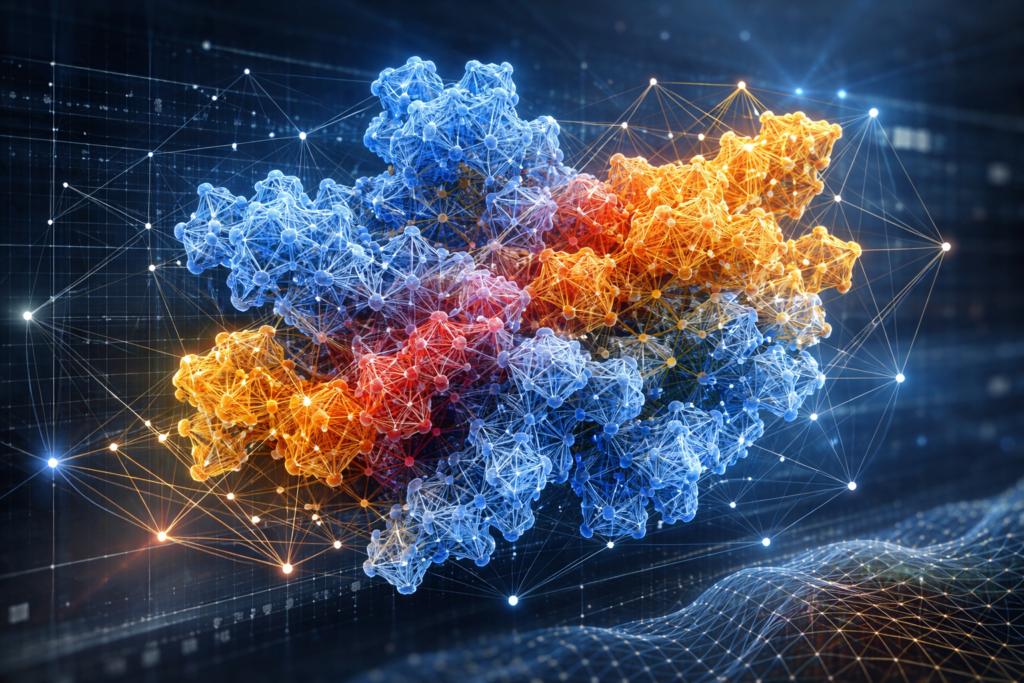
Examples are proteins which undergo a process of folding into complexes in the form of three dimensions which determine the biological activity. Using geometric modeling, researchers are able to visualize these structures using an incredible precision. Such methods as molecular dynamics simulations and X-ray crystallography generate data that can be converted into 3D geometric representations. With such models scientists are able to:
• Study the reactions of the amino acids.
• Determine drug binding active sites.
• Calculate the consequences of mutation on the protein.
Through the modeling of proteins and other biomolecules as geometries, scientists are in a position to obtain perspectives of the molecular mechanisms that cannot be observed under the conventional microscopy.
Molecular Interaction Networks and DNA
In addition to proteins, geometric modeling is useful in visualizing the DNA structures, RNA and complex molecular interaction networks. As an example, 3D geometric representations of the DNA dual helix can help a student and researcher comprehend base-pairing, helical twists, and supercoiling. Also, signaling networks in cells can be represented as geometric structures to emphasize relationships among molecules to aid in drug discovery and systems biology studies.
Improving the Anatomical and Medical Visualization
The other field where the geometric modeling has brought revolution in the scientific field is in anatomy and medical research. The human body is a very complex system and organs, tissues and structures of the cells interact in complex manner. The conventional two-dimensional anatomy figures cannot be used in most cases to fully express these relationships.
3D Anatomical Models
Geometric modeling enables the production of detailed 3D reconstructions of anatomical systems of medical images, including MRI, CT scans, and ultrasound. These models allow:
• Planners to be more precise in planning procedures.
• Medical students to learn about systems of organs in an interactive way.
• Scientists to investigate the pathology and the development of disease.
As an example, a 3D geometrical model of the heart can illustrate the blood flow, muscle contraction, and electrical conduction system so that a holistic view that is more basic than a stagnant image is gained.
Surgical Simulation and Training
Surgical simulators Virtual surgeries are also possible with the help of geometric modeling. Complex surgical procedures will enable the surgeons to train and enhance their expertise and patient outcomes in a virtual world that is risk free. Besides, these models facilitate the use of tele-medicine, enabling experts to work together even when they are away through anatomical clear visualizations.
Geological and Environmental Uses
Geometric modeling has many other applications than in biology and medicine. Environmental scientists working in geology and Earth system research are faced with massive, complex data that characterizes landscapes, underground geology and natural processes. Geometric modeling provides the means to form such data in the form of understandable graphics.
The Geological Formations: Modeling
There are geological features that are three dimensional in nature, including mountains, volcanoes, and sedimentary layers. Using geometric modeling allows geologists to build realistic 3D models of these structures which may be studied to:
• Mineral exploration and management.
• Knowledge on the tectonic activity and the risks of the earthquakes.
• Recreation of the paleoenvironmental conditions.
An example is that a geometric model of subsurface rock layers can be used to determine potential reservoirs by oil and gas companies without increasing the risks of drilling.
Visualization of the Environment and Climate
Geometric modeling is a method used by the environmental scientists to model phenomena like river flows, glacier movements and atmospheric patterns. The representation of these processes in a geometrical form enables the researcher to:
• Anticipate the effects of climate change.
• Determine flood risks and erosion trend.
• Share environmental information with policymakers and the society.
The Benefits of Geometric Modeling in Scientific Studies
The reasons why geometric modeling has become so popular in scientific visualization are:
Precision and Accuracy
Geometric models are modeled mathematically thus there is high degree of accuracy in representation. This accuracy is essential when minor changes in structure or location can be very important as in molecular drug design or surgical planning.
Enhanced Analytical Processes
The transformation of complicated data into geometrical models enables scientists to conduct a computational analysis, which could not be achieved using raw data. As an example stress distribution in bones or fluid dynamics in blood vessels can be simulated since a geometric model provides a structured manipulable framework.
Enhanced Communication
Scientific communication is improved with the help of 3D models. Scholars are able to share interactive models with their peers, teachers are able to give their students learning experiences through immersion, and policy makers are able to understand science in a better way. All these advantages of geometric modeling mean that geometry is a mediator between the complicated data and human knowledge.
Geometric Modeling Tools and Techniques
Geometric modeling is aided by diversified software and methods of calculation in many fields. These tools are specialized scientific to general purpose 3D modeling software.
Molecular and Biological Modeling Software
• PyMOL and Chimera molecular visualization.
• VMD (Visual Molecular Dynamics) to protein and nucleic acid modeling.
Healthcare Imaging and Anatomical Modeling Software
• Reconstruction of anatomy Structures based on imaging data using 3D slicer.
• Business Intelligence (BI) software developed to visualize DICOM images.
Environmental Modeling Platforms Geological
• GOCAD and Petrel to sub-surface geological modelling.
• Environmental and terrain visualization ArcGIS 3 D analyst.
These tools combine the use of geometry modeling using polygonal mesh generation, spline curves, surface fitting and volumetric rendering to provide accurate and interactive representations.
Challenges and Limitations
Although the advantages of geometric modeling are considerable, it also has its problems. The accuracy of modeling may demand good quality data and a lot of computing power. Also, developing and analyzing models require scientific and mathematical knowledge, as well as knowledge in computer methods. One can be misinterpreted through errors in modeling or simplification in geometry and therefore, validation and verification is important.
Future Directions
The future of geometric modeling of scientific visualization is bright. The progress of machine learning and artificial intelligence is also allowing the creation of geometric models on raw data automatically and without need of much time and expertise. The virtual reality (VR) and augmented reality (AR) technologies are developing in the area of immersion where scientists can study the structures of molecules or anatomical systems in 3D space.
The potential of the geometric modeling is also being increased through integration with big data and real-time simulations. Interactive geometric frameworks give researchers the ability to study dynamic systems in real-time i.e. physical systems like protein folding and climate simulations. The further development will further improve the knowledge, speed the discovery, and advance education in the realms of science.
Conclusion

Geometric modeling has revolutionized the manner in which scientists present and perceive intricate data. It allows closing the gap between abstract information and intuitive understanding by offering specific and interactive and multi-dimensional representations. Geometric modeling is used to enhance the analytical capabilities, aid in making the right decisions and creating effective communication between molecular structures to anatomical systems and geological formations. Due to the increased sophistication of computational methods, geometrical modeling is bound to continue to play an essential part in scientific inquiry and education, and become an inevitable instrument of future discoveries.