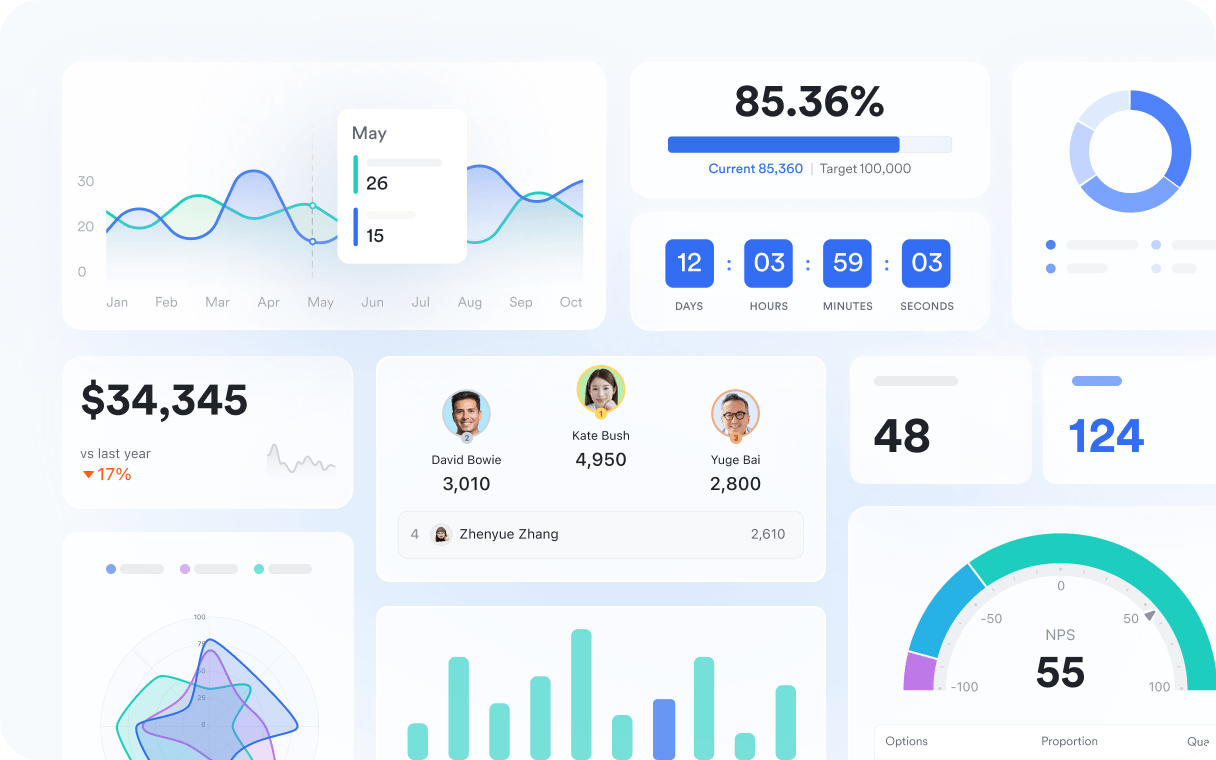
Every project has a level of risk that includes missed deadlines, priorities that shift, and unclear responsibilities. For many organizations, unpredictability has become the default, not because teams don’t have good talent, but because their systems keep them working in separate places. When tasks are captured in one app, conversations happen in another app, and progress is recorded in a spreadsheet, it becomes hard to have foresight into problems that arise.
Connected platforms change this dynamic by creating continuous information flow. Instead of chasing updates across hundreds of channels, teams primarily rely on project management tools that provide clarity and context in one space. Predictability does not come from micromanaging, it comes from systems that have visibility of progress and clear accountability. An effective example of this is Lark, which provides a strong, unified digital approach to project execution.
Lark Base: Building reliability with structured data
Predictable outcomes depend on visibility, and Lark Base provides it by centralizing how projects are tracked. Unlike static spreadsheets that leave room for errors, Base offers customizable views—from kanban boards to timelines that adapt to how teams work.
Also, Lark Base embodies the value of a CRM app, connecting client interactions to ongoing projects. At the same time, the operations team uses Base to monitor delivery schedules. Because all records live in the same environment, managers can anticipate risks—like a delayed shipment affecting client timelines before they cause disruption. This single source of truth reduces uncertainty and makes project delivery more reliable.
Lark Calendar: Turning plans into commitments
When plans are disconnected from your projects, unpredictability often arises. Teams commit to deadlines without identifying how they relate to the team and its other priorities. In so doing, they measure their productivity over the bottleneck. Lark Calendar resolves this, by associating commitments and milestones to the actual work that drove the outcomes.
If a product launch is tracked in Base, the important dates will be visible in Calendar. Meetings created in Base will show Docs and agendas for the meeting, so everyone arrives prepared. Reminders and notifications help keep commitments in view, so due dates are not forgotten. By giving time management a context of work within the same platform, Calendar lets businesses make dreams into predictable commitments that teams can work from.
Lark Docs: Creating clarity with living documentation
Documentation gaps are a hidden source of project unpredictability. When requirements, strategies, or feedback live in disconnected files, teams waste time reconciling versions or chasing missing details. Lark Docs eliminates this by turning documents into living collaboration spaces.
Imagine a software development project where the specification evolves across sprints. Instead of emailing multiple drafts, the team co-edits a single Doc, leaving comments and tagging colleagues in real time. That Doc links back to Base records and Tasks, ensuring requirements are never separated from execution. This connected documentation reduces misunderstandings and ensures every project stays aligned with its original goals.
Lark Mail: Keeping external inputs in the flow
External communication can be unpredictable when a client’s request or a vendor’s update doesn’t flow back into a project’s systems. Projects become reliant on teams duplicating updates manually, which is risky since some details may be missed. Lark Mail helps eliminate this by embedding email into the same connected platform that is used to manage projects.
An approved vendor can simply arrive in Mail, be linked to Base or transferred into a task, all without leaving the ecosystem. Client feedback can flow back into the same chain of communication that drives execution, rather than as an unrelated thread. This keeps external inputs visible and helps mitigate last-minute surprises, which ultimately improves predictability overall.
Lark Tasks: Automating accountability for consistency
Projects become unpredictable when responsibilities aren’t clear or when follow-ups rely on memory. Lark Tasks prevents this by making ownership visible and automating accountability. Managers assign tasks with deadlines and priorities, and individuals see them reflected in personal dashboards.
The real power lies in automation. An automated workflow can send reminders ahead of deadlines, escalate overdue tasks, or update project records automatically. For example, if a critical deliverable is late, the system alerts stakeholders without requiring manual follow-ups. This ensures that predictable progress isn’t left to chance, it’s built into the system itself. By embedding accountability, Tasks make consistency part of daily operations.
Lark OKR: Aligning work with long-term outcomes
Even in a well-defined project, the initiative can fall flat if it does not have the right linkage to organizational objectives. Lark OKR (Objectives and Key Results) brings predictability to a strategic level by connecting the day-to-day work teams are doing with longer-range outcomes. Teams will set objectives to determine what they are working toward, measure their progress with key results, and link the outcomes to the ongoing work with tasks and projects.
For example, if a company wants to improve customer satisfaction, it is possible to align projects in product, sales, and support under the same OKR. Real-time updates completed in Tasks or Base will automatically reflect progress tracking to allow leaders to see whether or not the execution of the project initiative produced the desired outcome. The combination of clear direction with OKR ensures that project predictability is not just about meeting assigned delivery dates but achieving the outcomes that matter most.
Conclusion
Predictability in projects cannot be mistaken to imply the eradication of uncertainty; is more so about developing systems and processes that diminish uncertainty. When teams use disconnected tools, the teams perpetually guess, they duplicate efforts, and they react too late. Connected systems build frameworks that provide structure, clarity, and accountability within a connected platform like Lark. Projects become flows of work that can be managed with confidence.
Base ensures that data is verifiably correct, Calendar commits to a plan, Docs will align knowledge across your organization, Mail allows you to pull in external responses, Tasks will embed accountability and automate updates into workflows, and OKR will ground execution in strategy. Each connected tool assists businesses in moving from uncertain outcomes to predictability and consistency in delivery.
For businesses who will scale with confidence, predictability will not be a bonus, it will be a necessity to achieve their goals. This occurs only through connected systems of work.
