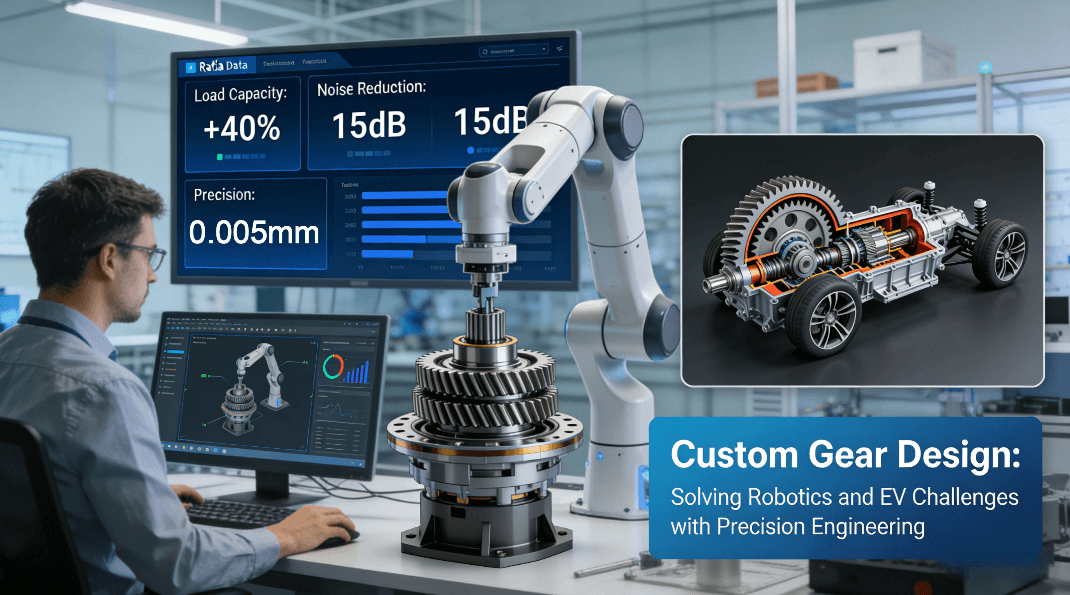
Figure 1: Custom gear design enables optimized performance for robotics and EVs through advanced modeling, precision manufacturing, and rigorous testing, ensuring durability and efficiency under high-speed conditions.
Introduction
In the realms of industrial automation and electric vehicles, manufacturers frequently grapple with persistent challenges such as inefficient power transmission, excessive operational noise, and premature gear failure under high-speed, high-load conditions. These issues directly undermine product performance, escalate maintenance costs, and diminish customer satisfaction. The underlying cause often stems from reliance on off-the-shelf gears, which fail to align with specific application demands, load profiles, and spatial constraints, leading to inherent flaws in design, material selection, and manufacturing.
This article explores how professional custom gear design services systematically address these pain points through a holistic approach — encompassing needs analysis, topological optimization, and precision manufacturing. By dissecting key principles of high-performance gear design and emphasizing collaborative engineering, we demonstrate how customization drives transformative improvements. To appreciate the impact of tailored solutions, we must first examine the core engineering tenets that govern advanced gear design.
What Core Principles Govern High-Performance Custom Gear Design?
High-performance custom gear design is anchored in four interdependent pillars that ensure reliability, efficiency, and longevity. These principles form a cohesive framework to overcome the limitations of standard gears.
1. Strength and Durability
Gear strength and durability are paramount for withstanding cyclic loads and preventing fatigue failure. Adhering to international standards like ISO 6336, which defines tooth contact fatigue strength and root bending fatigue capacity, ensures calculations account for real-world stresses. For instance, custom designs incorporate safety factors to handle peak torques in electric vehicle drivetrains, leveraging finite element analysis (FEA) to optimize tooth geometry and material selection. This proactive approach mitigates risks of pitting and fracture, extending service life even in harsh environments.
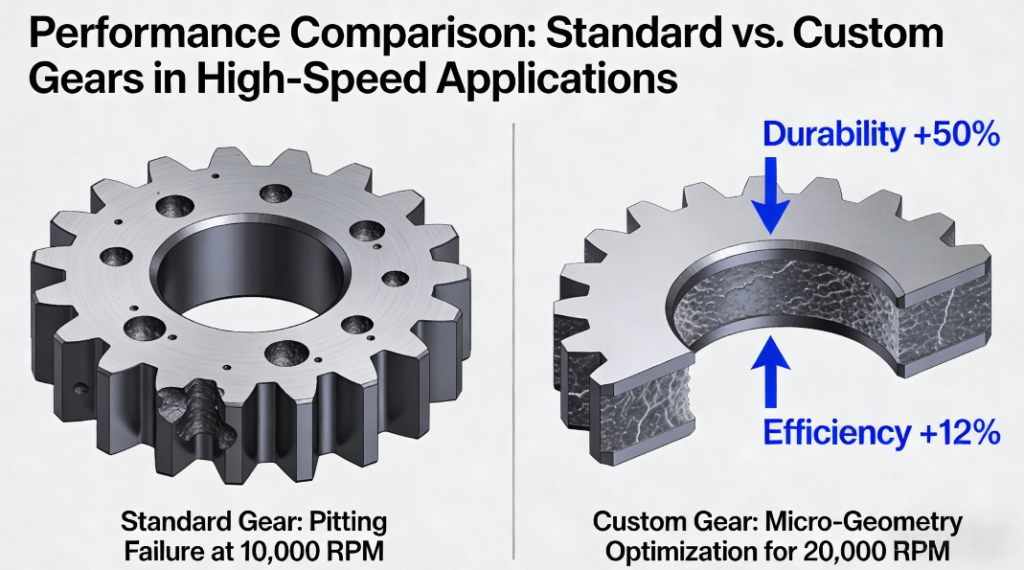
Figure 2: Custom gears eliminate common failures through tailored micro-geometry and material selection, achieving higher durability and efficiency compared to standard gears in demanding robotics and EV environments.
2. Meshing Characteristics Optimization
Smooth meshing is critical for minimizing noise, vibration, and wear. Key parameters such as contact ratio and sliding velocity are optimized to ensure uniform load distribution and reduce stress concentrations. Advanced software simulates meshing behavior under dynamic conditions, allowing designers to adjust profile shifts and pressure angles. By maximizing the contact ratio — often exceeding 2.0 for high-precision applications — custom gears achieve quieter operation and enhanced efficiency, essential for robotics requiring low backlash.
3. Integrated Thermal Management
Heat generation from friction and high speeds can degrade gear performance through thermal expansion and lubrication breakdown. Custom designs integrate thermal management strategies, such as optimized cooling channels or material selections with high thermal conductivity. Referencing standards like AGMA 925, which addresses surface temperatures, designers incorporate coatings or alloy treatments to dissipate heat effectively. This is especially vital for EV gears operating at over 15,000 RPM, where uncontrolled temperatures lead to premature failure.
4. Synergy with Manufacturing Precision
Dimensional accuracy directly influences gear performance, necessitating alignment with manufacturing capabilities. Standards like ISO 1328 specify tolerance grades for tooth thickness and runout, ensuring consistency in production. Custom gear projects leverage closed-loop manufacturing processes, where feedback from coordinate measuring machines (CMMs) refines toolpaths. This synergy eliminates deviations that cause noise or inefficiency, guaranteeing that design intent translates into physical parts with micron-level precision.
How Do Design Requirements Differ Between Automotive and Robotic Gears?
Design requirements vary significantly between automotive and robotic applications, reflecting distinct operational priorities. A comparative analysis highlights why universal gears fall short and underscores the need for customization.
Automotive gears, such as those in EV transmissions, prioritize long-term durability and high efficiency to support extended warranties and energy savings. They endure constant speed variations and high torque, demanding materials like case-hardened steels and tolerances within ISO 5-7 grades. In contrast, robotic gears, used in joint actuators, emphasize ultra-high precision and minimal backlash for repeatable motion control. Accuracy levels often reach AGMA 12 or finer, with designs favoring lightweight alloys to enhance dynamic response. This divergence necessitates tailored approaches — automotive gears benefit from robust thermal treatments, while robotic gears require specialized grinding to achieve sub-arc-minute accuracy.
What Role Does Material Science and Advanced Manufacturing Play in Gear Performance?
Material selection and manufacturing processes are decisive in translating design specifications into reliable performance. Custom gears exploit advancements in both domains to meet application-specific demands.
1. Material Selection for Enhanced Properties
Engineering-grade materials, such as high-strength alloy steels (e.g., AISI 8620) or polymers like PEEK, are chosen based on load capacity and environmental factors. For example, steels undergo carburizing to achieve surface hardness over 60 HRC, resisting wear in high-load scenarios. Authorities like ASM International provide data on post-treatment mechanical properties, guiding selections that balance weight, strength, and corrosion resistance. In robotics, aluminum alloys reduce inertia, while EVs use copper-infused composites for thermal conductivity.
2. Advanced Manufacturing Techniques
Processes like precision grinding and honing ensure geometric accuracy and superior surface finishes. For instance, gear grinding after heat treatment achieves tooth flank roughness below 0.5 μm, critical for noise reduction. Additive manufacturing enables rapid prototyping of complex geometries, such as internal cooling channels, while 5-axis CNC machining maintains tight tolerances for small batches. These methods, validated against standards like AGMA 2000, guarantee consistent quality across production runs.
How Can Manufacturers Implement Effective Quality Control for Small-Batch Gear Production?
Small-batch production demands rigorous quality control to maintain consistency without economies of scale. A comprehensive system spans from raw material inspection to final verification.
- In-Process Monitoring and SPC: Statistical process control (SPC) tracks key parameters like tooth profile deviations during machining, triggering adjustments if trends exceed limits. On-machine probes measure critical dimensions in real time, reducing scrap rates. This approach aligns with ISO 9001 requirements, ensuring traceability and continuous improvement for low-volume orders.
- Final Inspection with Gear Measurement Centers: Post-production, gear measurement centers conduct full-dimensional checks against CAD models, generating deviation reports for attributes like pitch error and tooth alignment. Compliance with standards such as ISO 1328-1 provides objective evidence of quality, essential for certification in regulated industries. Documentation includes material certificates and process records, enabling full traceability for each batch.
What Are the Special Gear Design Considerations for Electric Vehicles?
Electric vehicle gears face unique challenges due to the stringent conditions they must withstand, including high speeds, instantaneous torque, and NVH (noise, vibration, and harshness). Meeting these demanding requirements often necessitates collaboration with a precision manufacturing partner possessing extensive experience in the electric vehicle sector, who can provide comprehensive solutions encompassing design, material selection, and manufacturing.
1. High-Speed Efficiency and NVH Optimization
At speeds exceeding 15,000 RPM, micro-geometry modifications like tip and root relief minimize excitation forces that cause noise. Advanced software simulates NVH performance, allowing designers to optimize tooth microgeometry for smooth meshing. This reduces whine frequencies that are critical in cabin comfort, leveraging materials with damping properties to absorb vibrations.
2. Lightweighting and Thermal Stability
Weight reduction is prioritized to extend battery range, achieved through topology-optimized geometries and hollow shafts. Simultaneously, thermal management integrates cooling channels or oil-jet lubrication to dissipate heat from rapid acceleration. Designs reference ASME Y14.5 for geometric tolerancing, ensuring stability under thermal expansion during high-power cycles.
How to Approach Cost-Effectiveness in Custom Gear Projects?
Custom gear projects can be cost-effective through value engineering and strategic planning, debunking myths of prohibitive expenses.
- Value Engineering in Material and Design: By selecting materials based on actual load requirements — rather than over-specifying — designers avoid unnecessary costs. Design for manufacturability (DFM) principles simplify complex features, reducing machining time and tool wear. For example, consolidating multiple parts into a single gear minimizes assembly steps, lowering labor costs for prototypes.
- Lifecycle Cost Optimization: Emphasizing total cost of ownership (TCO), custom gears reduce long-term expenses through extended service life and fewer failures. Batch sizing flexibility allows small runs for testing, with scalability plans for volume production. Digital twins simulate production workflows, identifying bottlenecks early to cut downtime and overhead.
Conclusion
In summary, the escalating transmission challenges in robotics and electric vehicles necessitate a shift from standard to custom gear solutions. By adhering to core engineering principles, tailoring designs to application specifics, and leveraging advanced materials and quality control, manufacturers can transform gears into pivotal components for competitive advantage. This systematic approach not only resolves efficiency and durability issues but also unlocks innovation through collaboration.
FAQs
Q1: What is the typical lead time for a custom gear project?
A: Lead times vary with complexity, material, and certifications, typically ranging from 4 to 8 weeks. This includes stages like engineering review, material procurement, machining, and inspection. Expedited services are available for prototyping to align with urgent timelines.
Q2: Can you provide a fatigue life test report for the custom gears?
A: Yes, reputable manufacturers conduct tests per ISO 6336, delivering reports with load cycle data and life curves. These validate performance under simulated conditions, crucial for high-reliability applications.
Q3: What is the minimum order quantity (MOQ) for custom gears?
A: MOQs can be as low as 10 units, supporting prototyping and small-scale validation before volume production. This flexibility accommodates diverse project scales.
Q4: How is the cost for a custom gear project calculated?
A: Costs factor in design complexity, material choice, manufacturing processes, tooling, and quality assurance. Detailed drawings enable accurate quotations, emphasizing value-driven selections to avoid over-engineering.
Q5: How do you ensure noise control in gear systems?
A: Noise reduction hinges on precision design (e.g., micro-geometry modifications), high-accuracy manufacturing, material damping, and proper assembly. NVH simulations during design preemptively address acoustic issues.
H3: Author Bio
The author is a precision manufacturing expert affiliated with LS Manufacturing, a company dedicated to helping engineers overcome complex gear challenges in robotics, electric vehicles, and aerospace. With certifications includingIATF 16949 and AS9100D, the team ensures high-quality solutions through advanced technologies and collaborative engineering. For a free project consultation and DFM analysis, contact them to transform your concepts into reality.