Introduction
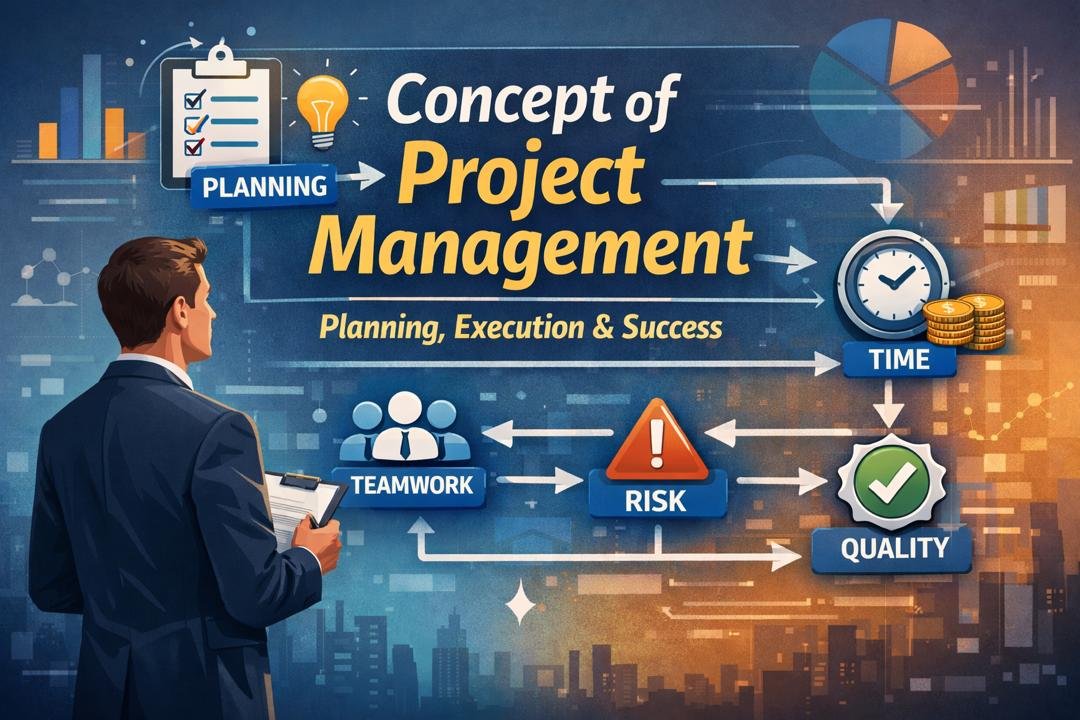
In the modern competitive and busy world, organizations are always struggling to accomplish objectives in small time frames and resources. The success of any venture is often determined by the effectiveness of planning and management of any activity whether it requires launching a new product, organizing an event, building a building, or installing a digital system. It is at this point that the concept of project management comes in. The very idea of project management offers a systematic and organized method that assists individual people and organizations to reach the goals effectively and efficiently.
Project management is not restricted to the big company and technical sectors any more. It has applications in the fields of education, health, government, business, technology and even in personal life. Knowledge of its fundamental principles will provide people with the ability to plan the work, handle resources, minimize risks, and provide services of high quality. This paper discusses the meaning of project management, its main principles, the main elements of project management like scope, time, cost and quality, and its applicability in various industries.
Project Management Definition
Project management may be called as the exercise of knowledge, skills, tools, techniques on project activities so as to satisfy project requirements. It entails the initiation, planning, execution, monitoring, controlling, as well as closing of a project to ensure that certain objectives are attained under certain restrictions.
A project in itself is a short-lived activity with an aim of producing something special in terms of product, service or outcome. Projects are different since they have a start and finish, defined goals, and are constrained by limited resources unlike normal operations. The projects are examples of projects being developed such as a mobile application, a road, a conference, or research study.
Project management makes sure that such projects are completed within the budget, quality and within time requirements. It offers a guideline that directs groups through every phase of the project cycle to make them remain focused, organized, and accountable.
The Significance of Project Management
The concept of project management is very instrumental in the success of an organization. A lack of proper management means that the project is prone to delays, higher costs, low quality, and the failure of the project to achieve its goals. Reasons why project management is important encompass some:
- Definite direction and focus: It determines goals and objectives such that everyone is aware of what is required to be accomplished.
- Effective utilization of resources: It assists in the efficient utilization of time, money and human resources.
- Risk management: It measures the possible threats at the very beginning and presents the measures to reduce the effects.
- Elevated communication: It improves the teamwork between team members and stakeholders.
- Quality assurance: It is a process whereby deliverables should be of the required standard.
- Accountability: It assigns and monitors performance.
Basically, the concept of project management converts the ideas into reality with the provision of structure, discipline and control.
Basic Principles of Project Management
Project management is based on a number of principles which are central to the management of projects. These values make the implementation of the project consistent, reliable, and effective.
Clear Objectives
Any project should possess clear objectives. Clear objectives enable the stakeholders to get to know the purpose of the project and give an evaluation of success.
Planning and Organization
Project management is based on proper planning. It entails the separation of tasks, the estimation of resources, establishment of timelines and responsibilities.
Stakeholder Involvement
The stakeholders are those people who are subjected to the project like the clients, the sponsors, the team and the end users. Their participation makes them to be in line with expectations and minimize conflicts.
Communication
Communication ensures that everyone is aware of developments, issues, and modifications. It also eliminates misunderstandings and facilitates collaboration.
Risk Management
Every project is associated with uncertainty. Risk identification and management is useful to avoid serious issues and is also a solution to a smoother implementation.
Constant Surveillance and Management
Tracking of the projects should be done at regular intervals to ensure that the projects remain on schedule, within budget and on course.
Quality Focus
There should be no compromise on quality. The deliverables should be of agreed standard and be stakeholder satisfying.
The Project Management Lifecycle
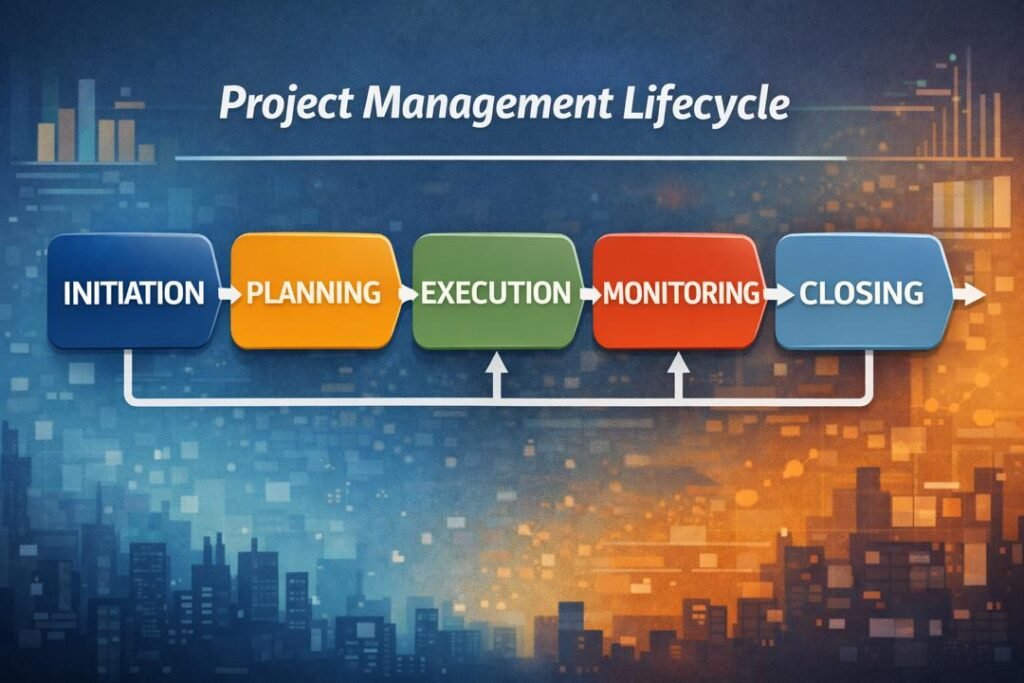
Project management lifecycle has five key stages that help in directing the project through to completion.
- Initiation
This is the beginning of the project. It entails the project requirement identification, setting of goals, and approval. A project charter is a document that is usually established to provide authorization of the project.
- Planning
Comprehensive plans are made during this step. These are scope, schedule, budget, risk management, communication and quality plan. Planning offers a guideline to the implementation of the project.
- Execution
This step entails the execution of the activities. Members of a team do work, they use resources and they give deliverables.
- Monitoring and Controlling
The progress is also monitored to keep the project on track. Deviations of the plan are rectified by means of control.
- Closing
Presentation of the project is done, deliverables are received and performance is assessed. The lessons learnt are written to be used in the future.
The Important Concepts of Project Management
In order to get a complete idea of the basic concept of project management, it is worthwhile to venture into the basic components of project management, which include the scope, time, cost and quality.
Scope Management
Scope is the task to be undertaken to finish the project. The scope management guarantees that every task needed is put in it and the redundant work is left out.
Significant processes in scope management are:
- Specification of project requirements
- Developing a work breakdown structure (WBS)
- Managing change to avoid scope creep
Good scope management is a way of avoiding confusion and keeping the project on track.
Time Management
Time management can be defined as organization of activities and completion in time. It is dedicated to the establishment of deadlines, scheduling of activities, and monitoring the progress.
Noteworthy features of time management are:
- Creating project schedules
- Estimating task durations
- Monitoring deadlines
Good time management prevents delays and provides an efficient working process.
Cost Management
Cost management makes sure that the project is within the budget. It is a process that deals with cost estimation, expenditure on costs and expenditure management.
Key elements include:
- Budget planning
- Cost estimation
- Expense tracking
Good cost control will eliminate financial overruns and even make best use of money.
Quality Management
Quality management is used to guarantee the meet of the necessary standards of the deliverables and fulfill the expectations of the stakeholders.
It involves:
- Defining quality standards
- Conduction of quality assurance
- Conducting quality control
Quality results increase customer satisfaction and reputation of the organization.
Additional Knowledge Areas in Project Management
In addition to the main constituents, the other significant knowledge areas in project management are also:
Human Resource Management
This is concerned with the management and arrangement of the project team. It involves role assignment, motivation, and training and performance evaluation.
Communication Management
This leads to the flow of correct information among the stakeholders in timely fashion. It entails communication planning, reporting and feedback systems.
Risk Management
The process of risk management identifies the threats and opportunities. It involves the risk evaluation, risk management mechanisms, and contingency.
Procurement Management
This is where they obtain external resources like equipment, materials or services that are required in the project.
Integration Management
This makes the elements of the projects to be in harmony. It links various procedures and harmonizes them with project objectives.
Applicability of Project Management in the Industries
Project management is very flexible and applicable in various fields since it is not limited to specific areas.
Business and Marketing
Project management facilitates the development of products, branding campaigns as well as the change initiatives within a company.
Information Technology
Structured project management is critical in IT projects like software development, system upgrades and even cyber security implementations.
Construction and Engineering
Massive infrastructure development needs proper planning, scheduling and management of resources to prevent delays and cost overruns.
Healthcare
Project management is applied by hospitals in expansion of facilities, implementation of a system and research program.
Education
Project management is used in educational institutions in curriculum development, research projects and academic programs.
Government and Public Sector
Policy implementation, social programs, and development of infrastructure are some of the examples of public projects, which require proper project management.
The Project Management is beneficial to individuals and organizations
The basic notion of project management has a variety of advantages:
- Better output: Duties are planned and scheduled.
- Improved decision making: Evidence-based actions.
- Less risk: Problems are found at an early stage.
- Improved teamwork: Work teams perform better.
- Better success rates: The projects will have more chances to achieve goals.
To individuals, project management competencies enhance employment and career development. To the organizations, they enhance efficiency, profitability and customer satisfaction.
Problems with Project Management
Project management has a number of challenges even though it has its advantages:
- Poor communication
- Inadequate planning
- Resource constraints
- Resistance to change
- Scope creep
To be able to overcome these challenges, a strong leadership, effective communication, and further learning are necessary.
Best Project Management Practices.
Professionals should embrace the best practices in order to enhance the output of the projects, including:
- Setting realistic goals
- Applying project management software and project management tools
- Encouraging teamwork
- Keeping track of the process
- Recording lessons learned.
These practices make the way of work more efficient and encourage continuous improvement.
Conclusion
The concept of project management gives a well-grounded basis of success in any project. It provides a systematic method of planning, execution, monitoring and closing of projects to ensure that goals are achieved within set limits of scope, time, cost and quality.
Project management is not a single profession/industry. It is an all-encompassing competence which enables individuals and organizations to convert ideas into reality. In business, technology, healthcare, education, or government, project management is better handled to achieve greater results, higher productivity, and sustainable development.
To novices, the learning of such fundamental concepts develops a solid knowledge foundation. To practitioners, these principles are strengthened to improve performance and project success. Finally, project management is not merely a technical field, but a strategic instrument to accomplishment and value in the long-term.
Get more well researched information about the concept of project management here.