Have you ever wondered why more small electric cars are suddenly appearing on Indian city roads? I notice it almost every day while driving through crowded streets.
Traffic keeps increasing, fuel prices fluctuate, and parking space is always limited. That’s exactly where compact EV cars in India are starting to change the way we travel. These vehicles are small, efficient, and designed mainly for daily urban driving. For people like you and me who mostly commute within the city, they offer lower running costs and easier handling in tight spaces.
In 2026, compact EVs are becoming a practical solution for urban mobility in India, combining affordability, convenience, and cleaner transportation.
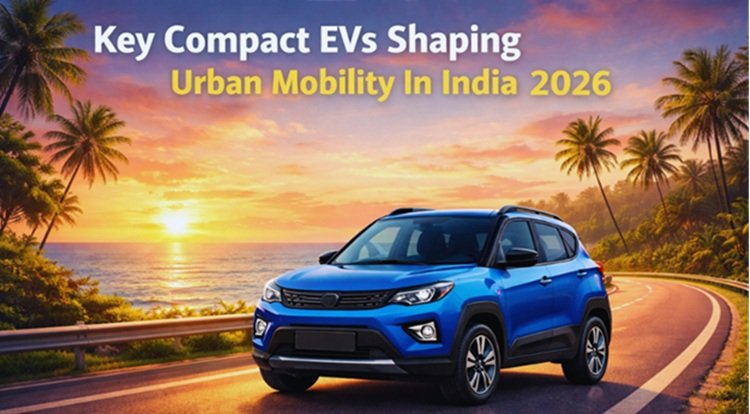
Key Compact EVs Shaping Urban Mobility In India 2026
Compact EVs in India are quickly becoming a practical solution for city driving. Designed to handle crowded streets and tight parking spaces, these vehicles offer a convenient and cost-effective way for people to travel within urban areas. As more drivers seek cleaner, smarter mobility options, compact EVs are playing an important role in reshaping how cities move in 2026.
MG Comet EV
The MG Comet EV is one of the smallest electric cars available in India, and it is clearly designed for busy city life. When you first look at it, the compact design stands out immediately. The car measures just about 2.9 metres in length, making it extremely easy to navigate through narrow streets and crowded parking areas. In terms of performance, the MG Comet EV is powered by a 17.3 kWh battery pack and an electric motor that produces 42 PS and 110 Nm of torque. The car offers a claimed driving range of around 230 km on a full charge, which is more than enough for daily city commuting.
Charging is also fairly convenient. With a 3.3 kW AC charger, the battery can be fully charged in about 7 hours, while a faster 7.4 kW charger can complete charging in roughly 3.5 hours. According to the latest automobile articles, the MG Comet EV is priced between ₹7.9 lakh and ₹9.9 lakh, making it one of the most affordable electric cars in India. For someone who drives 30–40 km daily in the city, this car could easily last several days on a single charge.
Tata Tiago EV
The Tata Tiago EV is one of the most practical electric hatchbacks in India today. Unlike micro EVs, it looks very similar to a regular petrol hatchback, which makes many drivers comfortable switching to electric mobility. The car comes with two battery options: 19.2 kWh and 24 kWh. Depending on the variant, it delivers a claimed range of around 250 km to 315 km on a single charge. The electric motor produces 61-75 PS and up to 114 Nm of torque, giving the car enough performance for city traffic.
Charging is also quite practical. Using a DC fast charger, the Tiago EV can charge from 10% to 80% in about 57 minutes, while a regular home charger takes around 6 to 8 hours for a full charge. Another reason why this EV is popular is its price. It typically ranges from ₹7.9 lakh to ₹11.8 lakh, which makes it one of the most affordable electric hatchbacks in the country. For everyday city driving, the Tiago EV offers a strong balance between price, range, and practicality.
Tata Punch EV
The Tata Punch EV is designed for buyers who want the look and feel of an SUV but still need a compact vehicle for urban roads. As per the latest car articles, it sits slightly higher than a hatchback, which gives drivers better visibility in traffic. The Punch EV comes with two battery options: 25 kWh and 35 kWh. The larger battery variant offers a claimed range of about 365 km, making it suitable for both city use and occasional longer trips. The electric motor in the long-range variant produces 122 hp and 190 Nm of torque, giving it stronger performance compared to many small EVs.
In real-world conditions, testing shows that the car can travel around 229 km on a single charge, depending on driving style and traffic conditions. The price generally ranges between ₹9.99 lakh and ₹14.4 lakh, placing it in the compact electric SUV category. For drivers who want a rugged-looking city EV with decent range, the Punch EV is becoming a very popular option.
Citroen eC3
The Citroen eC3 is another compact electric car that focuses on comfort and practicality. This one of the compact EV cars in India is slightly larger than some entry-level EVs and offers a spacious interior, which is useful for families. The car is powered by a 29.2 kWh battery pack connected to an electric motor that produces 57 hp and 143 Nm of torque. It offers a claimed range of about 246 km, while real-world tests show it can deliver around 228 km on a full charge.
Charging the eC3 with a standard 15A home charger takes roughly 10 hours, while fast-charging options are also available. The price generally falls between ₹11.6 lakh and ₹13.4 lakh, making it slightly more expensive than some smaller EVs but offering more interior space. For buyers who want a roomy compact EV with a comfortable ride, the eC3 can be a practical choice.
Mahindra XUV400
The Mahindra XUV400 is one of the more powerful compact electric SUVs currently available in India. While it is larger than most city EVs, it still fits well into the compact electric segment. The vehicle uses a 39.4 kWh battery pack paired with an electric motor producing 150 hp and 310 Nm of torque, which gives it strong acceleration compared to smaller EVs.
The SUV has a claimed driving range of around 456 km, although real-world tests show it typically delivers about 251 km depending on driving conditions. Because of its larger battery and higher performance, the XUV400 is priced around ₹17 lakh and above in the Indian market. According to the automobile articles, if someone wants a more powerful electric SUV while still driving mostly within the city, the XUV400 becomes a strong option.
Key Trends And Impact
As electric vehicles grow in India, one thing becomes clear: compact EVs are leading the transformation of city mobility. First, prices are gradually becoming more affordable. Just a few years ago, most electric cars were expensive, but now entry-level EVs start around ₹7–8 lakh. Second, running costs are much lower than those of petrol vehicles. Charging an EV typically costs far less than refilling with petrol, helping drivers save money over time.
Another major impact is on the environment. Electric vehicles do not produce tailpipe emissions, which helps reduce air pollution in crowded cities. As more people switch to EVs, urban air quality could improve significantly. Compact EVs also solve parking problems. Their smaller size makes it easier to navigate tight lanes and crowded residential areas.
Charging and Range
Charging and range are two of the most important factors people consider before buying an electric car. Fortunately, both areas are improving quickly in India. Most compact EVs today can be fully charged at home in about 6 to 10 hours using a standard charger. Fast chargers available in many cities can charge the battery up to 80% in less than an hour, depending on the model.
In terms of driving range, compact EVs typically offer 200 km to 400 km per charge, depending on battery size and vehicle type, as per the latest car articles. For most urban drivers who travel about 20 to 40 km daily, a single charge can last several days.
Conclusion
Compact electric cars are slowly reshaping the future of urban transportation in India. Vehicles like the MG Comet EV, Tata Tiago EV, Tata Punch EV, Citroen eC3, and Mahindra XUV400 show that electric mobility is no longer limited to expensive cars. They offer a practical driving range, lower running costs, and easier city driving. As charging infrastructure continues to expand and technology improves, you and I will likely see even more compact EVs dominating city roads in the coming years. In a country where traffic congestion and pollution are constant challenges, compact electric cars could become one of the smartest solutions for everyday urban mobility.
Written By Ankita Kumari