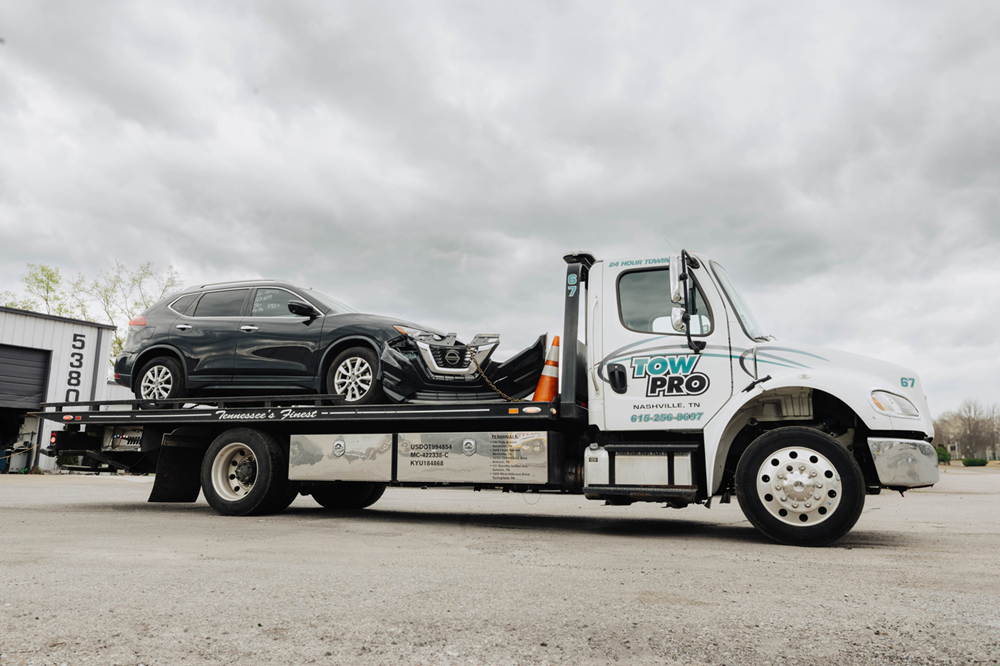
When a car breaks down, the tow truck that arrives isn’t the same across the board and there’s good reason. When a vehicle breaks down, it needs a proper lifting and towing process; if it’s towed incorrectly, it may cause too much damage that excess repairs are needed to what could have been a simple issue. By knowing what vehicle type needs what towing options, drivers and operators understand what’s best for their vehicles, what to request, and why certain equipment must be used for safety’s sake.
Flatbed Towing Is the Safest Option Possible
Flatbed tow trucks—which are also known as rollback or slide trucks—carry vehicles as a flat unit instead of towing with wheels on the ground. The truck bed tilts downward to create a ramp, the vehicle drives (or is driven with a winch) onto the bed, and then it’s lifted back to horizontal for travel. This means all four wheels are never on the ground when traveling down the road.
AWD and 4WD cars need flatbeds most because their drivetrains are configured such that no wheels can simply roll; it’s either all or nothing. If towed with wheels down, the transmission or transfer case could break, costing thousands in repairs. The same goes for many luxury cars with electronic features that make them incompatible with traditional towing methods.
Low clearance cars—sports cars, modified vehicles with lowered suspensions and cars with low front ends due to collisions need flatbeds to be moved. Typical towing lifts one side of a car while it’s still on the ground; this could scrape a bumper along the asphalt or unhinge crucial parts to the point where a vehicle should just be scrapped. A flatbed removes this risk entirely.
Cars with front-end damage often need flatbeds because they may have severed wheel components. Towing them with wheels on the ground risks further damage to steering if something’s wrong; similarly, if wheels aren’t functioning, towing could mean a car would steer into traffic.
Wheel-Lift Towing Is More Suitable for Regular Use
Modern wheel-lift tow trucks don’t use chains like those of old; now they have a metal yoke that slides under front or rear wheels, lifts the end, and tows it with the other wheels (and passengers) rolling freely. This is more effective for cars—sedans, coupes, SUVs, and two-wheel drive vehicles—that need a quicker move without incurring crazy amounts of damage.
Wheel-lift towing doesn’t damage a drivetrain; it just works differently. For front-wheel drives, the front lifts; for rear-wheel drives, the rear lifts. As long as they’re not broken in any other respect where wheels aren’t rolling properly, this is the more effective approach. It also saves time as more wheel-lift trucks are on the road than flatbed trucks and they require less manoeuvring space.
Since wheel-lift trucks take up less space than a flatbed truck, they work better in narrow streets, tight parking lots, and areas where manoeuvring can take up too much time. This means response efforts can be quicker as well; if there’s no clear flatbed option available, wheels need to stay lifted.
Understanding Your Region’s Service Capabilities
Depending on where someone is in their travels determines what’s more readily accessible. Urban areas have all-inclusive service options all the time; flatbeds are available for specialized needs and those seeking local options can learn about access before they’re ever in a situation. Resources which help assess how much does it cost to tow a car in Nashville oftentimes provide service options alongside price, helping vehicle owners know what to expect.
Rural areas often have less availability; depending on who you ask, a flatbed option may be further away. This consideration should be made during road trips; if you’re out in the country somewhere experiencing an issue with your 4WD suburban, it can be helpful to prepare yourself slightly more if it requires more specialised care to get it sorted.
Heavy-Duty Vehicles Require Heavy-Duty Service
Not all tow trucks can handle everything on the road. Giant trucks, RVs, commercial vehicles and buses require heavy-duty transportation with significantly stronger qualities and rigging specialized for additional weight. For example, heavier tow trucks have differently reinforced frames and access to more powerful hydraulics.
Heavy duty towing is often more complicated than simply connecting and driving away; operators must assess weight distribution and how best to move forward to prevent tipping. This can take longer than your average tow but it’s critical where any vehicle can weigh tons.
Additionally, trailers pose issues—sometimes RVs can’t be RV’d unless the trailer is unattached; sometimes it’s a two-step process which takes additional time and consideration.
Motorcycles Travel
Motorcycles are an entirely different beast when it comes to moves—some use specific motorcycle trailers while others load everything onto a van—or use reliable motorcycle specialists. Cars can’t properly tote motorcycles so motorcycle companies in metropolitan cities exist.
Classic cars also get transported via flatbeds regardless of drive needs. When someone’s put that much money into a vehicle—especially irreplaceable ones—they want maximum protection; wheels-on-the-ground transport regardless is not safe.
Certain vehicles require flatbed/tow attention due to modifications that make it complicated—they could lack standard tires (sized differently) or have upgraded (or downgraded) suspensions—and complicate matters for those without specific measures already set in place with their tow company ahead of time.
Transportation Safety
It’s one thing to tow—but it’s another thing to make sure everything is properly secured. There are times a tow operator will rip someone’s car out and even cause more damage without proper proper insistence they utilize their equipment appropriately from the get-go.
Straps and chains help secure decent vehicles so they aren’t rippped off balance while in transport; operators must assess clearances so nothing hits blacktop on the way there while following regulations all across the board.
Operators also photograph prior damage after people normally deny certain components—but if they’re marked before tow transport happens, it’s unlikely they’ll get re-tread in such situations.
Letting operators know what’s wrong with them—the leaking fluids or components attesting problems—do not merit hiding something precious; downriver problems do not help at all.
What to Tow
Knowing what kind of information to give when talking with a dispatcher can make all the difference. Explaining make, model and drivability helps let them know if to get a more specialized truck or what type works best right away.
If you’re unsure what your needs are for your vehicle by providing them getting to the scene/asking over an intercom helps recommend what’s most known between either party.
Flatbed service works better if people get what they need; AWD or extremely low clearance prevents someone from just risking it; valuable vehicles need extra protection.
Conclusion: Distinction Matters
There’s a reason there’s a difference between tow truck methods—there are many different types of situations. It’s easy for standard vehicles to get a simple gear wheel lift; those that require extra effort or drivability concerns work better via flatbed. Heavy-duty needs require heavy-duty service..