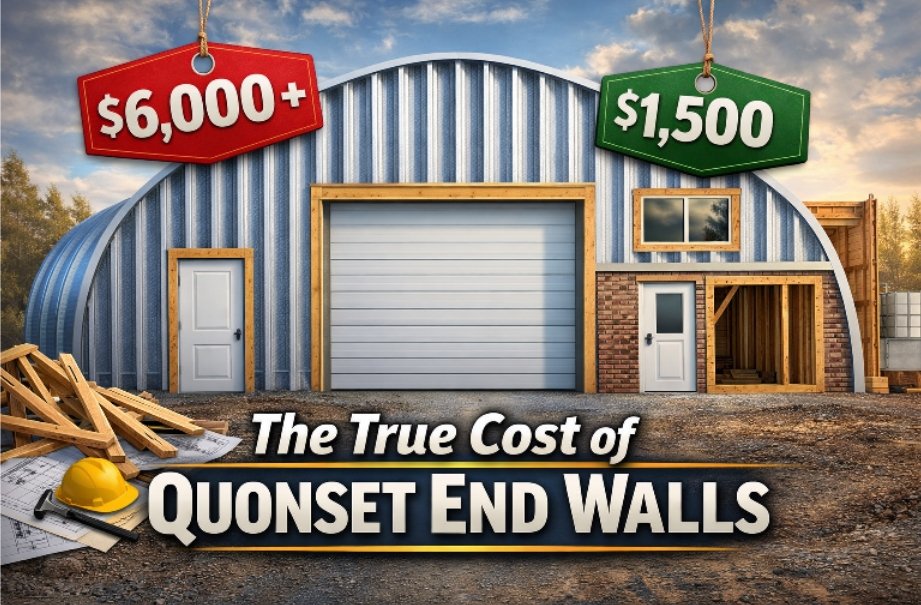
There comes a point in just about every Quonset building sale when the customer starts to compare Quonset building costs, placing two proposals side by side and wondering aloud why one costs $6,000 more than the other. The kits seem comparable. The sizes are identical. But the numbers don’t match. “It’s in the end wall configuration nine out of 10 times: the doors, the openings, how you specified them and engineered them and priced them.”
This is a common hidden driver of price for Quonset buildings, and it’s a factor that can move your total investment in the blink of an eye, faster than any other decision you make during the planning process.
Why you should think more about end walls than you do
When comparing Quonset building prices, the discussion naturally focuses on the arch panels, that is to say, exactly how thick is the steel, what’s your span width, and run length. That focus makes sense. The feature of the structure is its arched shell.
But a Quonset building wouldn’t be a complete structure without its end walls, and end walls are where customization and cost variation tends to concentrate most intensely.
End walls enclose the flat, vertical sides at either end of the arch. End walls are highly customizable, unlike the curved panels that fit a standard format. These can be basic one-door walk-through framed door assemblies or complex combinations of multiple large openings, commercial-grade sectional doors, windows between doors and at ends, and framed mechanical penetrations.
Every choice you make in such a setup alters your Quonset quote. This balance is one of the essences in creating a Quonset project budget that doesn’t come unwound at bid time, and understanding how these decisions interrelate.
The true price of picking the right door for your Quonset
Pass-thru doors vs. wide openings
A 3-by-7-foot personnel entry, more commonly known as a standard walk-through door, is the cheapest opening you can request. When it’s framed into an end wall, it adds relatively little cost and is part of most base kit configurations. But most buyers want more than one so-so entry.
Farmers need clearance for tractors and equipment. Shop owners need room to get cars in and out. For contractors putting up commercial storage buildings, overhead doors wide enough to admit forklifts is a must. The cost is significant on each step up in door size and door type.
A one-car, garage-style overhead sectional door in an 8-by-8-foot range can add $800 to $1,500 to a quotation once you factor in the framing, hardware, and installation. An agricultural overhead door, which is 14 feet by 14 feet, big enough to pull in a tractor with a cab, might cost $3,000 to $6,000 or more depending on the manufacturer of the door and your local labor rates.
As you’re shopping around for different Quonset building prices, the door specs that are embedded in each quote should receive no less attention than steel specs.
Stacking doors, bifold doors, and roller doors
In addition to traditional overhead sectional doors, Quonset end walls can also include sliding barn-style doors, bifold doors if you need maximum clearance, and commercial roll-up doors for high-traffic access. Each style has its own cost profile and makes sense in a different way based on how frequently the opening will be used and what needs to go through it.
Bi-fold doors, for instance, are used on aviation hangars and large agricultural equipment because they open all the way without any hardware mounted against the ceiling inside the structure. They generally are quite a lot more costly than an overhead sectional door of the equal size, but they can have benefits for the right use.
If you’re unsure about the type of door to go with, default to any sliding glass door.
Geometry of openings and its effect on structure cost
Framing, headers, and engineering loads
Each opening in a Quonset end wall has to be framed with a structural header and jambs that carry the load around the void. The larger the opening, the stronger the framing that is required. Additionally, engineering documents may be necessary for compliance with local building codes. All of these are key factors affecting Quonset building cost that buyers often overlook during early planning.
This is something that catches a lot of visitors off-guard and one of the things you need to consider when determining Quonset building cost because most people think openings are just deducted from wall space.
The myth is that when end wall openings are larger, they are less expensive. In reality, end wall openings can get very pricey. A 20-foot opening in a 40-foot-long end wall requires a big header that spans the opening and can support all of the loads transferred from the arch that it supports.
Be sure to discuss with your supplier or an engineer as you develop a budget and get the appropriate framing for each opening finalized. An apparent design decision can translate into a very real impact on the cost of materials and engineering fees.
Multiple openings in the same end wall
If a second or third opening is added to the same end wall, these costs increase. Every opening needs framing (material) to encase it, and then the rest of your solid truss sections will be supporting more load than they are.
Beyond a certain point, a heavily penetrated end wall may need structural support in more spots than originally anticipated, yet another reason up-front planning is far cheaper than change orders halfway through the build.
Windows, ventilation, and utility penetrations
Holes in your budget with significant price tags
Windows or fixed louvers are too often just an afterthought in the end wall design, but should be given careful consideration when you consider Quonset building prices.
What’s relatively small per framed window opening costs, maybe around $200 apiece for something that’s a standard residential window unit in both size and quality, multiplied over four or six of them across both end walls adds up.
What’s more, windows installed in end walls break continuity of insulation and energy loss considerations that can reverberate for years on heating and cooling bills during the service life of a building.
Utility penetrations, such as for electrical conduit or HVAC duct and plumbing supply lines, also must be thought out in advance and framed through construction. It is much more costly to cut and reinforce openings after the end wall is built than with the original framing installation.
End wall packages and comparisons: what to ask every supplier
When you pull quotes from different Quonset Hut manufacturers and compare the Quonset building cost from one to the other, end wall details are some of the first bits of information to look at side by side.
Ask each supplier what end walls are included or sold separately. Inquire as to what the framing is for each of these opening types. Inquire as to whether the cost estimate includes end wall engineering documentation or if it is extra.
The responses to those questions illuminate just what the extent of each quote is, and they prevent the hardly uncommon occurrence of realizing late in the process that a less expensive kit would have required many thousands more dollars in end wall work to get it close to being a viable building.
Final Thoughts
It is along the doors, openings, and end walls that a Quonset becomes specific to its owner and purpose, and where the expense of that specificity shows most clearly. When you’re planning a Quonset project budget, working out these specifics is not an afterthought but a core part of the whole package. These touches and elements deserve every bit as much careful consideration as your steel panels and the ground they sit on. Get the end wall design right at the beginning, and much of what follows in a project can begin cleanly.
Frequently Asked Questions
Do the end walls come with a Quonset kit I purchase?
Not always. Basic end wall framing packages are included by some manufacturers in their kit pricing while others list the end walls as a line item to be erected. This is perhaps the most typical source of pricing confusion when you compare Quonset building prices amongst different suppliers.
Be sure an itemized quote is provided so that you are told whether end walls, door frames, and hardware are included in the price.
What’s the cheapest type of door for a farm storage Quonset?
If you want to keep it simple for farm storage, then probably the most economical arrangement is a single large overhead sectional door on one end and a walk-through personnel door on another, retaining use of the building.
Bi-fold or sliding door systems deliver operational benefits, but come with higher upfront costs that are only economically justified when frequent large-equipment access is a daily necessity.
What factors influence the total cost of an end wall, like windows and the number of windows?
Each window needs a rough opening and a window unit, along with ties into the insulation system if it’s conditioned. Although the cost of an individual window is affordable, it all adds up, and where they are installed impacts load-bearing and thermal performance.
Planning window positions is much cheaper when it can be integrated during design than to have an end wall cut after construction.
Can I install a second big door on the end of my Quonset after it is built?
So, is it possible? Technically yes, but the price will be significantly more than if you had planned it during your first construction.
To turn a closed end wall into a wide opening means cutting, reframing (with structural engineering to prove the wall is still sound after it’s cut), and possibly adding more structure. If there’s even a tiny chance you’ll want to add another major opening later, then framing in one as a blocked-out rough opening during construction is the least expensive way to do so.