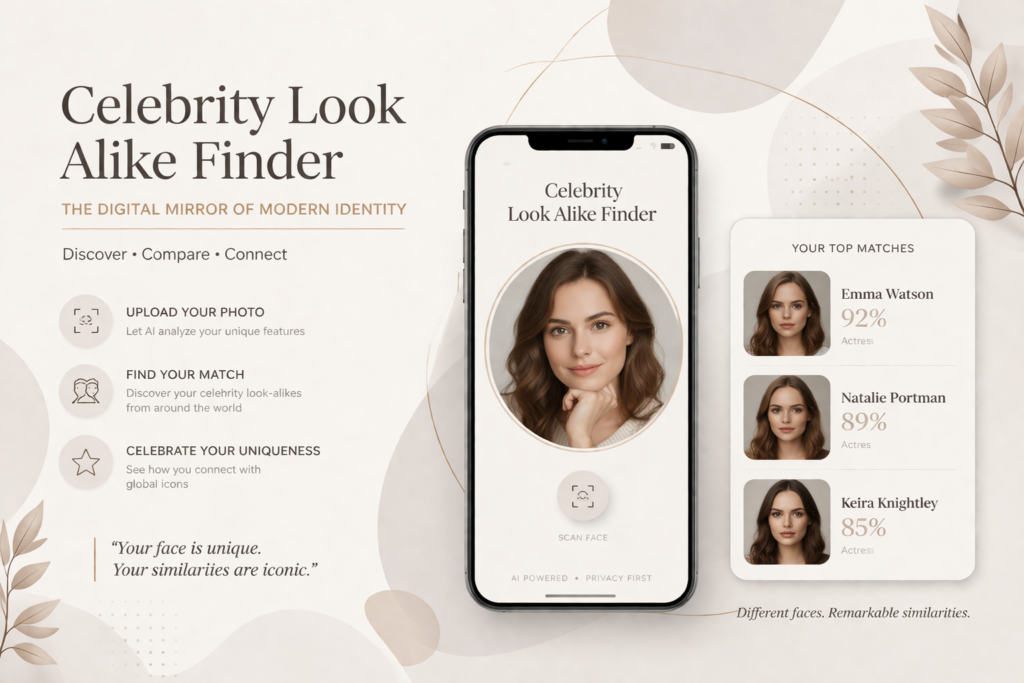
The perception of self in the current world, where selfies, filters, and social media profiles have become a part of our daily existence, has changed considerably. The celebrity look alike finder is one of the digital trends that can best characterize this new reality, and it is both amusing and unexpectedly thought provoking. These applications enable users to find out the famous faces that they resemble, a combination of the latest technology and human interest. What started as something new has now become a common online trend, and has touched on areas such as social media use to identity.
The Rise of Look Alike Culture
Humans have always been fascinated by resemblance. Long before technology, people would compare friends and strangers to well-known figures. However, the digital age has amplified this curiosity. With billions of images available online and powerful computing systems, it has become possible to automate what was once a subjective guess.
Celebrity look alike finder emerged as part of this broader trend. Social media platforms helped accelerate their popularity, as users began sharing their results for entertainment. Seeing someone matched with a famous actor, singer, or athlete often sparks reactions ranging from disbelief to excitement. This viral nature has made these tools a staple in online culture.
Technology Behind the Experience
At the heart of every celebrity look alike finder is artificial intelligence. These systems rely heavily on facial recognition and machine learning algorithms. When a user uploads a photo, the software scans and identifies distinct facial landmarks such as eye spacing, nose shape, cheekbone structure, and jawline.
The algorithm then compares these features against a vast database of celebrity images. Advanced systems go beyond basic geometry, analyzing skin tone, texture, and even subtle expressions. The result is a list of potential matches ranked by similarity.
What makes modern tools impressive is their ability to learn. The more images they process, the better they become at identifying patterns. This continuous improvement ensures that results become increasingly accurate over time.
Why People Love Using It
The popularity of celebrity look alike finders is driven by a mix of psychological and social factors. One key reason is validation. Being told you resemble a well-known figure, especially an admired one can be flattering. It taps into a desire for recognition and affirmation.
Another factor is entertainment. The results are often unexpected, which adds an element of surprise. Even when the match seems off, it can still be amusing enough to share with friends.
Social media also plays a major role. Platforms thrive on interactive and shareable content, and look alike results fit perfectly into that ecosystem. A single post can generate likes, comments, and discussions, making it an easy way to engage with others.
Beyond Fun: Practical Applications
While many people see celebrity look alike finders as simple entertainment, their underlying technology has practical uses. Facial recognition systems are already used in security, from unlocking smartphones to verifying identities at airports.
In the entertainment industry, similar tools can help casting directors find actors who resemble specific celebrities or historical figures. This can be particularly useful for biographical films or body doubles in complex scenes.
Marketing is another area where this technology is gaining traction. Brands can use look alike analysis to connect consumers with celebrity ambassadors who share similar features, creating a more personalized experience.
The Role of Data and Diversity
The effectiveness of a celebrity look alike finder depends heavily on the quality and diversity of its database. A system trained on a limited range of faces may produce less accurate or biased results. This has been a point of criticism for some platforms, especially when users from underrepresented backgrounds receive mismatched results.
To address this, developers are working to include more diverse datasets. A broader range of images ensures that the algorithm can recognize and match features across different ethnicities, ages, and styles. This not only improves accuracy but also makes the experience more inclusive.
Privacy in the Spotlight
Despite their appeal, celebrity look alike finders raise important privacy concerns. Uploading a photo to an online platform means sharing personal biometric data. Users may not always be aware of how their images are stored, used, or shared.
Some platforms retain images to improve their algorithms, while others may use the data for advertising purposes. This makes it essential for users to read privacy policies and choose services that prioritize data protection.
For those who are cautious, using apps that process images locally on the device rather than uploading them to external servers can be a safer option.
The Influence on Self-Perception
One of the more subtle impacts of celebrity look alike finders is how they shape self-perception. Being compared to a celebrity can influence how individuals view their own appearance. For some, it boosts confidence and self-esteem. For others, it may create unrealistic expectations or comparisons.
This highlights a broader issue in digital culture: the tendency to measure oneself against curated or idealized images. While these tools are meant to be fun, it’s important to remember that resemblance does not define worth or identity.
Tips to Get the Best Match
For those who want to try a celebrity look alike finder, a few simple steps can improve results:
- Choose a clear, high-resolution photo.
- Face the camera directly with minimal angles.
- Use natural lighting to avoid shadows.
- Keep your expression neutral for better feature detection.
- Avoid heavy filters or editing.
Trying different photos can also yield varied results, making the experience more interesting.
The Future of Look Alike Technology
Celebrity look alike finders will probably be more sophisticated and engaging as technology keeps on developing. The process can be extended in the future with real-time matching via video where the user can view their celebrity match immediately.
Augmented reality may go a step further and allow the user to turn themselves into their look alike, adopt their hairstyle, makeup or expressions in real time. This would change the way individuals relate to digital identities.
Integration with virtual environments is also a possibility where people can develop avatars in accordance with their celebrity matches. This may have a major influence in gaming, social sites, and even the workplace.
A Reflection of Modern Curiosity
At its core, the celebrity look alike finder is more than just a digital toy it’s a reflection of human curiosity and the desire to connect. It combines technology with a timeless question: “Who do I look like?”
While the answers may not always be accurate, they offer a moment of fun and self-reflection. In a world where technology increasingly shapes how we see ourselves, tools like these serve as both entertainment and a glimpse into the future of identity.
Conclusion
The celebrity look alike finder has become a defining feature of modern digital culture. By merging artificial intelligence with social interaction, it offers a unique blend of amusement and insight. Whether used for a quick laugh or shared across social platforms, its appeal is undeniable.