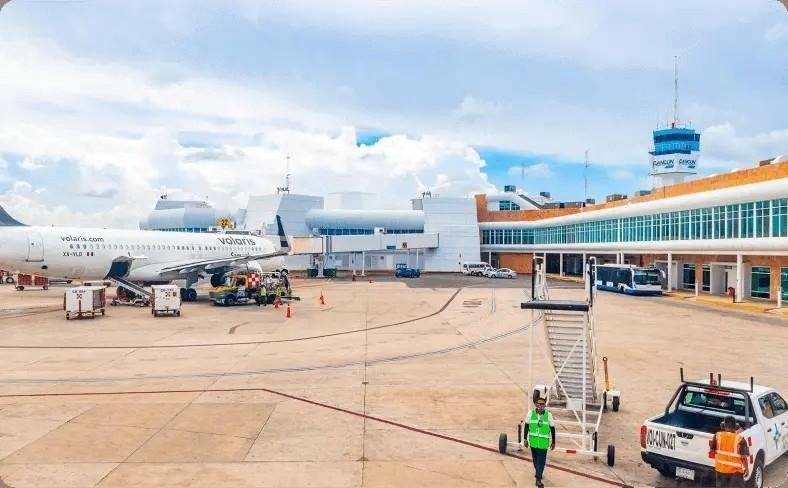
Cancun Airport’s dedicated private aviation terminal keeps charter passengers separated from the main commercial terminal chaos
Your jet touches down at Cancun International Airport. The pilots taxi away from the commercial terminal and head toward a separate building on the north side of the airfield. You’re about to experience what 99% of Cancun visitors never see—the private aviation terminal where immigration takes 10 minutes instead of 90.
The difference between arriving on a commercial flight and landing at Cancun’s FBO (fixed-base operator) isn’t subtle. One puts you in a queue with 300 other passengers fighting for taxi vouchers. The other has you in your resort-bound vehicle before the commercial flight passengers have even reached the immigration hall.
Here’s exactly what happens from wheels-down to hotel check-in when you arrive by private jet.
Cancun Airport Private Aviation Facilities
Cancun International Airport (CUN) maintains dedicated private aviation infrastructure separate from the main passenger terminals. The FBO facilities sit on the airport’s north side, handling all executive and charter aircraft operations.
The main FBO provider at CUN is operated under the airport authority’s private aviation division. The facility includes:
- Dedicated ramp space for 15+ aircraft simultaneously
- Private passenger terminal with climate-controlled lounges
- Customs and immigration offices exclusively for private flights
- Crew facilities including briefing rooms and rest areas
- Ground handling services coordinated with your charter operator
- Secured vehicle access directly to the terminal building
Unlike some airports where “private terminal” means a roped-off corner of the main building, Cancun’s FBO is a physically separate facility. Your aircraft parks at the FBO ramp. You deplane at the FBO. You clear customs at the FBO. You never set foot in the commercial terminal unless you specifically want to.
Multiple aircraft can park simultaneously at Cancun’s FBO ramp—your jet taxis directly to the private terminal after landing
The Arrival Process: Step by Step
The timeline from touchdown to departing the airport in your ground vehicle runs about 20 to 30 minutes under normal conditions. Here’s how it unfolds.
Landing and Taxi (5-8 minutes)
Your pilots land on one of Cancun’s two runways—likely runway 12L/30R, which handles most arrivals. After landing, they exit the runway and taxi toward the north FBO ramp rather than the commercial terminal gates.
The taxi takes slightly longer than at smaller airports because CUN is a busy facility. Your aircraft might hold briefly while other traffic clears, but you’re not sitting in a gate queue for 20 minutes like commercial flights do.
Deplaning (2 minutes)
The aircraft parks on the FBO ramp. The pilots shut down the engines. A ground crew positions stairs at your cabin door—or if you’re in a larger jet with integrated stairs, they deploy automatically.
You walk down the stairs onto the ramp. The FBO terminal building is right there, typically a 30-to-50-foot walk. In good weather, you’re outside for about 45 seconds. If it’s raining, ground crew typically provides umbrellas or the FBO sends a shuttle vehicle to pick you up directly at the aircraft.
Your luggage gets unloaded and brought into the terminal separately. You don’t touch your bags until after you’ve cleared customs.
Immigration and Customs (10-15 minutes)
This is where the FBO experience diverges most dramatically from commercial arrivals.
You enter the FBO terminal and proceed directly to the immigration desk. There’s no queue. The immigration officer is sitting there waiting for you because your aircraft’s arrival was coordinated in advance. If you’re traveling with 6 people, there are 6 people in line—not 300.
Mexico’s immigration process is identical whether you’re commercial or private:
- Present your passport
- Immigration officer stamps it and issues your FMM tourist card (white paper slip)
- Keep that FMM card—you’ll surrender it when departing Mexico
- No visa required for U.S., Canadian, or most European passport holders visiting for tourism
Processing time per person: 2 to 3 minutes. For a family of four, you’re through immigration in 10 minutes total.
After immigration, you proceed to customs. Mexico uses a random inspection system represented by a stoplight button. You press the button. Green means you proceed without inspection. Red means they want to inspect your luggage.
The randomization is genuine—it’s not profiling or suspicion-based. Statistically, most travelers get a green light. If you get red, the inspection is straightforward: customs officers look through your bags, verify you’re not importing prohibited items, and wave you through. This adds maybe 5 minutes.
Total immigration and customs time for a group of 4-6 passengers: 10 to 15 minutes from entering the FBO to clearing customs.
Baggage Collection (3-5 minutes)
Your luggage has been brought from the aircraft to the customs area. After clearing the stoplight system, you collect your bags from the holding area. Unlike commercial terminals with carousel roulette, your bags are sitting right there in a designated space.
Count your pieces, verify nothing’s missing, and you’re ready to exit.
Ground Transport (Immediate)
You walk out of the FBO terminal and your ground transportation is waiting immediately outside. If you arranged a vehicle through your charter operator, it’s there. If you’re renting a car, the rental company either delivers it to the FBO or sends a shuttle to take you to their counter.
There’s no taxi queue. No ride-share uncertainty. No shuttle bus to the rental car lot. Your vehicle is there when you walk out the door.
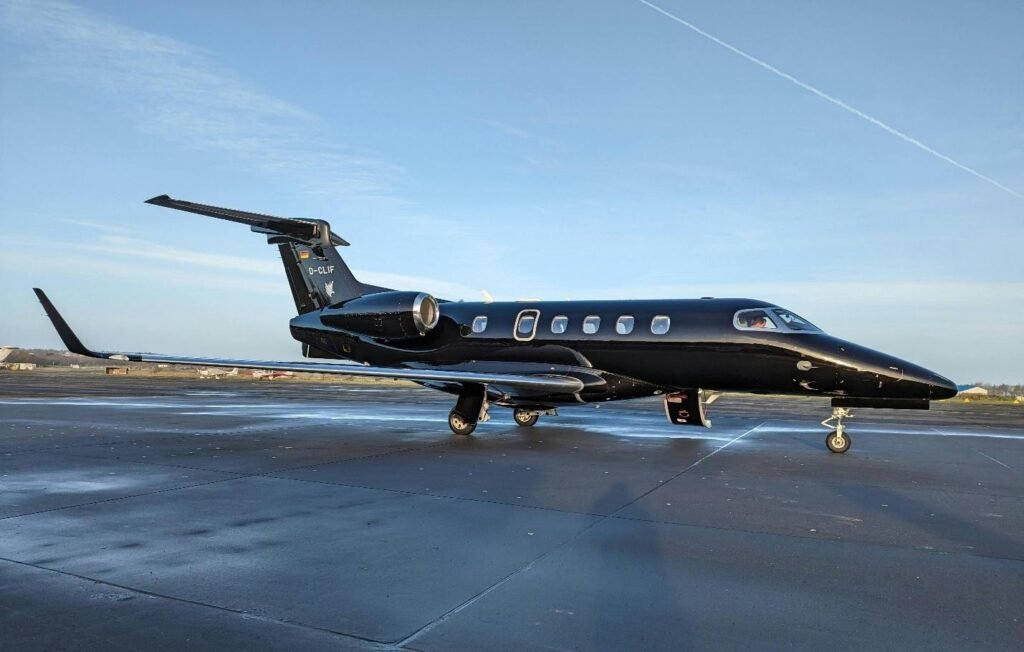
Ground transportation waits directly outside the FBO terminal—no taxi lines or shuttle buses required
Ground Transport Options from the FBO
You have several options for getting from Cancun Airport to your final destination. The choice depends on where you’re staying and what level of service you want.
Private Vehicle Arranged Through Charter Operator
Most charter companies offer to arrange ground transportation as part of your flight package. They coordinate with local luxury transportation providers to have a vehicle waiting when you land.
Typical options:
- Luxury sedan (Mercedes S-Class, BMW 7-Series): 1-3 passengers
- Large SUV (Cadillac Escalade, Suburban): 4-6 passengers
- Sprinter van: 7-10 passengers with luggage
Cost runs $150 to $300 depending on vehicle type and destination. The vehicles are air-conditioned, immaculately maintained, and drivers speak English. You pre-pay through the charter operator, so there’s no cash transaction or confusion about pricing.
The advantage here is seamless coordination. Your charter company knows exactly when you’re landing. The ground transportation provider knows you’re arriving via the FBO. The vehicle is staged and ready.
Hotel Transfer Service
Many high-end Cancun and Riviera Maya resorts offer dedicated transfer services. When you book your stay, request FBO pickup. They’ll send a resort vehicle to collect you at the private terminal.
Resort transfers are often complimentary for suite-level bookings or available for $100 to $200 depending on the property and distance. The quality matches private vehicle service—newer vehicles, professional drivers, cold bottles of water waiting.
Coordination is key. Make sure the resort knows you’re arriving at the FBO, not the main terminal. Confirm your arrival time 24 hours in advance. Have the FBO ground staff call the resort when you land if there’s any timing change.
Rental Car Delivered to FBO
Major rental companies (Hertz, Avis, Enterprise) can deliver vehicles directly to the FBO if you request this when booking. You specify “FBO delivery” and provide your aircraft tail number and estimated arrival time.
A rental company representative meets you at the FBO with the vehicle and paperwork. You sign the contract, get the keys, and drive off. The rental company typically charges $50 to $75 for FBO delivery service on top of the standard rental rate.
This works well if you’re planning to explore beyond your resort or if you’re staying in a villa rather than a hotel. You get the independence of having your own vehicle without the hassle of shuttle buses to off-airport rental lots.
Standard Taxi or Ride-Share
You can take a regular taxi or use ride-share apps from the FBO, but it’s less convenient than the other options. Taxis don’t typically stage at the FBO waiting for passengers the way they do at the main terminal. You’d need to have FBO staff call a taxi for you, which adds 10 to 15 minutes of waiting.
Uber and other ride-share services technically operate at Cancun Airport, but drivers aren’t always familiar with accessing the FBO area. You might have coordination issues getting the driver to the right location.
For the cost savings—maybe $50 less than a pre-arranged private vehicle—the inconvenience and uncertainty usually aren’t worth it when you’ve just paid for a private jet.
Travel Time to Major Destinations
The FBO sits on the north side of Cancun Airport. Here’s what that means for drive times to common destinations:
Cancun Hotel Zone: 15-25 minutes depending on which hotel. The northern Hotel Zone properties (closer to downtown) are 15 minutes. The southern end near Punta Cancun is 25 minutes. Traffic is rarely an issue because you’re not arriving during rush hour—private jets don’t follow commercial airline peak times.
Playa del Carmen: 45-55 minutes via Highway 307. The route is straightforward—south from the airport, then down the coastal highway. Traffic builds up in Playa itself, particularly near Quinta Avenida, but the drive from the airport is generally smooth.
Tulum: 90 minutes to 2 hours. You’re taking Highway 307 south through Playa del Carmen and continuing along the coast. The road is well-maintained. The drive itself is pleasant, though long. Most travelers heading to Tulum consider whether a helicopter transfer from the FBO makes sense—15 minutes in the air versus 2 hours on the road.
Puerto Morelos: 20-25 minutes. This small town sits between Cancun Airport and Playa del Carmen. It’s close enough that ground transport is always the sensible choice.
Mayakoba Resort Area: 35-40 minutes. The high-end resorts in this area (Rosewood, Fairmont, Andaz) are south of Puerto Morelos but north of Playa del Carmen. Easy drive, well-signed exits off Highway 307.
Isla Mujeres: Complicated. You need ground transport from the FBO to one of the ferry terminals (Playa Tortugas, Playa Caracol, or Puerto Juárez), then a ferry to the island. Total time is 45 minutes to 1 hour. Alternatively, you could arrange helicopter transfer directly from the FBO to the island—about 10 minutes flight time if there’s a suitable landing area.
Departure Process from CUN FBO
Leaving Cancun reverses the arrival process, with one additional step.
You arrive at the FBO 60 to 90 minutes before your scheduled departure time. This is longer than the 15 minutes you’d need at most U.S. FBOs because you’re departing Mexico, which requires outbound immigration processing.
Check-in at the FBO desk. They verify your passenger manifest and review your documentation. If you have a lot of luggage, ground crew starts loading it onto the aircraft while you handle immigration.
You proceed to the immigration desk within the FBO. The officer verifies your passport, collects your FMM tourist card (that white slip they gave you on arrival), and stamps you out of Mexico. This takes 5 to 10 minutes per passenger.
After clearing immigration, you wait in the FBO lounge until your aircraft is ready. The lounge has seating, Wi-Fi, restrooms, and usually some light refreshments. It’s comfortable but not extravagant—think business-class airport lounge, not private club.
When the pilots are ready, ground staff escorts you to the aircraft. You board, the pilots complete their checks, and you depart. Total time from arriving at the FBO to wheels-up: 60 to 75 minutes if everything runs smoothly.
FBO Services and Amenities
Cancun’s FBO provides the core services you’d expect, though it’s not as luxurious as FBOs in major U.S. cities.
Passenger Lounge: Climate-controlled waiting area with seating for 30-40 people. Basic refreshments (coffee, water, sometimes snacks). Wi-Fi is available though not always fast. Restrooms are clean and well-maintained.
Crew Facilities: Separate area for pilots with flight planning resources, weather briefing equipment, and rest facilities. If your crew needs to overnight in Cancun between legs, the FBO coordinates hotel transport.
Fueling: Jet-A fuel available on the ramp. Your charter operator pre-arranges fueling as needed. Cancun’s fuel prices run higher than U.S. Gulf Coast prices but are competitive with other Mexican airports.
Catering: The FBO can arrange catering for your outbound flight. If you want fresh food loaded for your return trip, coordinate this with your charter operator 24 to 48 hours in advance. The catering quality is good—certainly better than airline food—but it’s not gourmet restaurant-level unless you specifically pay for premium service.
Aircraft Services: Basic maintenance and cleaning available. If your aircraft needs something beyond routine servicing, Cancun has certified maintenance facilities on the field. Your charter operator handles these arrangements.
Customs for Goods: If you’re bringing items purchased in Mexico back to the U.S. or Canada, you declare them with Mexican customs on departure and then again with your home country’s customs when you land. The FBO staff can help with forms if needed, though most personal shopping doesn’t require special documentation.
Comparing FBO Arrival vs Commercial Terminal
The difference in arrival experience isn’t just about luxury—it’s about time and friction.
Commercial Arrival Timeline:
- Aircraft lands and taxis to gate: 5-10 minutes
- Waiting to deplane after doors open: 5-15 minutes (you’re in the back, everyone ahead of you is grabbing bags)
- Walk to immigration: 10-15 minutes (CUN’s terminal is large)
- Immigration queue: 30-90 minutes depending on how many flights landed simultaneously
- Baggage claim: 15-30 minutes waiting for bags to appear
- Customs (if you get red light): +10 minutes
- Exit terminal and find ground transportation: 10-20 minutes
Total: 85 minutes to 3 hours from touchdown to leaving the airport.
Private FBO Arrival Timeline:
- Aircraft lands and taxis to FBO: 5-8 minutes
- Deplane: 2 minutes
- Walk to FBO terminal: 1 minute
- Immigration: 10 minutes
- Customs: 2-5 minutes
- Collect bags: 3 minutes
- Meet ground transport: 0 minutes (it’s waiting)
Total: 20-30 minutes from touchdown to leaving the airport.
You’re saving an hour minimum, often two hours, by arriving via the FBO. That’s an hour you’re spending at your hotel pool instead of standing in a queue.
Peak Season Considerations
Cancun sees massive swings in visitor volume between peak and off-peak seasons. This affects the FBO experience, though much less than it impacts commercial passengers.
December 20-January 5: Christmas and New Year’s is the busiest period. The FBO handles significantly more traffic than normal. Immigration might take 20 minutes instead of 10 because multiple aircraft arrive within the same window. Parking space on the ramp can be tight—your jet might park slightly farther from the terminal building.
Even during peak season, the FBO experience remains dramatically faster than commercial. Those extra 10 minutes you’re spending still beat the 2-hour immigration queue at the main terminal.
March (Spring Break): The commercial terminal becomes chaos during U.S. spring break weeks. College students, families, everyone descends on Cancun simultaneously. The FBO sees increased traffic but nothing like the commercial terminal. Immigration still runs smoothly.
Summer (June-August): Lower overall volume at CUN. The FBO is quieter. Everything runs faster. If you have flexibility on when to visit Cancun, summer offers the smoothest FBO experience—plus lower charter costs because demand is down.
Special Situations and Considerations
Traveling with Pets: Mexico allows pet entry with proper documentation (health certificate, rabies vaccination). When arriving via private jet, you handle pet customs at the FBO. It’s simpler than commercial pet entry because you’re dealing with one officer who has time to review your paperwork properly. The FBO won’t have quarantine facilities, so make sure your documentation is complete before departure.
Medical Situations: If someone in your party needs medical attention upon arrival, the FBO can coordinate with local medical services. Cancun has excellent private hospitals. An ambulance can access the FBO ramp directly—no need to navigate through the public terminal.
VIP/Celebrity Arrivals: The FBO provides natural privacy. There’s no public access to the ramp or terminal. If someone in your party needs discretion, the FBO facilitates that without special arrangements. Paparazzi can’t access the secure areas.
Large Groups: If you’re arriving with multiple aircraft for a wedding or corporate event, the FBO can process everyone efficiently. They’ll stage multiple immigration officers if needed. Ground transportation for 50 people gets coordinated in advance—it’s all straightforward with proper planning.
What to Bring and Prepare
Documents you need for FBO arrival:
- Valid passport (must be valid for the duration of your stay—no six-month rule for Mexico)
- Return flight information (you may be asked when you’re leaving Mexico)
- Accommodation details (hotel name and address)
- Cash for tips (ground crew, drivers—U.S. dollars are fine)
You don’t need:
- Printed flight confirmations (private charters don’t issue tickets)
- Mexican pesos immediately (hotels, resorts, and ATMs are everywhere once you arrive)
- Special customs forms beyond what’s provided at the FBO
One practical tip: keep your FMM tourist card in your passport from the moment they give it to you. Losing that white slip creates hassles when you’re trying to depart Mexico. Your hotel safe is a good storage spot during your stay.
The Bottom Line on Cancun’s Private Terminal
Cancun Airport’s FBO delivers exactly what you’re paying for when you charter a private jet: efficiency and separation from the commercial airport experience. You’re not getting marble floors and champagne bars—this isn’t Dubai. You’re getting an immigration process that takes 10 minutes instead of 90, baggage that’s waiting for you instead of lost somewhere in the system, and ground transportation that’s ready when you walk out the door.
The 20-to-30-minute airport experience means you’re at your hotel or resort while commercial passengers are still waiting for their bags. That time savings compounds with the flexibility of setting your own departure schedule and the convenience of avoiding the main terminal entirely.
For travelers comparing charter options to commercial first class, the FBO arrival process is one of the clearest differentiators. First class gets you a better seat on the plane. Charter gets you a completely different airport experience on both ends of the flight. For route-specific information and availability, PrivateJetToCancun.com provides detailed FBO coordination for all Cancun arrivals.
The facilities are functional rather than luxurious, but that’s appropriate. You’re not going to Cancun to spend time at the airport. You’re going for the beaches, the resorts, and the Caribbean. The FBO’s job is to get you from your aircraft to your actual destination as quickly and smoothly as possible—and on that measure, it delivers completely.
