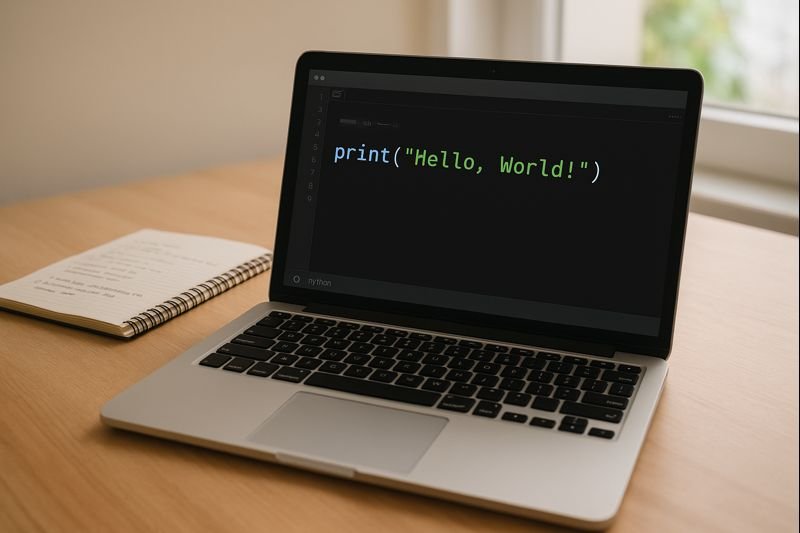
One of the most empowering activities that you can go through in your programming life is learning how to write and execute your first script. It turns coding into a reality, into something you can make, execute and alter and expand on. This guide was created in order to show you how to create your first and simplest program written manually, during your studies of programming, or just because you want to learn more about automation.
This guide includes details on what tools you need, how to write and test your code and how to customize the script to accomplish more advanced tasks. At the conclusion of this paper, you are going to have a functional script that you wrote, and you are going to feel confident, to go on and write others.
What Is a Script? An Easier to Understand Introduction
A script is a little program that is coded in a programming or scripting language that informs a computer on what to do, step-by-step. Scripts are often small and written in simple, lightweight, and interpreted directly by an interpreter, in contrast to large applications which demand heavy compiling.
Examples of common scripts use are:
- Roboticizing routine activity.
- Processing data
- Creating small tools
- Construction of utilities on bigger construction projects.
- Basic programming concepts Learning.
In this guide, we will be using python since:
- It’s beginner-friendly
- It reads almost like English
- It is extensively applied in software development, AI, cybersecurity, automation, and so on.
- It is both Windows- and MacOS-compatible and also Linux- and mobile device-friendly.
Tools: What You Need to Start
To write a script, one does not need to have a lot of extortionate equipment. As a matter of fact, it is all free and simple to install.
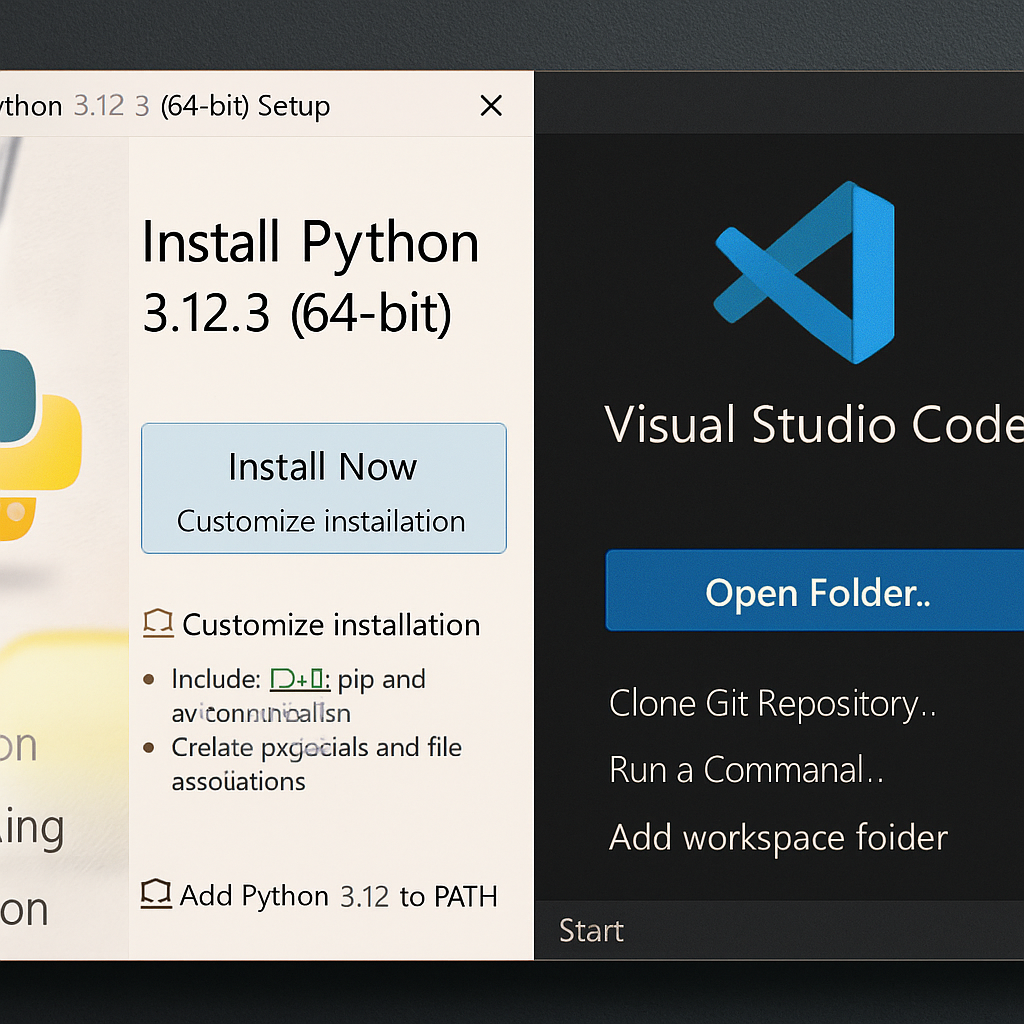
2.1 Install Python
Visit the official website: https://www.python.org/downloads
Update to the most recent version to your operating system.
Important:
When installing on windows, ensure that you also tick the box that states:
Add Python to PATH
This makes sure that your computer will be able to execute Python at the terminal.
2.2 Choose a Code Editor
One can write the script in Notepad, but with an editor which is designed to write the codes, it is much easier.
Recommended options:
- VS Code (most popular among beginners)
- Sublime Text
- Atom
- PyCharm Community Edition
VS Code is the most comprehensive option since it is lightweight and powerful, and easily customisable.
2.3 Open Your Terminal
A place to execute the script is required.
- On windows: Command Prompt or PowerShell
- On Mac: Terminal
- On Linux: Your shell terminal
To verify the installation of Python, run:
python –version
or on some systems:
python3 –version
You ought to see something of the kind:
Python 3.12.0
In case you see that you are prepared to write your first script.
Write Your First Script: An Easy and Easy-to-Follow Script
We need to make an example of a Hello, World! script. It is a traditional first project as it demonstrates the full process of writing, saving, running and modifying code without any complexities.
3.1 Create a New File
Open your code editor and make a new file named:
hello.py
3.2 Write Your First Line of Code
Inside the file, type this:
print(“Hello, World!”)
That’s it!
This single line is what tells Python to print out the text “Hello, World! on the screen.
3.3 Save the File
Press:
- Ctrl + S (Windows/Linux)
- Cmd + S (Mac)
3.4 Run Your Script
Terminate the terminal and go to the folder where you have uploaded the file.
For example, on Windows:
cd C:\Users\YourName\Documents
On Mac/Linux:
cd /Users/YourName/Documents
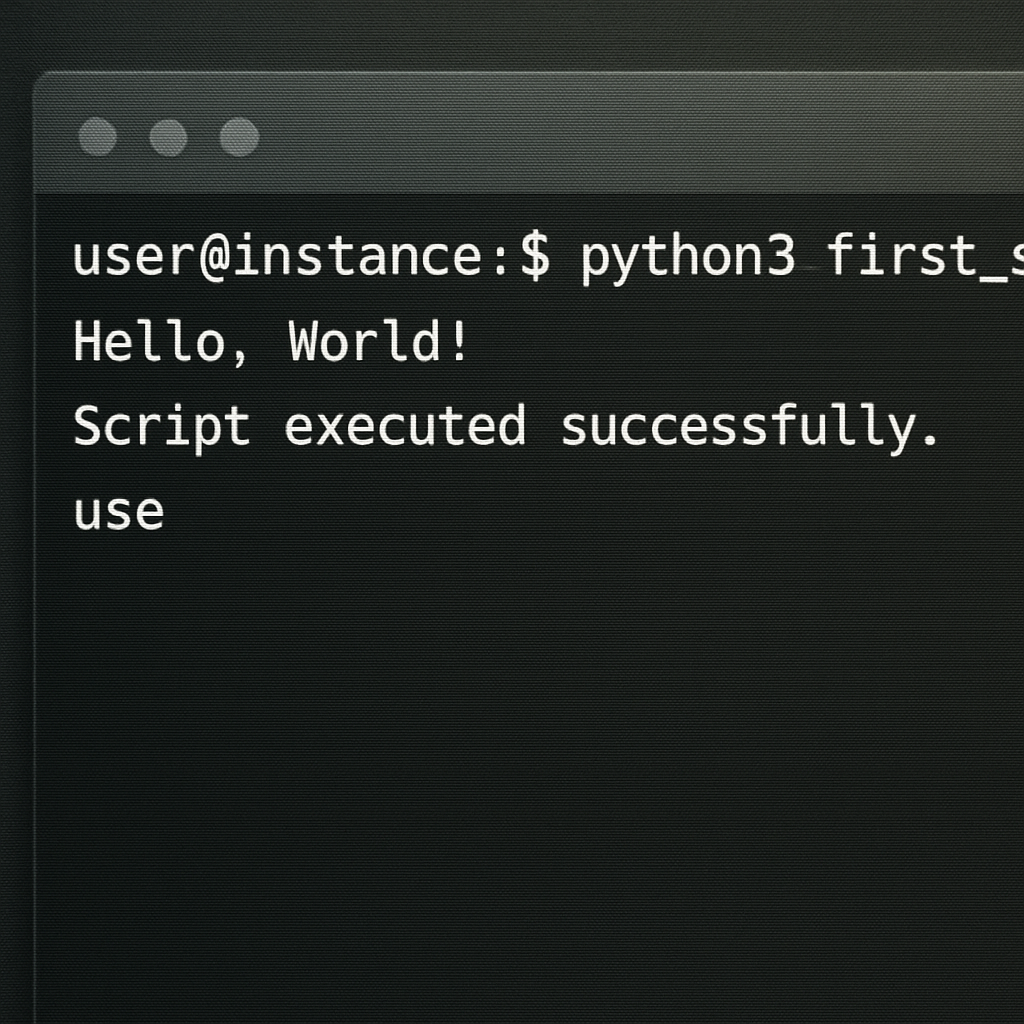
Then run the script using:
python hello.py
or
python3 hello.py
You should see:
Hello, World!
Hurrah–you have actually got your first script on!
Learning the Structure of a Simple Script
The fact that your script functions, then, being to break down the structure of scripts. A proper structure is also useful in maintaining a readable, organized, and later convenient code.
The majority of the scripts have the following order:
- Comments (optional)
- Imports – loads your script.
- Variables – storing data
- Functions – common blocks of code.
- Execution section – where the script is implemented.
The following is a typical python script written in a well-structured form:
# This script welcomes a user using his or her name.
import datetime
def greetuser(name):
currenttime = datetime.datetime.now()
print(f”Hello, {name}! The time is {currenttime:%H:%M:%S}”)
# Execution
greetuser(“Emmanuel”)
Cluttered structure causes your script to be harder to comprehend, particularly when you begin to create more complicated applications.
Creating a Better Script: A Name Greeter
We will improve your code to be interactive.
Create a new file called:
greeter.py
Now add this:
name = input(“What is your name? “)
print(f”Nice to meet you, {name}!”)
How this works:
- input: it waits until the user types something.
- The typed value is put in name.
- A message with an individual address is then printed by the script.
Run it the same way:
python greeter.py
Attempt to put in other names.
You have now created a script which takes user input and is dynamically responsive.
Test Your Script: Ensuring that You Have got it Right
Testing can assist you in making sure that your script will act as required under various situations.
6.1 Test with normal inputs
Example:
What is your name? Emmanuel
Nice to meet you, Emmanuel!
6.2 Test with empty input
If you just press Enter:
Nice to meet you, !
That is a tip that your script should be refined.
Test with unexpected characters
Try:
- Numbers
- Special symbols
- Spaces
There should be no crash of scripts due to unanticipated input. One of the scripting skills is learning to deal with errors.
Enhancing Your Script: Conditions and Validation
We shall make the script more intelligent and user-friendly.
Update your greeter.py:
name = input(“What is your name? “)
if name.strip() == “”:
print(“You didn’t enter a name. Please try again.”)
else:
print(f”Nice to meet you, {name}!”)
Improvements added:
- strip() removes spaces
- We check if the input is empty
The script provides feedback in case the user fails to provide a name.
Your script now supports more realistic scripts.
Further Edits To Make Your Script More Professional
Functions render the code cleaner and maintainable.
Rewrite the script like this:
def getusername():
name = input(“What is your name? “)
return name.strip()
def greet(name):
if name == “”:
print(“You didn’t enter a name.”)
else:
print(f”Nice to meet you, {name}!”)
name = getusername()
greet(name)
Why functions matter:
- More organized code
- Easy to expand later
- Functions can be reused in other scripts.
That is the way real developers write scripts.
Enhancing your Script (Optional Improvements)
When you are comfortable, go ahead and add features:
9.1 Add time-based greetings
Greetings Morning vs evening:
import datetime
hour =datetime.datetime.now.hour
if hour < 12:
print(“Good morning!”)
elif hour < 18:
print(“Good afternoon!”)
else:
print(“Good evening!”)
9.2 Allow repeated use
while True:
name = input(“Please enter your name (to quit type exit): “)
if name.lower() == “exit”:
break
print(f”Hello, {name}!”)
9.3 Save user names to a file
Introduce file handling:
with open(“names.txt”, “a”) as file:
file.write(name + “\n”)
You find yourself, suddenly, creating scripts that can have an interface with the real world.
What to Do When Your Script Goes Dead
What debugging entails is searching and correcting code errors.
Common Error Types
Syntax Error
And you left out a quote or a parenthesis.
Indentation Error
Python needs regular indentation.
Name Error
Employing a variable without defining it.
How to fix errors
- Find out the error message gradually.
- Check line number indicated.
- Look for missing symbols
- Print values so that we can know what is going on.
Example:
print(“Debugging value:”, name)
The greater the number of mistakes that you rectify, the better you are at scripting.
How to Change Your Script to suit New Features
You can modify your script to:
- Some greetings are to be translated.
- Record log into text files.
- Add menu options
- Turn it into a small chatbot
- Connect it with APIs
- Apply color through external libraries.
Every enhancement makes you stronger and more confident.
Writing Better Scripts Advice
The following are some developer principles to expand your scripting skills:
- Keep your files organized
- Use clear variable names
- Break functions into scripts.
- Write up comments describing sections.
- Test frequently as you code
- Bigger with a little.
- There is no cause to be afraid of mistakes because they are learning opportunities.
Good scripts do not exist concerning perfection, but clarity and purpose.
Concluding Statement: You have just written your first script!
Assuming that you did this guide step-by-step, you now have:
- Installed your tools
- Written your first script
- Run it successfully
- Improved it
- Learned to structure code
- Wrote and tested your work.
- Added new features to it.
That is a big achievement to an amateur.
Scripting is not a technical ability, but a creative one. All the scripts you write are solutions to a problem or bringing an idea to life. The practice will eventually allow you to automate and develop utilities, and later develop entire applications.
I will be glad to mentor you whenever you are willing to develop more sophisticated projects: automation tools, data processors, or even basic games.