Introduction
Running a business budget is not merely about simply creating a financial forecast at the start of an accounting duration and counting on that the outcomes will be similar to what was forecasted. No matter how well you plan, there will be some differences between what your business expects to spend/earn and what it actually does. The disparities can offer valuable insights into the financial status of a business, its operational efficiency, pricing strategies, customer demand, and cost management. This is where budget variance analysis is a must have management tool. The comparison of budgeted amounts and actual amounts will guide the manager and owner to find where the performance is not as expected as compared to the budgeted amount, investigate the cause of the differences and take corrective action before a small financial problem becomes a big financial problem. Variance analysis is thus a valuable tool which enables business to manage costs, ensure profitability, make better business decisions and be financially well equipped for the future.
What is it Budget Variance Analysis?
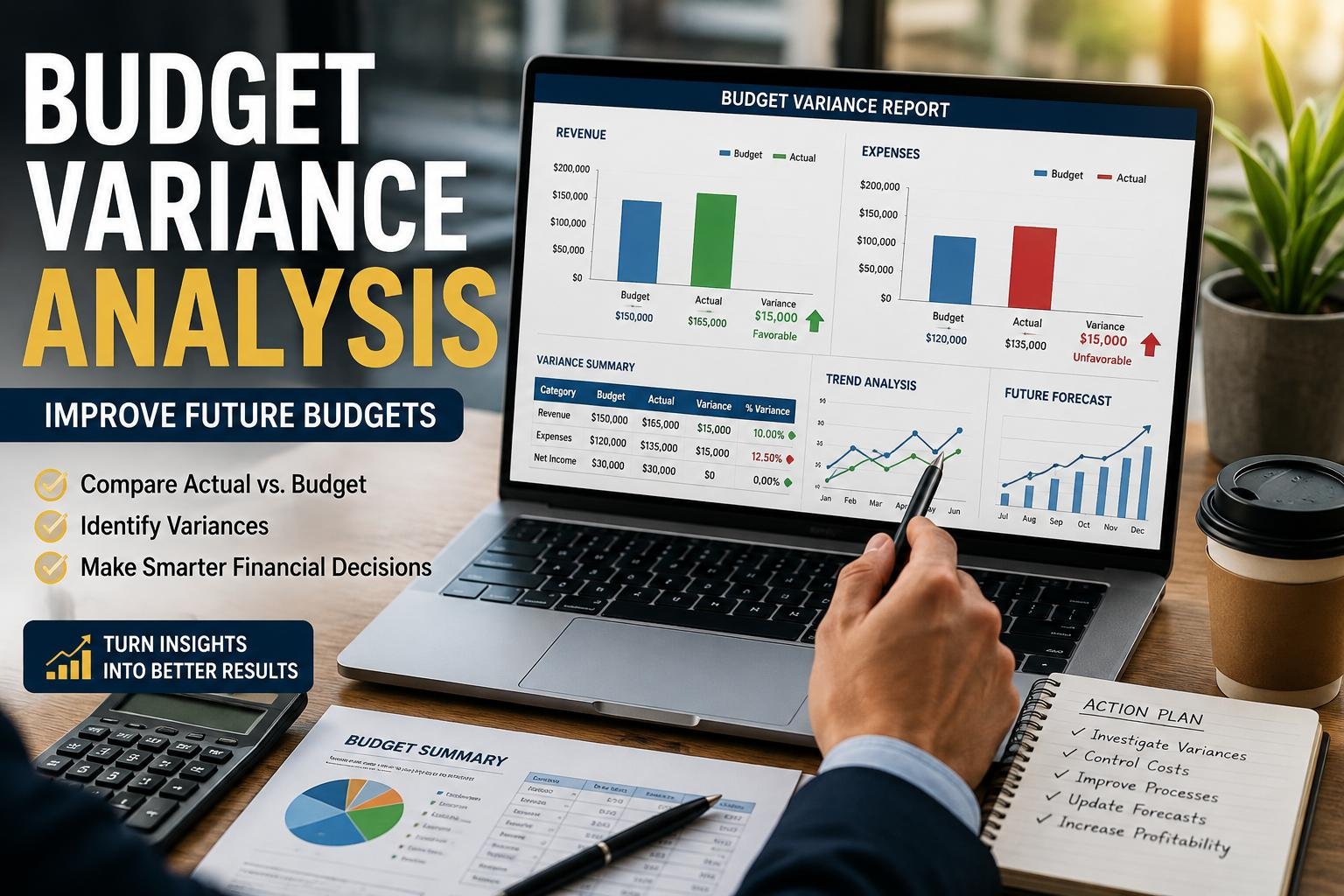
The Budget variance analysis is the comparison of the budgeted financial results and the actual results of an enterprise during a certain period. Typically, a budget will include revenue projections, operating expenses, payroll, production costs, marketing spend, purchasing, cash flow and other financial activities. At the end of the period, the actual performance is contrasted to the expectations. The variance is the difference between the budgeted and actual amounts. For instance, the business spent $23,000 on marketing when expected to spend $20,000, thus having an unfavorable expense variance of $3,000. However, if the business’ budget was set at $20,000 but only spent $18,000 and kept its performance level as expected, the business had a positive expense variance of $2,000. The reasons for the differences are not only to be found but understood, and management should decide if there is a need for action.
If a business is looking for a deeper understanding of budget variance analysis, there is a framework that allows them to compare planned and actual financial performance. If a business requires a more detailed explanation of the concept, budget variance analysis is a useful framework that allows them to compare their expected and actual financial performance. It is especially beneficial for the process, as a variance alone is not necessarily reflective of the business’s performance. If it has been caused by unnecessary spending, it may be bad, but if the firm has spent more on advertising and has obtained a lot more sales as a result, it may be justified. In the same way, when revenues are under budget, it could mean that there is a low demand for the product but could also be the result of a strategic decision to stop selling an unprofitable product. Thus, a well-executed variance analysis is more than just a numbers game; it’s about understanding the financial narrative behind the numbers.
Importance of Budget Variance Analysis
An important value of budget variance analysis is that it provides the management with an early warning system in case of financial issues. If the company does not make regular budget-actual comparisons, it could be spending more than its budget for a number of months without realizing that its costs are becoming excessive. An analysis of the variance report on a monthly basis may show that the utility bill is always higher than budgeted, that payroll is always higher than the budgeted amount, too much inventory is being purchased, or that a specific department is always overspending a certain amount. If these trends are detected early, managers have a chance to examine and respond to the trend before the impact is significant. Variance analysis also allows businesses to identify whether the events are one-off or recurring issues, so that management can prioritize their efforts on issues that are likely to impact long-term profitability and financial stability.
Budget variance analysis also allows departments and managers to have measurable financial goals, which allows for increased accountability through the entire organization. If a department is provided with a salary budget, for supplies, for marketing, for travel, or for other costs, then it’s possible that later on they can review the results of their performance and compare them to what they had budgeted for. This is not to say that managers are to be blamed if a variance does arise. Instead, it’s possible to have sensible discussions about how resources are used and business performance. Managers will be able to tell whether the expense was up or down from what was expected, if that was a controllable expense, whether the original budget was reasonable for the services provided, etc. These conversations can help management in the future when planning out budgets, as they shall have a better understanding of actual operating costs, seasonal trends, when customers are buying, and what resources are needed to get any objectives accomplished.
How to Calculate Budget Variance.
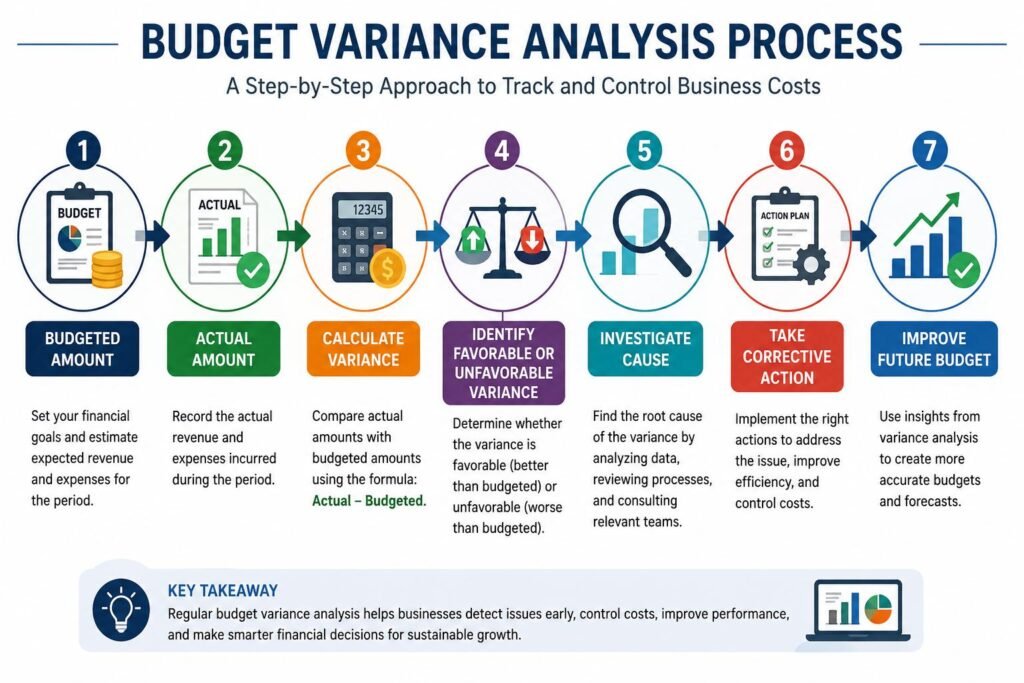
Understanding the basic calculations used to compute budget variance is pretty simple. The business makes a comparison between the actual financial outcome and the amount that was budgeted. One of the more popular formulas is:
Budget Variance= Actual Result – Budgeted Result.
But the interpretation of the result will vary depending on whether it is a revenue or expense. An actual amount that is over the budget is generally good for revenue as it is a greater amount than expected, which means this company made more money than they budgeted for. A real number of revenues is usually negative as it means that the company did not earn as much as it was budgeted. The interpretation is typically the opposite for expenses. It’s a good thing if you spend less than the budgeted amount and worse if you spend more than the budgeted amount. The variance can also be expressed as a percentage, allowing businesses to gain a better grasp of how large the deviation is from the original budget. Variance Percentage may be determined by using the formula (Actual Result – Budgeted Result) / Budgeted Result x 100. This percentage allows the comparison of variances at different sizes of categories.
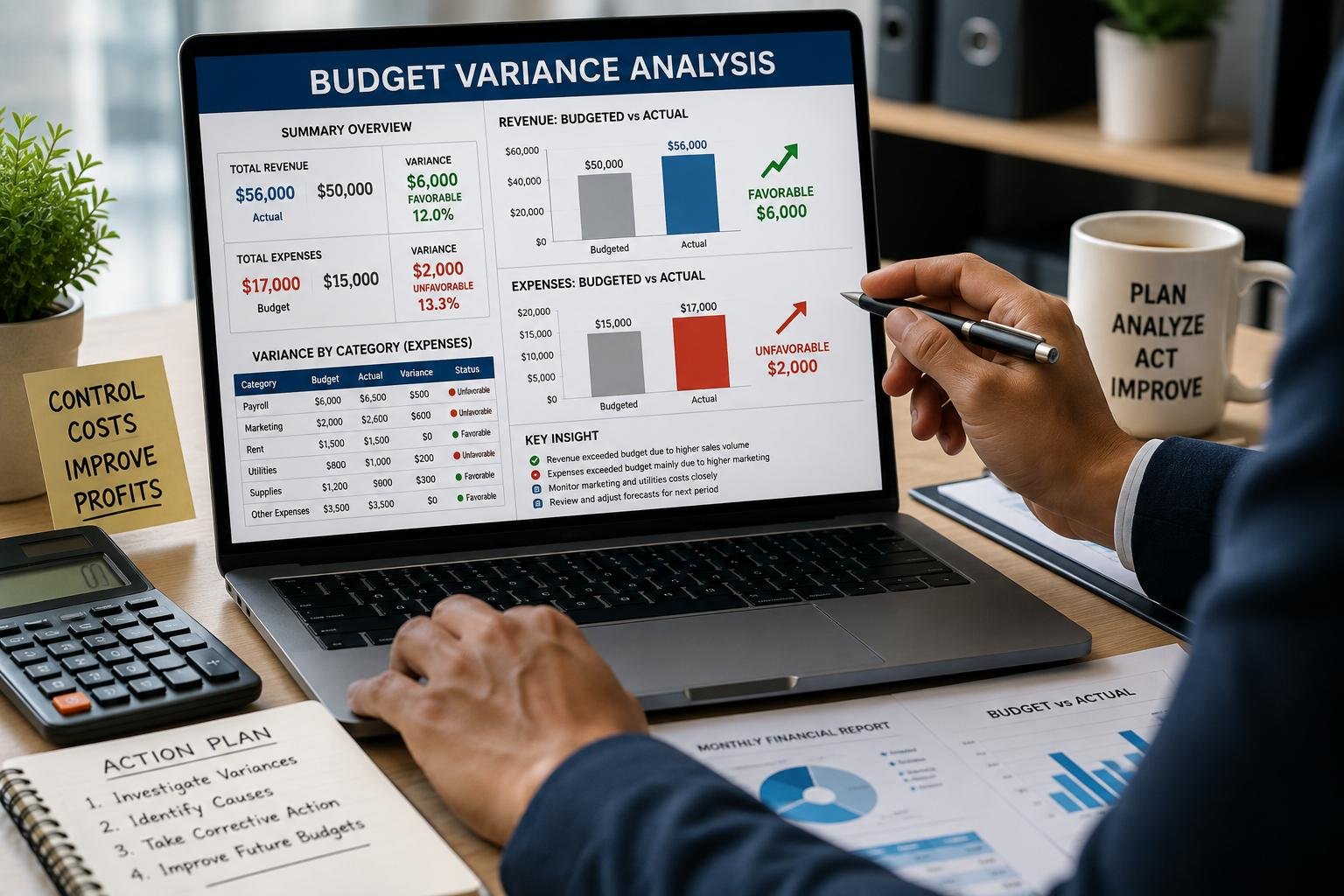
A business plans to make $50,000 in sales for a month, but actually sells $56,000 for the month. The variance is $6,000 favorable since the actual revenue is higher than the budgeted revenue. The percentage difference is 12% which represents the revenue being 12% more than the budgeted revenue. If the company planned for expenses of $15,000, but its expenses ended up being $17,000, then the budgeted operating expenses are $2,000 short of what the company actually spent. The variance is $2,000 unfavorable as the company incurred more expenses than was budgeted. The percentage deviation is about 13.3% from the actual amount of expenses. These calculations can be helpful as they reveal the level of deviation as well as the relative size of the deviation. Management can then judge if the variance is important and what it means; whether it is a temporary event, an operational problem or a change that should be planned for into the future’s budget.
Variance between the Expected and Actual Results
A variance is favorable when actual activity exceeds the budgeted expected activity, depending on the type of financial measure that is being studied. A favorable variance is when actual revenue is greater than budgeted revenue for revenue. A variance in the expenses that is favorable would be when the actual expenses are lower than the budgeted expenses, but in a way that doesn’t negatively impact operations or quality. For instance, if a business planned on purchasing $30,000 worth of office supplies and ended up spending $25,000, the $5,000 difference would be considered normal and favorable. Likewise, if sales were forecasted at $100,000 and actual sales totaled $115,000, the difference in sales revenue ($15,000) would be favorable. The favorable variances may be due to increased sales, better cost control, better purchase terms, better productivity or some other positive events, but management should still investigate them because not all favorable variances are necessarily good news.
When actual results are not as good as what was expected in the budget, it’s an unfavorable variance. Revenue in this context means the revenue is less than expected and expenses in this context means that the expenses are greater than the budget. For example, a business with $80,000 in sales each month, but only $70,000, would have a negative $10,000 sales variance each month. An unfavorable expense variance occurs when it spends more than its budget allowed. If it has a $3,000 unfavorable expense variance, it will have actually spent $15,000 when the budgeted amount was $12,000. Favorable and unfavorable variances can occur due to a variety of reasons such as drop in demand, increase in supplier rates, less efficient processes, unforeseen repairs, substandard purchasing choices, overtime, incorrect forecasting, or inflation. What’s essential is that a negative variance does not equal bad management. There are some costs that you simply can’t avoid, but there are others that show you a problem that you must handle.
Typical Causes of Budget Variances
An example of the reasons that budgets vary is inaccurate forecasting. Assumptions regarding future sales, costs, customer demand, supplier prices, staffing needs and other business conditions are the basis for a budget. But, if those assumptions are not feasible, actual performance may vary from the plan. A company may anticipate high sales due to high consumer demand in the past, but have lower sales due to shifting consumer tastes and preferences or more competition. Likewise, during the annual budgeting process, management may underestimate inflation or price changes by suppliers. However, in these cases, the variation that arises is not a sign of lack of employee cost control. Rather, it could be a sign of either overly optimistic assumptions or changes in circumstances since the budget was approved. Therefore, it’s important for businesses to periodically revisit the assumptions behind their forecasts, and not assume that these are always correct.
Variances can also be found due to fluctuations in sales volume. There are numerous costs that may be affected by the number of products sold or services provided in a business. If sales go up when they are not anticipated, then a firm might have to buy more supplies, hire temporary workers, cover for higher shipping expenses, or raise production expenses. The increase in expenses above the original budget may be detrimental in the first few years, but if the increased expenses resulted from higher than expected revenues, this may be acceptable. Conversely, if sales decrease, it can result in a favorable variable-cost variance as well as an unfavorable revenue variance due to the reduced level of sales. This is an example of why managers should not study one variance at a time. All revenue, expenses, production volume and profitability should be taken into account to determine if a financial deviation is a true issue.
Other common causes of variances are unexpected operating costs. Unexpected equipment failure, emergency repairs, legal fees, technology issues, property damage, unexpected insurance rate hikes or other expenses can be a burden on businesses. These costs have the potential to result in over spend on normal operations even if normal operations are efficient. Management needs to differentiate between these one-time costs and recurring costs as these will need to be handled differently from the actions that need to be taken to correct the situation. An equipment repair may be in need of a contingency reserve or maintenance program, and excessive spending on supplies may be a need for a purchasing review. Whereas, sorting variances into their root causes means businesses can make more informed decisions on areas that don’t directly cause financial issues and go about them without making unnecessary cost reductions.
Substantial differences can also be expected in the prices. A business might budget for raw materials, transportation, rent, utilities, software subscriptions, or any other input based on the price at the time it does the budgeting. In some cases, the company may have bought the necessary quantities, but the cost could ultimately be higher than budgeted because suppliers may be raising their prices throughout the year. Businesses that import goods or service in foreign currencies can have similar issues with exchange-rate fluctuations. Under such conditions, there is a need for management to renegotiate supplier contracts, to find alternative suppliers, to revise the price, to minimize waste or to modify the financial forecast. Through regular variance analysis these price pressures can be made visible, rather than hidden as a part of the total expenses.
Types of Budget Variances that Business should monitor
One of the most important measures is revenue variance because it indicates whether or not actual revenue is at or above expectations. Comparing the actual sales with the budgeted sales and further exploring why the difference has occurred is then possible. A shortfall in revenues may be due to decreased sales, price reductions, cancellations, seasonal fluctuations, more competition, and faulty sales predictions. A Positive Revenue Variance may be due to increased customer demand, marketing success, increased prices, new customers or better sales performance. If data is available, these revenue differences should ideally be broken down by product, service, customer group, region, sales channel and/or salesperson. This detailed reporting enables management to determine the growth’s happening in and what areas they need to focus on to improve performance which they wouldn’t be able to do with just one figure.
Expense variance analysis is concerned with the differences between the planned and actual expenditure. Expenses can be filtered to a business by category, department, project or cost center. Examples of expenses are payroll, rent, utilities, inventory, marketing, transportation, technology, insurance, professional services, and administrative expenses. The detailed expense analysis can assist managers in determining which the areas where the costs are always exceeded are. But, every negative variance doesn’t need to be something that reduces cost. If necessary costs are cut too drastically, the quality of the products may be compromised, employee productivity may be lowered, the satisfaction of customers may be decreased, or revenue may be lost. The aim is to see if expenditure is worth the business and if there is a more efficient way of getting the equivalent business value.
Profit variance is used to combine revenue and expenses to provide a summary view of financial variances on profitability. With a good revenue variance, a company may have an unfavorable profit variance if its costs go up even faster. Likewise, profits could be at about the same level when revenues are down but management has been able to lower variable costs. Profit variance is therefore useful as it gives a wider picture of the financial performance. Managers need to review if they are collectively getting closer or further away to achieving the profitability goals of their business; revenue, cost, gross margin, operating expenses and other financial information. This helps management to not put too much emphasis on one item of expenditure, whilst ignoring its impact on the performance of the business as a whole.
How to Investigate the Causes of Variances
Once a significant variance is identified the next step is to find out what caused the variance. It is good practice for managers to start by questioning if the difference is real, material and regular. These apparent differences may be due to a number of issues, such as differences in accounting periods, mis-classifications, delayed invoices, data entry errors or transactions occurring in a period other than that expected. If all these possibilities are ruled out, then there are operational causes which management can explore. This can include checking of invoices, purchase orders, sales, payroll, inventory, production, customer and departmental explanations. Direct communication with employees responsible for the activities under concern can also be useful in obtaining information as frontline employees may be knowledgeable about operational problems which may not be apparent from financial statements.
It is also important for businesses to identify the variances that they can control and those that they cannot. Overtime, purchasing decisions, discretionary travel or some administrative expenses might be within the control of a department manager, while other costs such as inflation, government costs, exchange rates, and sudden supplier cost changes may not be. This is significant as it means that the manager won’t be blamed for something they can’t control, and they will be encouraged to concentrate on what they can do to improve. A good variance investigation should be able to answer some of the following questions: What has changed? Why did it change? Is the change anticipated? Was it controllable? Would it likely happen again? How will it impact its finances? What should management do (if something)? These questions make it more than a mere accounting exercise and make variance analysis process a practical management process.
Corrective Actions for Unfavorable Variances
If the variance is due to the unnecessary expenditure, then the management might need to take corrective measures. Examples could be renegotiating supplier contracts, cutting waste, increasing purchasing controls, staffing review, eliminating superfluous subscriptions, tighten up expense authorization or stock management. But corrective action should be taken based on the root cause of the variance and not assumptions. For instance, if there are increasing material costs due to employees wasting materials, this could be a problem that could be solved by increasing production controls. However, if the increase in material cost is due to an increase in price from the supplier, then it will not be enough to reduce waste. Alternatively, the management may renegotiate or find alternative suppliers. Therefore, effective corrective action will be targeted, measurable, and directly related to the cause of the variance.
Unfavorable variances that are revenue related need a different method of approach. When sales are not on budget, management might have to review the pricing, demand for the product, customer retention, marketing, conversion rates, and/or market competitiveness. Possible solutions might include enhancing the selling skills of the sales force, modifying prices, launching a new promotion, improving the service of the sales force, revising the product line, or seeking new customers. But companies need to refrain from taking hasty decisions based on poor sales numbers for one month. If there is a temporary drop due to a special circumstance or seasonality, it may be unwise to make a significant change in strategy. A comparison of several periods and a comparison to the past may be useful in determining if the difference is temporary or indicative of a trend.
Use Variance Analysis to Enhance Future Budgets
The work of budget variance analysis should not be completed at the end of the current month, when management provides an explanation for the current month’s results. It is one of its best features that it is used to provide information to enhance future budgets. If in the future utilities actually are higher than the initial estimates, the future budgets should be adjusted accordingly. If the sales always overestimate, the business management could need to rethink its income model. There is the possibility of a budget change for the budgeted department if it is found that it is always spending less than its allotment and not affecting the performance. Variances repeated over time can indicate problems in the budgeting planning process, and serve as a measure of the effectiveness of forecasting. With time, the historical variance data will enable businesses to make more precise assumptions for future costs, demand, staffing, pricing and seasonal changes.
This process can also allow for rolling forecasts which means that financial predictions are forecasted on a more regular basis rather than the entire year. A business could have an annual budget, but revise its forecasting on a monthly or quarterly basis as it finds out which is the best based on actual results and circumstances. A good example of this is that, if sales are well short of the forecast in the first quarter, then management can adjust the forecast for the rest of the year instead of sticking to unrealistic expectations. Traditional budgeting and frequent variance analysis and rolling forecasts provide management with a more up to date perspective of expected financial performance. This is especially useful when there is a high volatility in the business sector, such as customer demand, cost, technology, and/or market conditions.
Best Practices for Effective Budget Variance Analysis course.
It is essential that a timeline for budget variance analysis be set for a business. For many organizations, monthly analysis will be enough, but for organizations with high number of transactions, close cash margins or volatile situations, weekly monitoring of important financial indicators might be beneficial. Management should also set thresholds for materiality so that employees are not wasting too much time looking into meaningless differences. For instance, if a company sets a limit of more than a certain percentage or money, then it needs to be explained. The threshold level will vary according to the size and the type of organization. The key to it is consistency. If variance reporting is done regularly, on quality data, then management can pick up trends a lot easier when compared to reviewing financial performance only occasionally.
Another best practice to consider is integrating financial data with operational data. Financial statements can provide managers with information about the actual cost of labor being incurred, but operational information can give an explanation as to why the cost of labor is higher, such as increased production levels or overtime due to staffing shortages. Likewise, managers can review customer acquisition information, campaign performance, website traffic, and sales conversions to gain insight into the unfavorable marketing variance. It is important to see the financial numbers in the context of the operations, and to avoid drawing false conclusions. Businesses need to also ensure that the results are clearly translated to the various participants in the performance. Managers who understand the importance of variances and know how their actions can influence financial outcomes are more likely to take ownership of cost control and help to improve financial outcomes.
Conclusion
Budget variance analysis is a key financial management tool that is used to monitor measure and explain the difference between forecasted and actual performance of a business. Managers can use favorable and unfavorable variance calculations to determine revenue shortfalls, unexpected expenses, inefficient processes, changing market conditions and weaknesses in the market. The most important part of the process is that it allows businesses to take action before bad trends develop into significant financial issues. Variance analysis needs to involve more than computing the difference between a pair of numbers. It’s important for managers to understand the root causes; identify which problems can be controlled and which are external; examine the relationship between revenues and costs; and decide if appropriate action should be taken.
If done regularly, variance analysis can be a good reinforcement to cost control, enhance accountability, aid in better budgeting and assist companies to safeguard their profits. Variances can help identify if a successful approach was used that should be replicated and areas that need investigation and improvement that resulted in an unfavorable variance. The information from every reporting period should also be utilized to improve the next reporting period’s budgets and forecasts. The end aim is not to eradicate all the variations as the business environment will undergo changes at all times. The aim is to grasp those changes rapidly, respond appropriately and to maintain the consistency of financial decisions with the operational and profitability aims of the organization.
Get more well researched information about Budget Variance Analysis here.