Introduction
Nursing is a career that is based on trust, love and expertise. To provide safe and effective care, nurses have to integrate theory and practice. This traditionally was accomplished by classroom education with clinical placements in hospitals, clinics and community health centers. Nevertheless, virtual training has emerged as an eminent aspect of nursing education with the advent of modern technology and increased need of healthcare professionals.
Online simulation, online courses and interactive digital world have provided new avenues of the practiced technical skills of students, which include making of decisions and also, critical thinking. The tools provide safe learning environments, reduce patient risks, and present students with clinical situations in a standardised way. However, there is one significant question, will virtual training be sufficient to equip nurses with the realities of providing care to a real patient?
This paper discusses the possibilities and constraints of virtual training in eliminating the classroom-to-clinic gap. It dives into the role of digitalised tools in the skill acquisition, and their weaknesses, and ways of combining them with practical training in order to leave nurses prepared to the uncertainty of patient care.
The Important of Real World Clinical Competence
Care of a patient is a complicated task, and it is not only technical but also communicative, emphatic, and flexible. Depending on the shift, a nurse might have to provide medications, console nervous families, identify minor shifts in patient conditions, and address the emergencies.
Such environments cannot be handled by mere textbook knowledge. It needs to be intuitive (learned by working with actual patients), collaborative during a crisis, and comfortable to handle uncertainty. This is why clinical placements were always regarded as incomparable.
There is, however, no assurance that quality clinical experiences would be accessible in all cases. The increasing number of students, the lack of hospital placements, and security issues among patients has become challenging. The virtual training provides the answer, but whether it is entirely realistic on the learning aspect, or not yet remains the issue of discussion.
The Role of Virtual Training in Nursing Education
Simulations for Skill Development
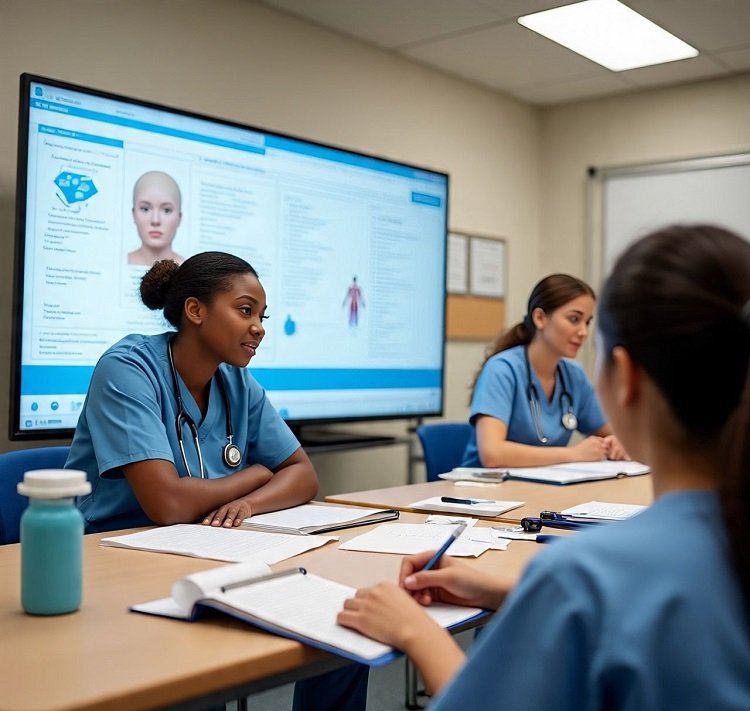
Simulation based learning refers to computer software, manikin or VR where clinical scenarios are simulated. These tools will allow students to be trained to carry out tasks like administering medicine, wound care or CPR under safe and controlled conditions. Errors are treated as learning opportunities instead of potential hazards to patient safety.
Standardization of Learning
Standardization is one of the largest benefits of a virtual training. In practice placements, students will have different experiences, and some will experience several cardiac arrests, whereas others will not experience one. Online classes also make sure that each student is subjected to critical situations so that they develop confidence in the uncommon but high-pressure situations.
Accessibility and Flexibility
Environment Virtual education is cheaper especially to the students in rural or underprivileged schools. They can also be repeated and learnt at a specific pace that provides the student with the opportunity to go through a complex subject matter until they have mastered it.
Where Virtual Training Excels
Reducing Errors
Virtual environments are also beneficial because they permit repetition of practice and such practices help to minimize frequent nursing errors like medication errors or failure to wash hands. It has been found that learners training in digital simulations commit fewer mistakes during the transition to clinical practice.
Building Confidence Through Repetition
Many students are afraid to make mistakes, which is a significant obstacle to learning. Through virtual training, this fear is eliminated and people have a chance to practice the procedure until they feel comfortable.
Supporting Technological Competence
As telehealth and online records become more common, and the use of AI technologies in healthcare emerges, nurses must be comfortable with technology. Online training also introduces students to the digital world, which is an aspect of contemporary health care systems.
Where Virtual Training Falls Short
Lack of Human Interaction
Nursing is a highly interpersonal occupation. Online patients can mimic symptoms, but not feelings, cultural and non-verbal nuances of real people. This constrains the interpersonal preparation of students in care.
Limited Tactile Feedback
Tactile sense is needed in skills such as dressing wounds, inserting catheters or intravenous pipes. However, although simulations inform on the phases of the process, this is not yet in a position to offer the sense of the patient skin or tissue resistance.
Overconfidence Without Real Work Context
A small number of students experience high confidence in simulations and fail to carry it over to live clinical settings. The simulated confidence can be shattered when subjected to real life patient care, which cannot be predicted without exposure to the hands-on component.
Perspectives of Nursing Students and Practicing Nurses
Student Views
Most students appreciate virtual training due to its safety, flexibility, and the possibility of repetition. Simulations usually make them more ready to handle technical jobs. Unknown is whether these skills will be transferred to the clinical setting.
Practicing Nurse Views
Mentors and supervisors often value virtual trainee students who come with a better theoretical background. However, they warn that confidence and competence can only be tested when dealing with a real patient. Nurse practitioners stress that only in the field can one learn to be emphatic, work as a team, and be flexible.
The Case for Blended Learning
The answer is not to either opt for virtual training or real-world training but to combine both. The best of both is a mixed model:
- Virtual Training: Gives open detailed procedures to students also introducing reinforced theoretical Knowledge and give safe and secured spaces for error correction.
- Clinical Placements: present the students with the uncertainty, interpersonal aspect and relationality of care.
Through a mix of these strategies, nurses receive sufficient education that makes them not only technically qualified as professionals in their field but also emotionally ready to practice.
Future Directions in Bridging the Gap
Artificial Intelligence and Adaptive Learning
The customization of the training can be carried out with the help of smart technologies, and the analysis of the performance helps to identify the weaknesses and provide personal exercises. This will see students attain competency prior to joining clinical placements.
Augmented Reality for Hybrid Practice
AR is employed to superimpose computerized instructions on physical activities, including IV insertion or wound care. This fills the simulation/tactile experience gap.
Virtual Patients with Emotional Depth
New technologies are creating virtual patients that are able to respond realistically to emotions and culture. Although these tools are not an alternative to real human beings, they are bringing closer to simulating the relationship facet of nursing.
Expanding Telehealth Training
Since telehealth is an element of care delivery today, online classes can teach the students the features of digital communication, online documentation, and remote monitoring of patients, which will become part of the practice in the future.
Challenges in Implementation
Technology Gaps
Not all students are able to purchase a decent device and a reliable internet connection. The digital divide must be addressed in a manner that the preparation is equitable.
Faculty Readiness
Teachers should be prepared to use virtual tools. Mistrust or suspicion of the members of the faculty can influence the perception and trust of the student of digital learning.
Accreditation Standards
The regulatory authorities should establish specifications related to counting of virtual training hours in competency. Lack of standardization can lead to a lack of confidence in any digitally trained graduate.
Conclusion
Whether virtual training could equip nurses with all the values that they needed in the real-life patient care does not have a straight-forward answer. The virtual tools play a significant role in developing technical competence, reducing and standardizing exposures to critical situations. They are also accessible, safe and repeatable. They, however, do not match up with the human, physical and unpredictable aspects of nursing practice.
The future of the blended learning is that the virtual training will not be replacing the clinical placements, but augmenting them. Integrating the veracity and safety of simulation with personal and emotional aspects of practice in the real world, nursing education can produce a competent graduate who is sensitive and adaptable as well.
Herein, the key to classroom-clinic integration is the key to the classroom-clinic bridge – a bridge that would make sure that nurses are fully equipped to the challenges and responsibilities of patient care in the 21st century.