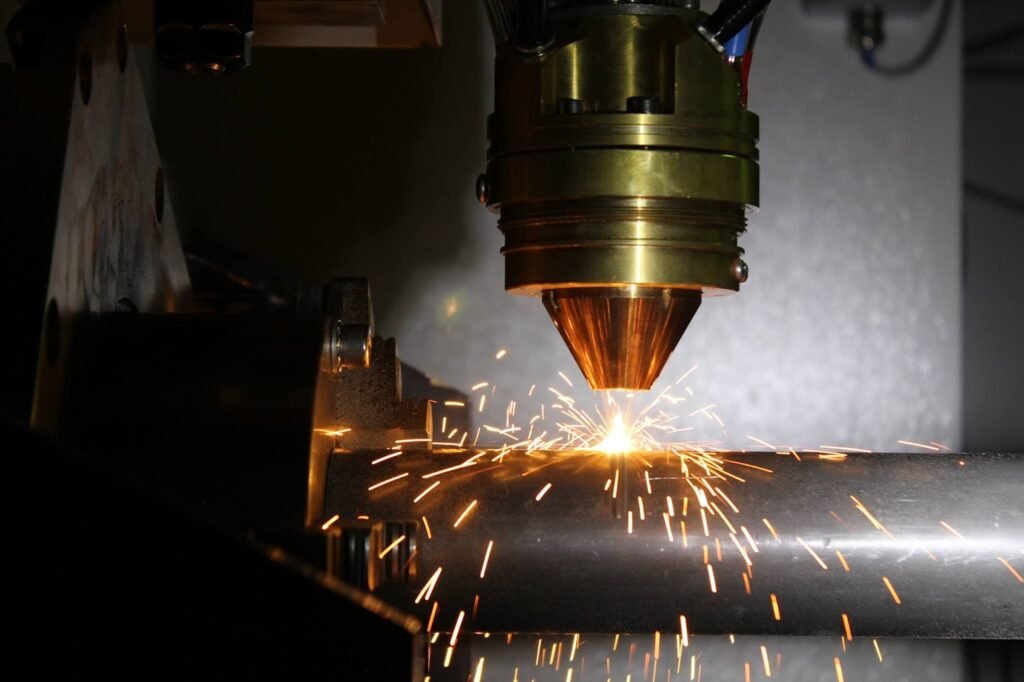
The industrial landscape is undergoing a silent, yet seismic, shift. For decades, subtractive manufacturing—milling, turning, and grinding—defined the limits of what was possible. If you wanted a complex metal part, you started with a massive block and removed everything that didn’t look like your design. Today, that paradigm is being challenged by the rapid maturation of additive manufacturing, specifically through the lens of directed energy deposition (DED).
As engineers and manufacturers push to reduce lead times, minimize material waste, and increase design freedom, DED-based manufacturing has emerged as the frontrunner for high-stakes, large-scale industrial applications.
Understanding the Directed Energy Deposition Landscape
At its core, directed energy deposition is an additive manufacturing process that delivers material—typically metal powder or wire—directly into a melt pool created by a high-intensity energy source. This source, whether a laser, electron beam, or plasma arc, allows for the precise, layer-by-layer creation of 3D geometries.
Unlike powder-bed fusion, which is often limited by build chamber size and the need for expensive support structures, the energy-based deposition process is uniquely flexible. It allows for “open-architecture” manufacturing, meaning you can deposit material onto existing, complex parts. This is why DED has become the preferred choice for industrial repair and feature enhancement in sectors like aerospace, defense, and oil and gas.
The Technological Edge: Why DED Systems Matter
The rise of advanced directed energy systems has allowed us to move past the early “prototyping only” phase of additive manufacturing. Today’s industrial-grade hardware is designed for round-the-clock production. By utilizing directed deposition technology, manufacturers can create parts that possess superior metallurgical properties, often matching or exceeding the strength of forged components.
A significant breakthrough in this space has been the refinement of the laser-driven deposition method. Because this process offers high spatial resolution and localized heat control, it is perfect for thin-wall features and high-precision cladding. When you combine this with the agility of energy-focused metal buildup, you gain the ability to produce components that were previously impossible to cast or machine.
Transforming Metallic Tech through High-Energy Deposition
What makes modern metallic tech so exciting is not just the ability to create new parts, but the ability to innovate the very materials we use. We are seeing a shift toward “functionally graded materials,” where the alloy composition changes throughout the build. Imagine a turbine component where the base is optimized for toughness, while the exterior is engineered specifically for extreme heat resistance.
This level of material customization is only possible through high-energy metal deposition. By controlling the feed rate and the energy input in real-time, engineers at firms like Formalloy are pushing the limits of metallurgical science. This shift is critical as we look toward decarbonization and the need for lighter, stronger, and more durable industrial assets.
The Efficiency Imperative: Repairs and Sustainability
Perhaps the most compelling argument for DED is its sustainability profile. In traditional manufacturing, the “buy-to-fly” ratio—the amount of raw material purchased versus the weight of the final part—is often abysmal. Much of the original material ends up as scrap metal.
In contrast, DED-based manufacturing is a material-efficient process. Furthermore, its repair capabilities are unrivaled. Industrial components such as turbine blades, shafts, and forging dies represent millions of dollars in capital investment. When these parts wear down, they are often discarded. With directed deposition technology, we can precisely add material back to the worn areas, restoring the part to its original, or even improved, specifications.
This isn’t just a cost-saving measure; it is a fundamental shift toward a circular industrial economy.
Looking Ahead: The Evolution of Industrial Solutions
As we look toward the remainder of the decade, the adoption of directed energy systems will continue to accelerate. The integration of artificial intelligence and closed-loop process monitoring is taking the guesswork out of the melt pool. We are moving toward a future where every layer is monitored in real-time, ensuring that the energy-focused metal buildup meets rigorous aerospace-grade standards every single time.
For manufacturers considering their next capital investment, the question is no longer if they should adopt DED, but how they can integrate it into their existing workflows. Whether you are looking to optimize production for the aerospace sector or searching for a way to extend the lifespan of critical infrastructure, this technology provides the agility required to stay competitive.
Bridging the Gap
The transition to these advanced methods requires expertise and the right technological partnership. At Formalloy, we believe that the potential of metallic tech is limitless when paired with robust directed energy deposition hardware.
The tools of the future are here. By embracing the flexibility and precision of high-energy metal deposition, we are not just building better parts—we are building a more efficient and capable industrial world.