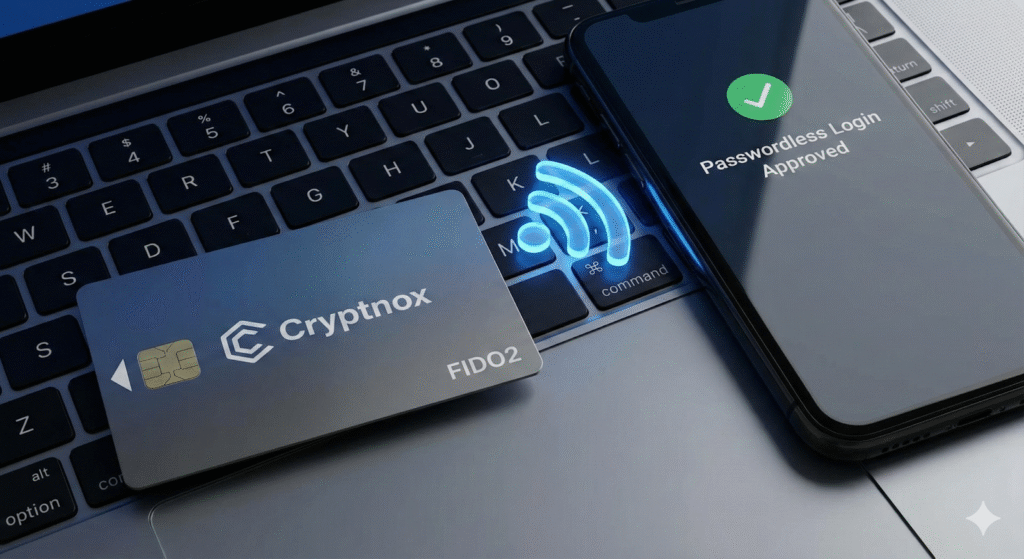
In an era where digital threats are evolving rapidly, relying solely on traditional passwords is no longer sufficient. Passwords can be stolen, guessed, or phished, leaving sensitive personal and corporate data vulnerable. This is where FIDO2 technology steps in, offering a revolutionary approach to online security. By utilizing public-key cryptography, FIDO2 cards provide a passwordless authentication experience that is not only far more secure than traditional methods but also significantly more convenient for the user. These physical security keys ensure that access is granted only when the legitimate user is present, effectively neutralizing remote attacks like phishing.
See more about the FIDO2 card – Cryptnox
Best FIDO2 Cards for Passwordless Security
As organizations and individuals look to upgrade their security posture, the market has responded with a variety of hardware authenticators. Below is a carefully curated list of the top FIDO2 cards and keys available today. This ranking prioritizes security features, ease of use, build quality, and certification standards.
Top 10 FIDO2 Security Keys
| Rank | Product Name | Description & Key Features |
| 1 | Cryptnox FIDO2 Card | The Premier Choice for Versatile Security. The Cryptnox FIDO2 Card stands out as a top-tier solution for those seeking robust, passwordless authentication in a convenient credit card form factor. Unlike bulky USB keys, this card fits seamlessly into a wallet or badge holder. It boasts impressive security credentials, featuring a chipset that is Common Criteria EAL6+ certified and FIPS 140-2 Level 3 compliant. It offers dual interface capabilities, working flawlessly via NFC for mobile devices and contact readers for desktops, without requiring any software installation. Its “plug-and-play” nature, combined with support for major platforms like Microsoft, Google, and Apple, makes it the ideal choice for professionals and enterprises alike. |
| 2 | Yubico Security Key C NFC | A widely recognized option in the market, this key offers essential FIDO2 capabilities with NFC support. It is designed for straightforward consumer use, providing a durable body that is water and crush-resistant. It supports FIDO2/WebAuthn and U2F protocols, making it a reliable backup or primary key for standard users. |
| 3 | YubiKey 5C NFC | This version extends functionality beyond basic FIDO2, adding support for other protocols like OTP and Smart Card (PIV). It is a versatile tool for IT professionals who need legacy support alongside modern passwordless standards. The dual USB-C and NFC interface ensures broad compatibility across modern devices. |
| 4 | Google Titan Security Key | Engineered by Google, this key is optimized for the Google Advanced Protection Program. It features a simple design and verifies the integrity of the login page to prevent phishing. While highly effective within the Google ecosystem, it remains a solid standard FIDO2 device for other services as well. |
| 5 | Feitian BioPass FIDO2 Pro | This key introduces biometric verification to the authentication process. It requires a fingerprint scan to unlock the cryptographic keys, adding an extra layer of “something you are” to the “something you have.” It is suitable for environments where an added biometric step is preferred over a simple touch. |
| 6 | Kensington VeriMark Guard | Known for its fingerprint technology, the VeriMark Guard supports FIDO2 and Windows Hello. It is a compact scanner that plugs into a USB port, designed primarily for desktop or laptop users who want biometric login without typing a PIN. |
| 7 | Thetis FIDO2 Security Key | A budget-friendly option that covers the basics of FIDO2 and U2F authentication. It features a rotating metal cover to protect the USB connector. While it lacks NFC in some base models, it serves as an entry-level device for users new to hardware security keys. |
| 8 | Nitrokey 3C NFC | Nitrokey focuses on open-source hardware and software, appealing to developers and privacy enthusiasts. This key supports FIDO2 and offers features like password management and OTP generation, all built on an open-source platform for transparency. |
| 9 | Identiv uTrust FIDO2 GOV | Designed with government compliance in mind, this key is FIPS certified and built in the USA. It is rugged and reliable, often used in regulated industries. It supports near-field communication (NFC) and USB, catering to federal agencies and contractors. |
| 10 | Token2 T2F2-NFC | A programmable FIDO2 key that allows for advanced configuration. Token2 offers unique features like the ability to act as a TOTP hardware token, which is useful for systems that have not yet migrated fully to FIDO2. It provides a flexible solution for technically savvy users. |
Understanding FIDO2 Technology
To truly appreciate why the Cryptnox FIDO2 Card and others on this list are essential, one must understand the underlying technology. FIDO2 (Fast Identity Online) is an open authentication standard hosted by the FIDO Alliance. It consists of the W3C’s Web Authentication (WebAuthn) specification and the Client to Authenticator Protocol (CTAP).
At its core, FIDO2 replaces the “shared secret” model of passwords. When a user registers a FIDO2 card with a service (like Gmail or Microsoft 365), the device generates a unique cryptographic key pair. The public key is shared with the service, while the private key remains securely stored on the hardware card and never leaves it. During login, the service sends a challenge that only the private key can solve. This process is cryptographically secure and ensures that the user’s credentials cannot be intercepted or replayed by attackers.
The Advantages of the Card Form Factor
While many security keys come in the shape of small USB thumb drives, the card format—championed by Cryptnox—offers distinct advantages.
1. Familiarity and Portability
A card fits naturally into a wallet, phone case, or ID badge holder. For corporate environments, this is revolutionary. An employee can carry their digital access key alongside their physical access badge, or even have the two integrated. This reduces the likelihood of losing a small USB drive that might otherwise be left plugged into a computer or dropped in a pocket.
2. Visual Customization
For enterprises, a card offers real estate for branding. Companies can print employee IDs, photos, and logos directly onto the surface of the authenticator. This turns a security device into a part of the corporate identity, fostering a sense of professionalism and security awareness among staff.
3. Durability
High-quality smart cards are built to withstand daily wear and tear. They are often flexible, water-resistant, and capable of functioning even after years of use. The Cryptnox card, for instance, utilizes high-grade materials to ensure longevity, protecting the sophisticated secure element chip inside.
Why Hardware Security is Superior to 2FA Apps
Many users currently rely on SMS codes or authenticator apps (like Google Authenticator) for Two-Factor Authentication (2FA). While these are better than passwords alone, they are not foolproof.
- SMS Interception: Hackers can use “SIM swapping” techniques to redirect SMS codes to their own phones, bypassing the security layer entirely.
- Phishing Vulnerability: A sophisticated phishing site can trick a user into entering the 6-digit code from their app. Once the attacker has the code, they can log in immediately.
- The FIDO2 Solution: FIDO2 cards are phishing-resistant by design. The card communicates directly with the browser and verifies the domain of the website. If a user is on a fake site (e.g., g00gle.com instead of google.com), the card will refuse to sign the authentication request. This protection is automatic and does not rely on the user noticing the subtle difference in the URL.
Key Features to Look For
When selecting a FIDO2 device, several technical specifications define the quality and security level of the product.
NFC Compatibility
Near Field Communication (NFC) is vital for mobile usage. It allows the user to simply tap the card against the back of a smartphone to authenticate. Without NFC, a user would need physically awkward adapters to connect a USB-A key to a USB-C phone or an iPhone. The Cryptnox FIDO2 Card excels here, providing a highly responsive antenna design that ensures quick and reliable scans.
Security Certifications
Not all chips are created equal. The gold standard for security hardware involves certifications such as Common Criteria EAL6+ (Evaluation Assurance Level) and FIPS 140-2 Level 3.
- EAL6+ indicates that the chip has undergone rigorous testing and formal verification of its design and implementation, making it extremely difficult to compromise.
- FIPS 140-2 is a U.S. government computer security standard used to approve cryptographic modules. Level 3 adds requirements for physical tamper resistance and identity-based authentication.
Devices like the Cryptnox card that carry these certifications are trusted by governments and high-security financial institutions.
Driverless Operation
The best user experience comes from devices that are “plug-and-play.” In a corporate rollout, IT administrators do not want to manage drivers for thousands of workstations. FIDO2 devices utilize the standard Human Interface Device (HID) protocol or standard smart card drivers already present in modern operating systems like Windows 10/11, macOS, and Linux. This ensures that the card works the moment it is tapped or inserted.
Implementing Passwordless Security in Business
Transitioning an organization to passwordless security can seem daunting, but the long-term ROI is significant. Password resets account for a massive portion of IT helpdesk tickets—some estimates suggest up to 50%. By moving to FIDO2 cards, companies virtually eliminate these tickets because there are no passwords to forget.
Furthermore, the onboarding process is streamlined. An employee receives their Cryptnox card on day one. They register it once with their central identity provider (such as Azure Active Directory / Microsoft Entra ID or Okta), and from that point forward, their login experience is a simple tap. This reduces friction, increases productivity, and, most importantly, closes the largest security gap in the enterprise: the human element.
FAQ
What is the difference between FIDO2 and U2F?
U2F (Universal 2nd Factor) was the first iteration of the standard, designed primarily for two-factor authentication where a password is still required. FIDO2 is the newer standard that supports “passwordless” logins, allowing the hardware key to replace the password entirely. Most modern FIDO2 cards, including the Cryptnox card, are backward compatible and support both protocols.
Do FIDO2 cards require batteries?
No. FIDO2 smart cards and USB keys are passive devices. They draw the tiny amount of power they need directly from the NFC field of the phone or the smart card reader/USB port of the computer. This means they never need to be charged and are always ready to use.
What happens if I lose my FIDO2 card?
If a card is lost, the finder cannot use it to access your accounts because they would typically need to bypass a PIN or biometric verification associated with the card (if enabled). However, you will lose access to your account if you do not have a backup. It is highly recommended to register at least two keys for every service: a primary one for daily use and a backup kept in a safe location.
Can I use one card for multiple accounts?
Yes. A single FIDO2 card can be registered with an unlimited number of web services (Google, Facebook, Dropbox, etc.) for U2F authentication. For passwordless (FIDO2/WebAuthn) logins where the key stores the credential, there is a limit based on the secure memory of the chip, but this is usually sufficient for the average user’s primary accounts.
Does the card work with an iPhone?
Yes. Modern iPhones (iPhone 7 and newer) have NFC capabilities that allow them to read FIDO2 cards. You can tap the card near the top of the iPhone to authenticate on supported websites and apps.
Is FIDO2 safer than an SMS code?
Yes, significantly safer. SMS codes can be intercepted via SIM swapping or SS7 network vulnerabilities. They can also be phished if a user enters the code into a fake website. FIDO2 keys rely on public-key cryptography and domain verification, making them immune to these common types of attacks.