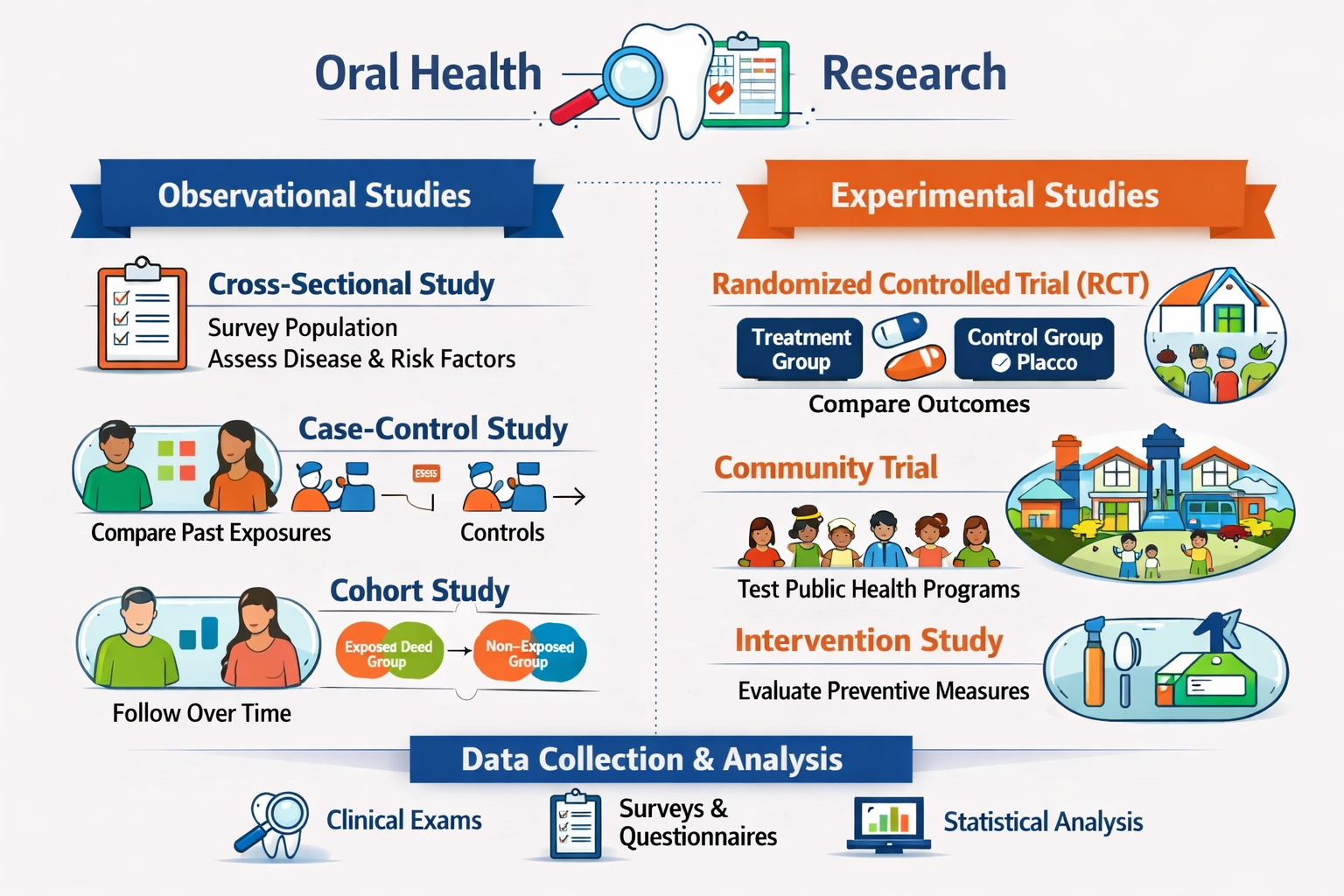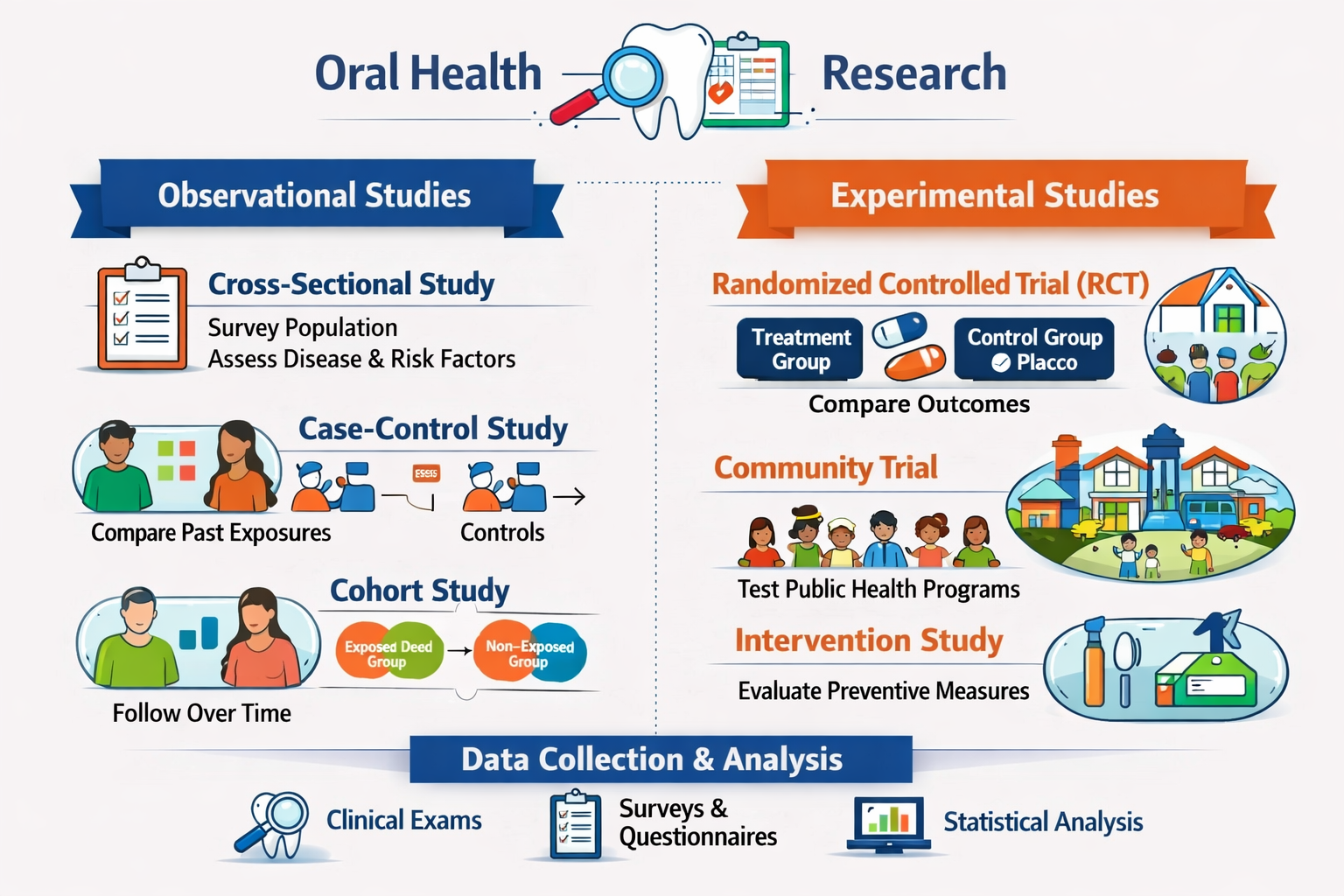
The scientific study of oral disease patterns within populations should be organized properly. Oral epidemiologic studies are the foundation of determining disease distribution, risk factors, and effectiveness of preventive or therapeutic interventions in the field of public health dentistry. These research studies are based on well chosen research designs that define the way data are gathered, analyzed and interpreted.
The research design is simply a plan of a scientific study. It describes the methods of selection, measurement of variables and the study of relationships between factors and outcomes. When conducting oral epidemiology, the selection of the right design is what makes the findings reliable, valid, and applicable to the real-world dental practice and the decision-making process regarding the population health.
There are a number of basic research designs commonly applied in oral epidemiology and they include cross-sectional studies, case-control studies, cohort studies, and clinical trials. The designs possess their unique strengths and weaknesses and uses. The knowledge of such strategies will assist clinicians, students, and researchers to be more critical when interpreting scientific evidence and put it into practical use with regard to oral health care.
Appreciating the Purpose of Research Design in Oral Epidemiology
The discipline of oral epidemiology is concerned with the research of the distribution and determinants of oral health conditions among populations. Biological, behavioral, environmental and social factors have an effect on conditions like dental caries, periodontal disease, oral cancer and malocclusion. In order to investigate them in their intricate, composite relationships, the researcher needs to embrace study designs in which he or she is able to observe and measure in a systematic manner. (ScienceDirect)
The design chosen in an investigation is based on a number of factors:
- The research question under consideration.
- The type of the disease or the condition under investigation.
- Ethical considerations
- Resources and time available.
- The appropriateness of the protracted tracking of the subjects.
To illustrate, in case the researchers need to estimate the current level of dental caries prevalence among schoolchildren, a cross-sectional study will be suitable. A case-control or cohort study could be more appropriate in case the purpose is to define the role of tobacco use in causing oral cancer.
Various designs provided in the framework of oral epidemiologic studies would provide complementary information on the disease patterns and causes. A practical scientific case study of how oral health conditions are analyzed in a population-based research may be derived out of this study on oral epidemiologic studies, which identifies how structured research methods enhance the cognizance of the trends and determinants of oral diseases.
Cross-Sectional Studies
Definition and Structure
A cross-sectional study is a study of a population at one point in time or within a brief duration. It is also called a prevalence study since it will determine the percentage of people who already have a specific condition.
Under this design, a researcher measures exposure factors (i.e. dietary habits, oral hygiene habits, or fluoride exposure) and health outcomes (i.e. dental caries or periodontal disease) concurrently.
As an example, a dental study can be carried out on a sample of teenagers to find out the number of those that have had cavities and at the same time document their brushing habits, sugar levels, and dental treatment access.
Oral Epidemiology Applications
Cross-sectional studies are commonly applied to:
- Determine the occurrence of oral diseases within a community.
- Determine the relationship between risk factors and oral conditions.
- Determine oral health behaviors and knowledge.
- Assess oral health requirements of community.
The survey studies are especially applicable in conducting a survey of large-scale populations as well as national oral health.
Strengths
Cross-sectional studies have a number of benefits:
- Efficiency- They can be done comparatively faster as data are gathered once.
- Cost-effectiveness – They do not need so many resources as long-term studies.
- Population knowledge – They give us the useful information concerning the oral disease burden within societies.
Limitations
In spite of their usefulness, cross-sectional studies are limited:
- They are not capable of determining cause and effect since exposure and outcome will be measured simultaneously.
- In case the sample is not representative, they will be subject to selection bias.
- They can be overlooking short-term diseases.
Due to these constraints, cross sectional studies are frequently employed as preliminary discovery studies that formulate hypotheses concerning subsequent studies.
Case-Control Studies
Definition and Structure
A case-control study involves comparison between people with a given disease (cases) and those without it (control). Researchers then research on the previous exposure or risk factors to establish whether some of the factors are related to the disease.
As an example, there may be a study on oral cancer which may include:
- Cases: Patients with oral cancer.
- Controls: Oral cancer free individuals.
The researchers would then study the past exposures like the use of tobacco, alcohol, or the human papillomavirus infection.
Oral Epidemiology Applications
Case-control studies come in particularly handy when:
- Research in rare diseases, e.g. some forms of oral cancer.
- Determining possible risk factors of oral conditions.
- Sub-topic: the study of relationships between oral diseases and lifestyle.
Since the disease has already taken place, researchers are able to reverse engineer to analyze probable causes.
Strengths
Case-control studies have several benefits that include:
- Efficiency of rare diseases – It is especially important where the disease of interest is rare.
- Time saving – Researchers need not wait till the development of the disease.
- Capability to compare exposures – It is possible to analyze a number of potential risk factors at a time.
Limitations
Nevertheless, case-control researches also have a number of issues:
- Recall bias: This is a situation where the participants do not have accurate recollections about past exposures.
- Selection bias: It may be hard to select control groups appropriately.
- Limited causal inference: It is possible to identify associations, but it is hard to prove that they are caused.
Despite these restrictions, case-control designs have been very instrumental in the determination of key risk factors of oral health especially lifestyle risk factors.
Cohort Studies
Definition and Structure
A cohort study is based on a group of persons and observes them over a period to see how exposure to some factors would result in the development of particular outcome.
The first classification of the participants is into individuals who are exposed or not to a certain risk factor. A group of researchers then follows the participants in months or years so as to observe who develops the disease.
As an example, a cohort study of periodontal disease would involve:
- An organization of tobacco smokers.
- A non-smoker group of people.
Researchers could then observe both groups as they grow during a number of years to ascertain the information of whether smokers are prone to develop periodontal disease.
Types of Cohort Studies
There are two broad categories of cohort studies, namely:
Prospective Cohort Studies
The participants are tracked over time after the exposure to the incidences of disease.
The Retrospective Cohort Studies.
Scientists study the records available and establish exposures and effects that have already been accomplished.
Oral Epidemiological Applications.
Cohort studies are useful in the study of:
- The progression of oral diseases in nature.
- The association between disease development and risk factors.
- Oral health behavior long-term outcomes.
They are especially handy in analyzing how other dietary, tobacco, or oral hygiene factors affect the risk of diseases in the long term.
Strengths
Cohort studies have a number of significant benefits:
- They enable measurement of the incidence of disease directly.
- They gain temporal relations between the exposure and the outcome.
- They allow the investigation of several outcomes that are related to one exposure.
Limitations
Nevertheless, cohort studies are also problematic:
- They may be costly and time consuming particularly in cases where the follow-up period is long.
- The participants might lose interest in the process and follow up bias occurs.
- They do not suit in studying rare diseases.
Notwithstanding such constraints, cohort studies still qualify as some of the most effective observational designs in examining the causality relationship in the study of oral epidemiology.
Clinical Trials
Definition and Structure
A clinical trial is a type of research that is an experiment that is intended to assess the effectiveness and safety of preventive, diagnostic, or therapeutic interventions. Clinical trials are also active as opposed to observational studies.
Usually, the participants are allocated into groups in most cases via random assignment so that they are given various treatments or interventions.
An example of a clinical trial could be:
- An innovative fluoride varnish medication.
- Normal dosage of fluoride.
- A placebo or control group
Researchers will then determine whether the new treatment will be more effective in preventing dental caries.
Randomized Controlled Trials
Randomized controlled trial (RCT) is the most stringent type of clinical trial. The participants in this design will be randomly grouped in intervention groups or control groups, which will minimize bias and enhance the validity of the outcomes.
RCTs have been regarded as the gold standard when it comes to assessing clinical interventions in the field of dentistry.
Oral epidemiology Applications
Clinical tests are usually applied to:
- Test prevention measures, like fluoride programs.
- Pilot dental materials or treatments.
- Evaluate oral health behavioral interventions.
- Test the community oral health program effectiveness.
Strengths
Clinical trials have a number of benefits:
- They are the best proofs of causality.
- Randomization reduces confounding variables.
- They permit the accurate assessment of intervention efficacy.
Limitations
Nevertheless, there are also disadvantages of clinical trials:
- They can be costly and complicated to undertake.
- Ethical concerns can constrain the nature of the interventions to be tested.
- Controlled conditions may not necessarily provide the results that should be encountered in the real world.
Nevertheless, despite all these, clinical trials are essential in promoting evidence-based dentistry.
Assessment of Oral Epidemiologic Studies of Validity
Irrespective of the design, scholars need to achieve valid and reliable results in studies. There are two concepts that are important in assessing the quality of a study.
Internal Validity
Internal validity is used to refer to how the study measures the relationship between exposure and outcome without favoritism.
Methodological threats to internal validity are:
- Selection bias
- Measurement errors
- Confounding variables
External Validity
The concept of external validity is based on the extent to which one can make generalizations about other populations.
As an illustration, the results of a research study in a urban school may not be applicable to the rural population with another lifestyle and access to dental treatment.
The validity of both kinds will help a researcher to know whether the research findings are reliable and applicable.
The Significance of Selecting the right Research Design
The oral epidemiology is very critical in the selection of the research design since it distinguishes the strengths and applicability of research conclusions. The designs respond to various research questions.
For example:
- Cross-sectional research determines the prevalence of diseases and trends of the population.
- Case-control designs are used to investigate the possible risk factors of rare diseases.
- Cohort studies are the ones that investigate the progress of disease.
- The efficacy of interventions is examined through the use of clinical trials.
The synthesis of results of different study designs may help researchers create a complete picture of the state of oral health and work out more successful methods of prevention.
Conclusion
The research design is a critical aspect of a scientific study of oral epidemiology. Researchers are able to investigate the prevalence, predictors, and prevention of oral diseases among populations through a series of study designs, including cross-sectional studies, case-control studies, cohort studies, and clinical trials.
All the designs are bringing in something new. Cross-sectional studies give a snapshot of the prevalence of the disease, case-control studies identify the possible cause of risk factors, cohort studies determine the effect of exposures on the disease development, and clinical trials determine the effectiveness of interventions.
The knowledge of such research methodology allows dental practitioners, students and public health practitioners to be in a position to critically understand scientific evidence. This information will enhance evidence based decision making, enhance designing future oral epidemiologic studies and eventually promote healthy oral health of people.
With the ever-changing nature of oral health issues on an international level, the prudent use of the right research designs will be critical in knowledge progression, informing people on the health policy, and enhancing dental care delivery.