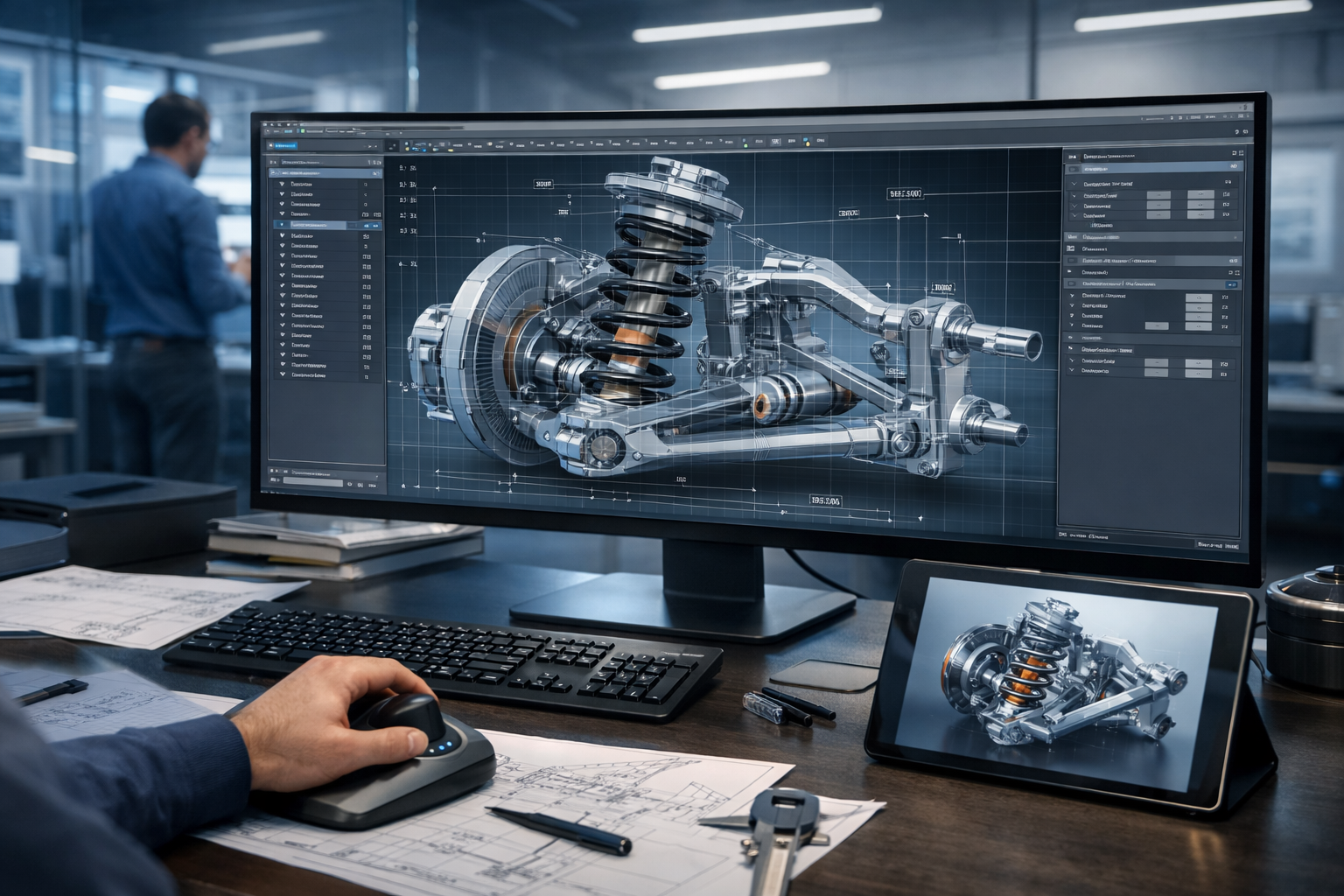
In the contemporary field of engineering, accuracy, efficiency, and communication are essential in effectual development of products. Geometric modeling is one of the most revolutionary means that facilitates these purposes. With the development of precise digital images of objects, engineers are able to visualize, simulate and design and optimize designs well before actual prototypes are produced. In this paper, I look at the efficacy of the geometry modeling in improving precision design, prototyping, simulation, manufacturing planning, and communication between teams and stakeholders.
Conceptualizing Geometric Modeling
Geometric modeling These are the mathematical and computing methods applied to express the shape, organization and geometry of objects digitally. It is an essential part of the current engineering and product design processes.
The geometrical models that are primarily used are:
• Wireframe Models- These are objects that are modeled around lines and curves to form edges and boundaries.
• Surface Models – Model surfaces of objects; they are generally used when studying aesthetics and aerodynamics.
• Solid Models – This depicts the volume of an object, and makes it possible to simulate and plan its manufacture.
• Parametric Models – Design constraints and relationships are added to models, such that when they change automatically, they will automatically change the rest of the model.
The main Characteristics of Geometric Modeling:
• Parametric Control – It is possible to define shapes and features in terms of accurate dimensions and relationships.
• Flexibility – The model can be altered by the designers without beginning the design all over again.
• Accuracy – Digital designs are kept to the precise geometrical requirements minimizing design and production errors.
• Integration – The models may be interconnected with simulation, analysis and manufacturing tools to create smooth workflows.
With these capabilities, the engineers are able to streamline the manufacturing process, performance under different conditions and optimization of product design.
Precision Design: Geometric Modeling
Accuracy is the key to engineering. Geometric modeling helps an engineer to develop true-to-life digital prototypes that are consistent with tight tolerances. This accuracy is of particular importance to the aerospace, automotive, biomedical engineering and mechanical engineering industries where the slightest deviation can jeopardize safety, functionality or even regulatory adherence.
Precision Design Strengths:
• Error Minimization- Digital models minimize the error that is caused by human error on manual drawings.
• Precise Placement of Component – Engineers can accurately locate components in the assemblies, and the placement is correct.
• Digital Measurement and Validation – Models give the measurements and validation of dimensions prior to physical production.
• Design Iteration – Parametric and flexible models can be used to rapidly undergo iterations to optimize design features.
An example is in the design of aircraft where a deviation of a millimeter wing geometry could result in a huge difference in the aerodynamics. In geometric modeling, the engineers are able to make sure that the end product is of precise specifications.
Prototyping and Simulation
Before manufacturing, it is necessary to have prototyping and simulation. Geometric modeling enables the engineers to test designs virtually, which saves resources and time.
Virtual Prototyping
Virtual prototyping involves 3D models that analyze form, fit and functionality of components:
• Designers are able to locate the design shortcomings at an earlier stage of development.
• Alterations in geometry can be immediately implemented without the expensive physical alterations.
• It is possible to evaluate several design options within a short period of time and find the best solution.
Stress and Performance Analysis
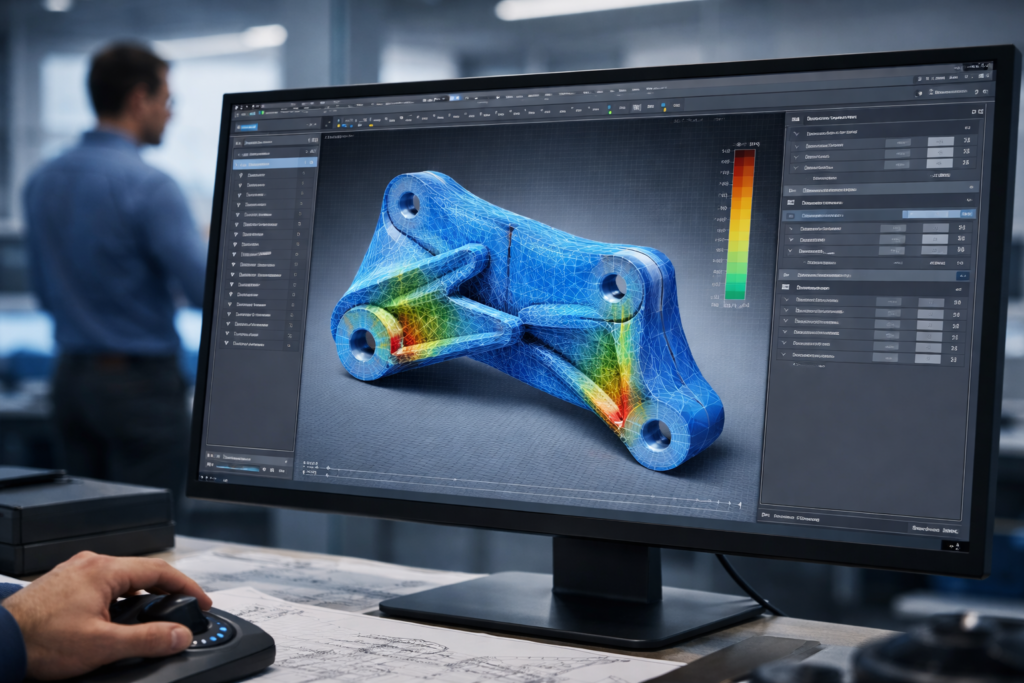
In the real world, engineering structures and components are put under different forces. With the help of geometric modeling, the engineer can do:
• Finite Element Analysis (FEA) – Determines stress, strain and deformation on complicated components.
• Thermal Simulation – Estimates the heat distribution and suggests those regions which could be particularly at risk of overheating.
• Fluid Dynamics Simulation (CFD)- Assesses airflow, water flow or other fluid interaction around or through components.
• Dynamic Motion Analysis – Investigates mechanical movement, collisions and kinetic action.
Benefits:
• Eliminates usage of expensive physical prototypes.
• Safety and performance meets are ensured in the designs.
• Rapidly develops the cycle by testing it out.
Improving Planning of Manufacturing
Geometric modeling serves to bridge the gap between design and production so that manufacturing planning is possible and less post-production error reduction is possible.
In the Manufacturing Industry:
• Material Optimization – Exact models are used to determine the precise number of raw material needed to save wastages as well as costs.
• Toolpath Generation – CAD models are used to direct CNC machines, 3D printers, and other computer controlled fabrication tools.
• Tolerance Check- Makes sure that everything will go in place in assemblies.
• Assembly Simulation – Engineers are able to simulate assembly processes so as to find any possible conflicts or challenge.
• Process Planning – Assists in determining the optimum machining processes, equipment and machine order of operation.
These functions enable manufacturers to make a confident production plan to reduce delays, errors and achieve uniform quality.
Representation and Communication
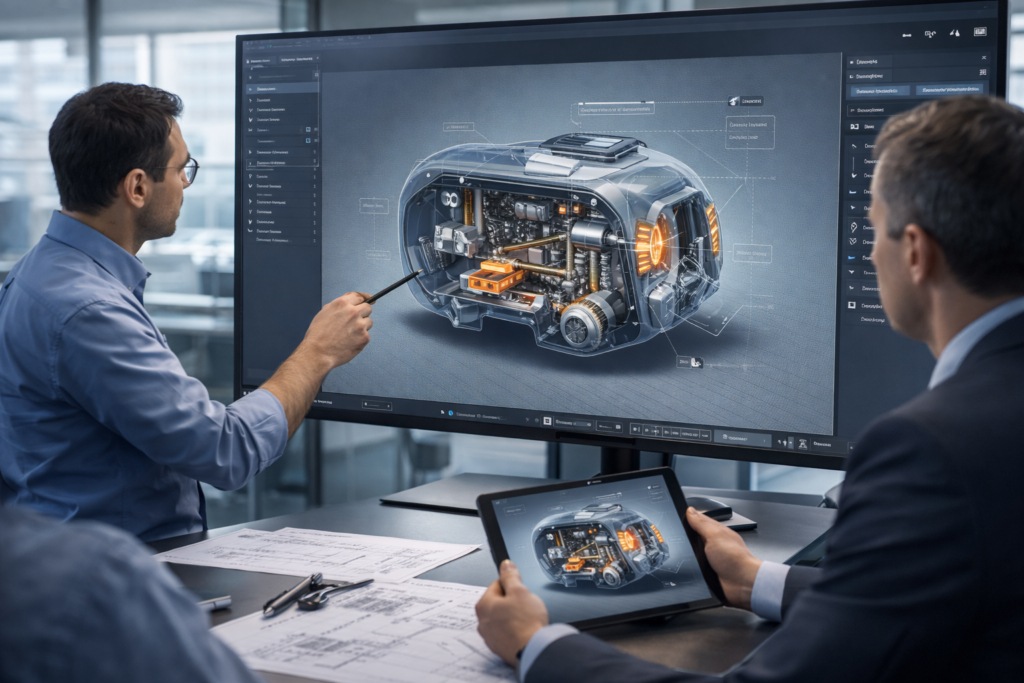
Geometric modeling has one of the greatest benefits of enhancing communication between the engineers, the stakeholders, and the clients.
Key Benefits:
• Interactive 3D Presentations – The client is able to view products virtually, with each detail being explored in many different angles.
• Cross-Departmental involvement – Design, engineering and marketing will be able to directly input on the digital model.
• Error Prevention – It is possible to visualize the process of assembly and interaction and avoid misunderstanding.
• Pre-Marketing Visualization- Promotional materials can have a realistic visualization even prior to the release of the product.
Having a clear visualization would make sure that the design is understood by all parties making it easier to make decisions and cut costs associated with miscommunication.
Real-World Applications
The geometric modeling is used broadly in many areas of engineering:
Automotive Industry
• Maximizes the aerodynamic characteristics of vehicles by CFD simulation.
• Pre-physical crash tests are done by a computer-based use of tests of safety and crash worthiness.
• Mimics the assembly lines to enhance efficiency.
Aerospace Engineering
• Develops components, which are lightweight and strong.
• Mimics service during severe conditions of temperature, pressure and stress.
• Simulates complicated assemblies, minimizing the number of prototype cycles.
Consumer Electronics
• Secures functional, small and ergonomic.
• Evaluates thermal behavior and material.
• Efficiently locates the position of components so as to maximize the space utilization.
Medical Devices
• Develops surgical equipment and implants of specific geometries.
• Models the physiological environment.
• Improves patient safety and compliance in regulations.
Industrial Equipment
• Imitates the work of machinery in order to be efficient and durable.
• Streamlines the mechanical systems to the least wear and tear.
• Enhances the security and trustworthiness in the working process.
Possible Obstacles and Reflections
Although geometric modeling has numerous benefits, the engineers should also consider some challenges:
• Model Complexity – These are complex models that need talented professionals and robust computer programs.
• Data Management – 3D models are very large in nature and require a lot of storage and version control.
• Software Integration – there should be a good deal of interoperability between the CAD and simulation and manufacturing tools.
• Computational Costs – Advanced models like FEA and CFD are very needy in computation power.
These issues are essential concerns that need to be dealt with to make the most out of the opportunities that geometric modeling can offer in any engineering process.
The Future of Geometric Modeling
The uses of geometric modeling keep on developing due to technological progress:
• AI-Assisted Modeling- AI can be used to automate the repetitive design process and provide optimised geometries.
• Digital Twins – Physical product models are real-time models that can predict maintenance and performance.
• Virtual and Augmented Reality – Engineers and clients can engage with models in an immersive manner to gain a clearer insight and test them.
• Integration Additive Manufacturing Models can be used to run 3D printing processes directly to create rapid prototyping and manufacturing.
The innovations will ensure a speedier, more precise and more collaborative product design.
Conclusion
The modern-day engineering and product design heavily rely on geometric modeling, which makes it possible to be precise, be able to simulate, prototype, and communicate effectively. Using the digital models as a form of interaction in the design processes, engineers will be able to:
• Minimize development time and costs.
• Increase product performance and reliability.
• Enhance the interaction of design, engineering and client teams.
Geometric modeling is not merely a design tool in an age of innovation, haste and precision- it is a key motivator to a successful engineering process.



A really good blog and me back again.