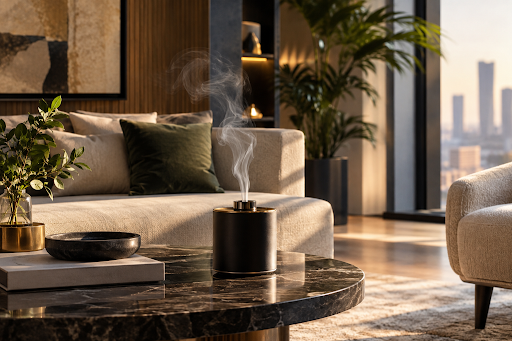
Interior design has traditionally been a visual discipline. Color palettes, furniture, lighting, materials, artwork, and architecture usually receive most of the attention when a space is being designed.
But the way a room looks is only one part of how people experience it.
Scent is increasingly being considered alongside lighting, acoustics, texture, and temperature as part of the broader sensory environment of a home. From subtle diffuser oils in living spaces to carefully chosen fragrances in hotels and retail environments, scent can contribute to the atmosphere people associate with a place.
This does not mean fragrance is replacing traditional interior design. Rather, it is becoming another layer of it, one that cannot be seen but can still influence how a space is perceived and remembered.
Interior Design Is Becoming More Multisensory
Walk into two rooms with identical furniture and similar lighting, and they can still feel remarkably different.
One might feel fresh and airy. Another might feel warm and intimate. A third could seem calm and understated.
Part of this difference comes from visual design, but our perception of an environment is formed through multiple senses simultaneously.
Interior designers have long worked with sensory elements without necessarily describing them that way. Soft rugs change both texture and acoustics. Curtains alter light and sound. Natural materials introduce distinctive tactile qualities. Plants affect the visual character of a room and, in some cases, its natural aroma.
Fragrance extends this principle.
A carefully selected home scent can become part of the atmosphere rather than simply an accessory placed on a shelf.
Why Does Scent Have Such a Strong Connection With Memory?
One reason scent can feel unusually powerful is its relationship with the brain systems involved in emotion and memory.
Olfactory information follows neural pathways that have close connections with areas associated with emotional processing and memory. This helps explain why encountering a familiar smell can sometimes bring back a surprisingly vivid recollection.
The aroma of coffee might remind someone of mornings at home. A particular flower may bring back memories of a garden. Wood, spices, rain, or citrus can similarly become associated with particular places and experiences.
For interiors, this creates an interesting possibility.
When a fragrance is used consistently in a space, people may gradually begin associating that aroma with the environment itself. In much the same way that a particular color palette can become part of a home’s visual identity, a familiar fragrance can contribute to its sensory identity.
What Is Scent Styling?
Scent styling is the intentional selection of fragrance to complement a space, activity, season, or desired atmosphere.
Instead of choosing a fragrance simply because it smells pleasant in isolation, scent styling considers the environment where it will actually be experienced.
A minimalist living room, for example, may pair naturally with restrained woody, herbal, or fresh notes. A bedroom might call for something softer and less intrusive. Kitchens often benefit from lighter fragrance profiles that do not compete heavily with food aromas.
The principle is similar to selecting lighting.
Bright task lighting may be appropriate for a kitchen workspace but uncomfortable beside a bed. Likewise, a fragrance that works beautifully in a large entrance hall may feel overwhelming in a compact room.
Context matters.
Diffuser Oil and the Move Toward Continuous Home Fragrance
One reason scent has become easier to integrate into interiors is the availability of home-fragrance formats designed for gradual or continuous scenting.
Reed diffusers, for example, typically use fragrance formulations—often referred to by consumers as diffuser oil, that travel through reeds and disperse fragrance into the surrounding air. Other diffuser systems may operate differently, so oils and formulations should always be used according to the manufacturer’s instructions.
Unlike candles, passive reed diffusers do not require a flame while operating. They can therefore provide a relatively consistent fragrance presence without needing to be lit each time someone enters the room.
Their decorative role matters too.
Modern diffusers are often designed as interior objects, with glass vessels, ceramic containers, understated labels, and materials intended to complement contemporary décor.
The fragrance and the object containing it can therefore become parts of the same design decision.
The Rise of the “Signature Scent” at Home
Signature scents have long been associated with perfume and hospitality, but the idea increasingly makes sense in residential spaces as well.
A signature home scent is simply a recognizable fragrance profile that is used consistently enough to become associated with a particular environment.
It does not necessarily need to be complicated or expensive.
The goal is coherence.
Someone who prefers clean, restrained interiors might gravitate toward green, woody, mineral, or lightly citrus profiles. A warmer home filled with natural wood, textiles, and earthy colors may suit amber, spice, resinous, or deeper woody notes.
The best choice remains highly personal.
Rather than asking, “What fragrance is fashionable?” a more useful question is:
What should this particular space feel like?
Matching Fragrance Families With Interior Atmospheres
There are no universal rules connecting fragrance to décor, but understanding broad fragrance families can make experimentation easier.
Citrus and Fresh Notes
Lemon, bergamot, grapefruit, orange, and related profiles often create a bright impression.
They can work well in kitchens, entrances, workspaces, and rooms designed around natural light and clean lines.
Floral Notes
Rose, jasmine, peony, lavender, and other floral profiles range from delicate to rich.
Lighter floral compositions can complement bedrooms and quiet sitting areas, while more complex floral blends can create a more decorative atmosphere.
Woody Notes
Cedarwood, sandalwood-inspired accords, vetiver, and similar notes are commonly associated with warmth and depth.
They often complement interiors featuring timber, leather, stone, neutral colors, and natural textures.
Herbal and Green Notes
Herbs, leaves, tea-inspired accords, and green botanical profiles can create a crisp, natural character.
These fragrances can work particularly well in contemporary interiors where the goal is freshness without pronounced sweetness.
Amber, Spice and Resinous Profiles
Warmer fragrance families can contribute richness to a room.
They are often suited to evening spaces, colder seasons, libraries, dining rooms, and interiors designed around deeper colors and softer lighting.
These associations are guidelines rather than formulas. Personal preference should ultimately determine what belongs in a home.
Why Fragrance Intensity Matters More Than People Think
When incorporating scent into an interior, stronger is not necessarily better.
A fragrance can become distracting when its concentration is too high for the size or ventilation of a room. Because people also adapt to persistent odors over time—a phenomenon commonly called olfactory adaptation—the person living in a home may notice a fragrance less than a visitor does.
This can lead people to keep increasing fragrance intensity unnecessarily.
A better approach is subtlety.
Ideally, a home fragrance should be noticeable without dominating every other sensory element in the room.
Room size, airflow, temperature, placement, formulation, and the number of fragrance sources can all influence perceived intensity.
Scent Can Help Differentiate Spaces
Modern homes frequently contain open-plan areas where traditional physical boundaries have been reduced.
Sensory cues can help create softer distinctions between these zones.
Lighting already does this. A pendant light can visually establish a dining area, while a floor lamp creates a reading corner.
Fragrance can potentially perform a similar supporting role.
A fresh profile near an entrance can create one impression, while a softer fragrance in a bedroom establishes another. The goal is not to fill every room with competing aromas but to consider whether different spaces benefit from different sensory identities.
Transitions should generally remain harmonious.
Hotels and Retail Spaces Helped Popularize Scent as Part of Design
The hospitality and retail industries have demonstrated how fragrance can contribute to a recognizable environment.
Many hotels, spas, stores, and other commercial spaces use carefully selected scents alongside architecture, music, lighting, materials, and service design.
This practice is sometimes described as scent marketing when fragrance forms part of a broader branding strategy.
Residential scent styling has a different objective.
A home is not trying to persuade visitors to purchase something. Instead, fragrance can be used to support personal preferences, routines, seasonal changes, or the overall character of the interior.
The underlying design lesson, however, is similar: people experience environments through more than their eyes.
Seasonal Scenting Offers an Easy Way to Change a Room
Furniture and architectural finishes are relatively permanent. Fragrance is not.
That makes scent one of the easier interior elements to change with seasons or circumstances.
Spring might inspire green or floral notes. Summer may suit citrus and lighter botanical profiles. Autumn often encourages warmer woods and spices, while winter can accommodate richer resinous or comforting compositions.
These are cultural and personal associations rather than fixed design rules.
The advantage is flexibility.
Changing a home fragrance can alter one dimension of a room’s atmosphere without replacing furniture, repainting walls, or purchasing new décor.
Using Home Fragrance Responsibly
Fragrance products should be treated as household products rather than assumed to be harmless simply because they smell pleasant or contain ingredients described as natural.
Instructions and safety warnings can differ considerably between products.
Diffuser oils, essential oils, fragrance oils, candles, and electronic diffusers are not interchangeable categories. A formulation intended for one application may not be appropriate for another.
Consumers should follow the manufacturer’s directions regarding placement, ventilation, skin contact, spills, ingestion risks, and use around children or animals.
People with fragrance sensitivities, respiratory concerns, allergies, or other relevant health conditions may also need to limit or avoid fragranced products and seek appropriate professional advice when necessary.
For homes with pets, additional care is appropriate because animals can respond differently to certain substances and methods of fragrance dispersion.
Good scent design should never come at the expense of comfort or safety.
How to Choose a Scent for Your Interior
Choosing fragrance does not need to begin with a long list of individual scent notes.
Start with the room.
Consider its purpose, size, materials, ventilation, natural light, and the time of day when it is most frequently used.
Then define the atmosphere in a few words.
Is the room supposed to feel fresh and energetic? Warm and intimate? Quiet and minimal? Natural and earthy?
From there, explore fragrance families that seem compatible with that character.
Testing matters because fragrance perception is subjective. Something that sounds appealing from a description may smell entirely different when experienced in a particular room.
It is also sensible to begin with lower intensity and adjust gradually.
Scent Should Complement Design, Not Compete With It
The most sophisticated use of fragrance is often the least obvious.
Visitors should not necessarily walk into a room and immediately think about the diffuser sitting in the corner. Instead, scent can operate in the background, contributing to the overall impression of the environment.
This is similar to good lighting.
People may not consciously analyze the color temperature, positioning, or intensity of every lamp, yet those decisions strongly affect how the room feels.
Scent can function in much the same way.
The Future of Interior Design May Be More Sensory
As interior design continues to focus on experience as well as appearance, scent is likely to remain part of the conversation around sensory spaces.
Visual beauty will still matter. Furniture, architecture, materials, and lighting remain fundamental.
But a beautiful room is not experienced as a photograph.
People hear it, touch it, move through it, breathe in it, and build memories inside it.
That broader perspective changes the question from “How should this room look?” to “How should this room feel?”
Scent provides one possible answer.
Whether introduced through a subtle diffuser oil, seasonal fragrance, fresh flowers, natural materials, or simply the familiar aromas of everyday life, scent adds an invisible dimension to interiors.
And perhaps that is why it is becoming a new language of modern design: it communicates without needing to be seen.
Frequently Asked Questions
What is diffuser oil?
Diffuser oil is a general term commonly used for liquid fragrance formulations designed for certain types of home diffusers. Formulations vary significantly, so consumers should use only products intended for their particular diffuser and follow the manufacturer’s instructions.
Where should a reed diffuser be placed?
A reed diffuser is generally best placed on a stable surface in an area with moderate air circulation. Avoid locations where it can easily be knocked over, and follow the product’s instructions regarding sunlight, heat, children, pets, and nearby materials.
How do I choose a fragrance for my home?
Start with the function and atmosphere of the room rather than selecting fragrance solely by popularity. Consider room size, ventilation, existing household odors, décor, personal preferences, and desired fragrance intensity.
Can different rooms have different scents?
Yes. Different fragrance profiles can help create distinct atmospheres throughout a home. However, fragrances used in adjoining or open-plan spaces should ideally complement one another rather than compete.
Are essential oils and diffuser oils the same thing?
Not necessarily. “Diffuser oil” can refer to different fragrance formulations depending on the product, while essential oils are concentrated aromatic substances derived from plant materials. Neither should automatically be substituted for the other. Always check what a particular diffuser is designed to use.
Does a stronger fragrance make a room smell better?
Not necessarily. Excessive fragrance can become overwhelming, particularly in smaller or poorly ventilated rooms. A lower, balanced scent level is often more comfortable and allows fragrance to complement rather than dominate the space.