
Introduction to Database Design
Database design is among the most crucial phases for a dependable software program application. Whether you are running an online store, a banking site, a school management system, a hospital database or a social media site, all applications that store information rely on a well-organized database to function properly. Database design is the process of organizing and structuring data within a database to ensure its accuracy, security, and usability.
A poorly designed database can lead to issues like duplicate data, inconsistent data, slow query, modifications and expansion of an application. However, a well-designed database offers significant benefits in terms of future expansion and effective operations. Knowing these principles for databases can help developers design databases that are flexible to future changes and can meet current needs.
Principles of Database Design
Database Design is the process of organizing the data into logical structures so that it can be stored and retrieved efficiently. It consists of knowing what information an application requires, knowing how various pieces of information are connected to each other and knowing rules that ensure that data is accurate. Typically, data in relational databases is stored in tables, which consist of rows and columns, where each row is a record of an individual instance, and each table is for a specific subject or entity. For instance, an e-commerce app could have tables dedicated to customers, products, orders, and payments.
These tables are related to each other so that when the application needs data from related tables, only the pertinent data is retrieved, not all the data stored in a single large table. A good database design also takes into account performance, security, data integrity and maintainability – all of which are essential to ensure that the database can meet the daily needs of the organization and its evolving requirements.
Database Entities and Their Relationships
The initial step in the design of a database is to determine the entities that describe the principal objects or concepts in an application. An entity is an object that the system maintains data on, like a customer, employee, product, student, course, or transaction. Each entity typically is stored in a separate table in a relational database, where the information can be managed separately from the other entities. A school management system, for instance, could need Student, Teacher, Course, and Department entities because each is a unique set of information.
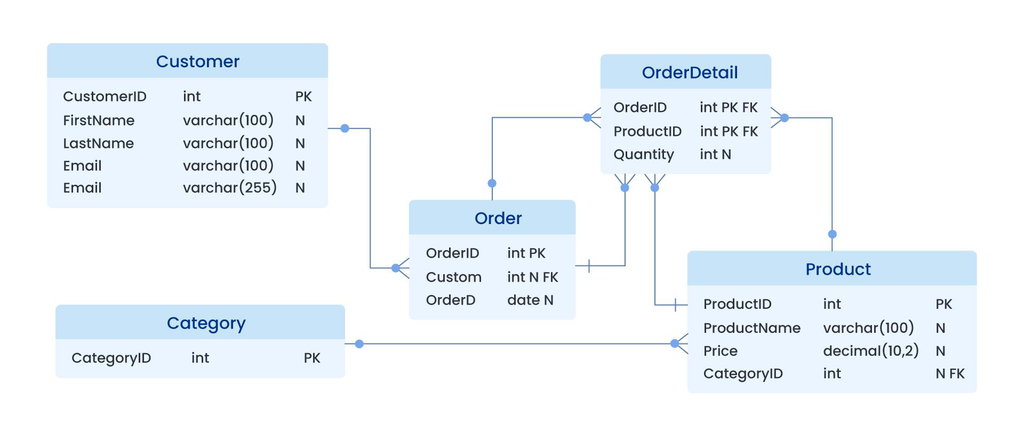
Correct entity identification avoids confusion of unrelated information and helps to make the database more understandable. Before developing entities, it is critical to understand the application’s needs, processes and anticipated operations. This way, the database will be designed more based on what people do, and not on the assumption that the developer had at the time of coding.
Defining Attributes Clearly
An attribute is a quality or characteristic of something, such as a person, place, thing, or event; it is a column in a database table that represents a property of an entity. For instance, a Student entity can have attributes like StudentID, FirstName, LastName, DateOfBirth, EmailAddress, and EnrollmentDate. Every attribute should have a definite purpose and be used to represent a specific piece of information. Hacking or creating unnecessary columns, or adding unrelated information into a single column, may make searching, updating or validating it harder.
The names of attributes should also be descriptive of the attribute being used, and consistent throughout the database so that the developers do not get confused. The attributes need to be defined, and the attributes should be considered in terms of whether they must be provided, if they can vary over time and if they should be stored separately or derived from other information. Precise attribute selection ensures data structure that is easier to maintain and to retrieve accurate data from.
Relationships Between Tables
Relationships describe how records in the various tables of a database are related. They are key because information in the real world is seldom contained in a single record and applications often require related data to be retrieved in a single operation. For instance, one customer can order multiple times and each order is related to a specific customer. The relationships in a relational database are typically one to one, many to one, or many to many. One-to-one relationships are relationships where one record in one table corresponds to one record in another table and one-to-many relationships are relationships where one record in one table can be linked to many records in another table.
A many to many relationship is one that can be established between multiple records in a table to multiple records in another table. Knowing these relationships will allow developers to know how the tables should be related and avoid redundant data. Relations that are well specified also facilitate the development of complex queries, and enable accurate reporting over multiple components of an application.
Many-to-Many Relationship
The many-to-many relationships are another special case, since relational databases typically have an extra table called a junction table or linking table that is used for many-to-many relationships. Imagine a university system that allows a student to enroll in multiple courses and the same course to have many students enrolled. Creating a direct relationship between the Student and Course tables would not adequately represent all possible registrations. Instead, the developer can add an Enrollment table to the database with the StudentID, CourseID, EnrollmentDate, etc. as the registration data.
Each enrollment record links one student to one course, so that the database doesn’t necessarily repeat complete student or course records for multiple enrollments. This design provides more flexibility and helps to deal with information like grades, registration status, and enrollment dates. Properly dealing with many-to-many relationships is critical for systems that include records with multiple relationships, like memberships, product categories, employee assignments and more.
Choosing the Right Data Types
Another basic concept of database design is the appropriate use of data types, which is because the type of data a column can hold will affect the type of data that the database will process. The basic data types include integers, decimal numbers, character strings, dates, timestamps, and boolean values. For example, an employee’s identification number could be an integer or some other type of identifier, but a person’s name would need to be a character-based data type. When precise calculations are needed, it’s best to use an exact decimal type, an approximate floating-point type should be used only in exceptional cases.
Use a date or timestamp type for dates rather than all kinds of text formats, so that the database can sort, compare and calculate dates properly. Choosing the right types also avoids the use of unnecessary storage space and invalid values being added to the database. It is important that developers think about what the intent of each attribute is, the value range, format, accuracy, and other characteristics before deciding upon the data type, instead of choosing a type without knowing the applications requirements.
Creating Primary Keys and Foreign Keys

Primary Key
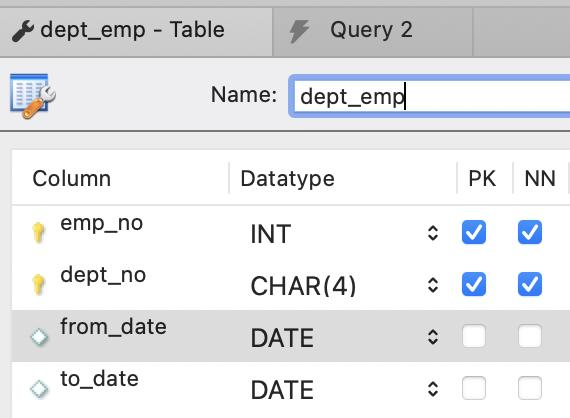
The primary key is a column (or column combination) that identifies each record in a database table. It guarantees that even if there are more than one record with similar information, each row will be unique. For instance, two customers can have the same First Name and Last Name, but each customer should have a CustomerID that is unique to them. Primary keys must have the following characteristics: they must be unique, they must be always available and they must be stable enough to identify the record at any moment in its lifetime.
Both numeric identifiers automatically generated by the system and universally unique identifiers can be used in various applications. Email addresses, phone numbers or names are not suitable primary keys, as they can change, may not be provided, or they may not be unique. A good primary key will make relationships easy, record identification easy, and make it easy to update and delete the records. Primary keys can be used at the initial design phase to avoid data duplication and provide a reliable basis for establishing relationships between tables.
Foreign Keys
A foreign key is a column that links with primary keys or other suitable unique keys in other tables. They create relationships between records and support referential integrity, ensuring that relationships are preserved when data is added, updated or removed. For instance, an Orders table can have CustomerID as a foreign key on the Orders table that references the Customer table. This effectively makes it possible for the database to determine the customer who made each order without saving the whole customer record for each order.
Foreign key constraints may help prevent the order from referencing a customer that doesn’t exist; this helps to minimize inconsistent records. Developers should also take care on what to do when a record to which it refers is deleted or updated. Depending on the business rules, the database might deny the operation, cascade changes to it, or perform some other appropriate operation. Careful foreign key design can also ensure that data remains accurate and that the information that is connected is meaningful throughout the lifespan of the application.
Applying Database Normalization
Database normalization is a systematic approach to structuring data to minimize redundancy and ensure data consistency. It includes breaking information into well-structured tables and establishing relationships between them, so that each fact is kept at an appropriate place. If not normalized, a database could include the same customer information in numerous orders, which makes it hard to update and makes it more susceptible to inaccuracies. For instance, if a customer has several addresses, modifying one of those addresses could need to modify multiple addresses, and if one of those is overlooked, it would lead to confusing information.
To avoid these problems, the normalisation process segregates customer information from order information and relates these two by means of keys. The developers who have learned the concept of normalization will have more clarity about the benefit of structured tables to manage data reliably.The developers who have learned the concept of normalization will have more clarity about the benefit of structured tables to manage data reliably. While normalization helps to ensure consistency, it should be done with practical considerations in mind: for some applications, the more tables a query needs to access, the more complex it becomes.
Main Normal Forms
The first three normal forms are useful guidelines for designing many relational databases. First Normal Form ensures that there are no repeating values in the columns; this makes records easier to search and manage. The second Normal Form extends the first, by ensuring that all non-key attributes are dependent on all primary key attributes, especially when a table has a composite key. DB3 or Third Normal Form is about eliminating inappropriate dependencies between non-key attributes so that each fact resides in the table where it belongs.
If a department name is based on the DepartmentID, not the employee’s ID, department data could be in its own Department table. These concepts minimize data duplication and eliminate insertion, update, and deletion anomalies. But it is not a mechanical exercise that should be considered as normalization. This will help developers appreciate the relationships between business facts, and select the suitable structure that allows for accurate information, but is also practical for application queries.
How to Use Constraints for Data Integrity
Constraints are rules that are enforced on the database columns or tables for the information that is stored in them. They are also used extensively to ensure the integrity of the data, even in the case of a programming mistake in the application. Some of the most common constraints are NOT NULL, UNIQUE, CHECK, PRIMARY KEY and FOREIGN KEY. The NOT NULL constraint prevents the essential field from being blank and the UNIQUE constraint makes sure that there are no duplicate values in a specific column or set of columns.
For example, a quantity must be greater than zero, or a status field can only have certain values, depending on the type of condition that you want to specify. For instance, a payments table can be set up so that each payment must come with a transaction ID and must be a positive value. Applying constraints directly in the database gives another layer of security beyond application-level constraints. Early identification and implementation of important business rules by the developers through appropriate constraints, if possible, is required to ensure that the information in the database is consistent in all its forms.
Tools for Data Performance and Efficiency
The efficient database should be able to retrieve and modify information without any unnecessary delays, especially when an application has to process large data amounts or process a lot of user requests. Performance planning starts at the design stage of the database and not once issues are encountered. Developers should think about the operations that are likely to be performed on their columns: search, filter, join or sorting, as they can affect indexing. An index may be used to speed data retrieval by enabling the database to locate data without having to read all of the rows, but too many indexes can make it more difficult to add, update, and delete data from the database.
Table structure, relationships and choice of appropriate data types should also be determined by query patterns. These patterns are significant for planning, for example, when a web application is needed in an e-commerce context and background it often needs to search for a product based on its category, price, or availability. Additionally, developers should refrain from returning irrelevant columns and should use execution plans and testing for their databases while optimizing queries. A balanced approach means that the database will still respond quickly without adding unnecessary complexity or maintenance costs.
Planning for Future Expansion and Growth
The term scalable describes a database that can easily handle the addition of more data, users, and applications without becoming cumbersome and hard to use or manage. A small application might have taken advantage of a good database, but as the customer base, transaction volume or concurrency grows, the application could begin to cause problems. When planning for future growth, selecting a suitable database management system, setting up sensible naming conventions, thinking about the size of the data that will be added and designing relationships that are capable of handling future needs are all important considerations.
Additionally, developers should assess whether the application might require future functionality like reporting systems, audit trails, integrations or additional application services. Do not add complicated infrastructure before it’s needed, but make sure to avoid making design choices that cause unnecessary blocks as requirements change. Partitions, replication, caching, and read replicas can be beneficial for larger systems, depending on the workload. It is easier to add features to the database in the future and the application will run smoothly despite fluctuations in requirements.
Database Security and Access Control
Security is a fundamental requirement of any database design since sensitive information such as personal information, financial data, business information, and other data may be stored in the database. The principle of least privilege should be followed by developers, it includes granting access to users and application accounts only the permissions required to complete their assigned tasks. For instance, an ordinary application user might need access to some records but not be able to change the structure of the database, or be unable to use administrative functions. Database roles can provide structure for permission and authentication mechanisms can control access to the database.
Sensitive data must be handled properly, encrypted, and connected to via secure techniques. The developers should also take into account audit logging, data protection, backup, and data retention where applicable. Security is not an afterthought and should not be considered separately after the database is complete as access to that data will affect the way that information is stored and handled. Security can be incorporated to the design process to minimize unnecessary exposure and aid responsible information management during the systems operation.
Testing, Documentation and Database Maintenance
To ensure the reliability of a well-designed database, it must be tested, documented and maintained throughout its lifecycle. What developers should do before deployment is to perform tests to see if tables, keys, relationships and constraints respond in a proper manner in real-life scenarios. Normal operation and some cases of missing values, duplicate records, invalid referencing, and unexpected user actions should be tested. When a database is going to be used by other developers, documentation is important to explain why each table exists, what the important attributes are, what the rules are in the relationship, how names are used, and the significant design decisions made for the database.
Activities done for maintenance can involve checking query performance, evaluating indexes, running the database update, checking storage space, or ensuring backup can be restored in the event of failure. The database schema might require carefully planned migrations as application needs evolve, to avoid service disruptions and data loss. An ongoing review process can determine outdated structures and performance problems early on before they become a serious issue. A long-term responsibility approach to database design ensures reliability and maintainability.

Most Common Errors in Designing Databases
There are a few typical pitfalls that can make even a well-designed database system problematic when it comes to scaling up, or even when it comes to making it work at all. A common issue is having a mix of unrelated data in the same table, which can result in redundant data and complex updates. One of the errors is not defining the primary key or foreign key, which makes it difficult to identify the records uniquely, especially for maintaining relationships between the records. Selecting the wrong data types can also cause inaccuracies – for example, using an approximate numeric type for data that must be accurate or storing dates as inconsistent text.
The developer can also design too many indexes or forget to include them and rely solely on the application code to check the information. A database that is not properly named, or has little documentation can be hard to understand and maintain for other developers. Requirements analysis, careful modeling, testing and design reviews can often avoid these errors. Developers will make less costly corrections later in development if they make decisions about structures early in development, and build a database that can be operated as business needs change.
Conclusion
Database Design Principles offers a practical approach to designing a system that is able to store information in a correct and efficient manner that is also secure. Through identification of entities and attributes, meaningful relationships, selection of data types and primary and foreign keys, the developers provide a logical structure that meets the needs of the application. Normalization minimizes redundant data and constraints ensure consistency and integrity between related records, preventing invalid data entry. Other factors that influence the long-term success of a database include performance planning, security considerations, documentation and scalability.
The principles apply to all applications, ranging from small student management applications to large-scale business applications that deal with a significant number of transactions. Designing a database is a delicate balance of following rules and rules of thumb while taking into account real-world needs, and making sure that the structure is easily understood and is flexible. Familiarizing oneself with and understanding these basics is crucial for aspiring developers and database professionals to create robust applications capable of meeting current requirements and future growth.