
Data structures are one of the most crucial components of the programming world as they have a significant influence on how data is organized, stored, accessed, and modified within a computer program. Although a programmer may know how to write loops, functions and conditional statements, selecting the correct structure to store data can mean the difference between a program that works well and one that performs efficiently as the number of data increases.
The good news is that it is not necessary to memorize difficult mathematical definitions when learning data structures. The best way to do this is to know what each structure does, what operations are successful with it, and where it’s likely found in the real world of software. Students, beginners, and seasoned developers will find a list of the most important structures introduced, such as arrays, linked lists, stacks, queues, hash tables, trees, heaps, and graphs.
What’s a Data Structure?
A data structure, at the most elementary level, is a data organization method that enables a program to efficiently interact with the data. No one structure will fit all applications, so there can be no single best structure. An application may require rapid retrieval of an object by its location, frequent additions or removals, rapid retrieval by key, keeping the data sorted, or storing a lot of related objects.
These operations depend on the structure chosen, with respect to ease of execution and the amount of memory needed by the program. It is for this reason that it is crucial to grasp the fundamentals of data structures when learning to program and preparing for technical interviews.
Why Every Programmer Should Understand Data Structures
Learning about data structures allows programmers to consider problems as an organized entity, and in terms of the operations they can perform on it, instead of just writing code until it works. As soon as a development team gets a problem, they usually have to ask themselves the question of how the needed information should be stored before they begin to implement it. A list of items whose primary (or only) access is by their position might be implemented differently than a collection that needs to be searched constantly by a unique identifier.
Likewise, an application that processes requests in the order they are received has different requirements than an application that requires prioritization of urgent requests. Knowing the structure of common structures makes these decisions easier and aids the programmer to write manageable programs that grow more manageable when the data grows larger.
Arrays
An array is one of the most elementary and commonly used data structures. It holds a group of elements in an ordered sequence, each element has an index. In several programming languages, an array can be accessed quickly by specifying its position if it is known since the program can compute the location of its element.
Arrays are very convenient to use when a program must repeatedly access values according to their position. Depending on language and implementation, values of any type can be stored in arrays. Their simple design also makes them great first steps into learning to store and process sets of information.
When to Use Arrays
Arrays are convenient if the number of elements is fixed or if a dynamic array can be implemented in the programming language and the array may expand when needed. They are good for collections like scores, product prices, sensor readings, or a series of records that must be read and indexed many times. Adding or deleting elements to a middle section of the array, however, can move other elements in the array, which can be costly for large arrays.
As a result, programmers should not just take for granted that arrays are the answer when they’re faced with a problem. They are well suited when rapid indexing access is required, but changes are occasionally made to a middle part of a collection.
Linked Lists
The elements of a linked list are held in nodes, each of which stores data and a link to the next node. Elements of a linked list don’t need to be stored in contiguous memory locations like the elements of an array. A singly linked list links each node to the next node and a doubly linked list links each node to the next node and also the previous node.
A linked list is useful when elements must be added or removed from it without having to move an entire collection of values around. The disadvantage of accessing by position is that it typically involves traversing the nodes sequentially. So, linked lists will be more appropriate for some types of modification operations than random access.
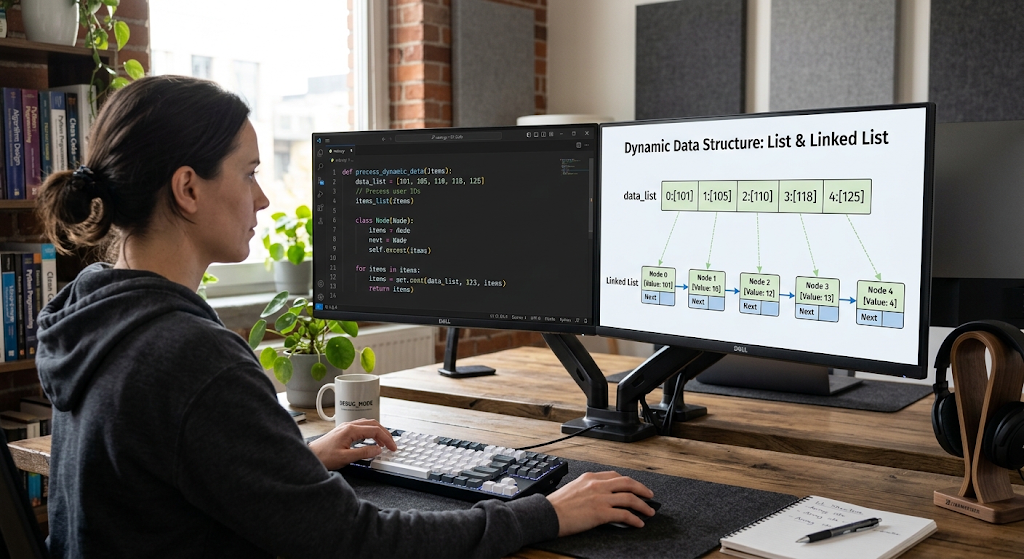
Common Applications of Linked List.
Other structures can be implemented using linked lists, and collections that are modified often can be implemented using linked lists. They may be used to keep sequences of items, for some memory-related operations or for lists where there are frequent insertions and deletions from the end.
Another good concept to illustrate with a linked list is the relationship of objects to each other. While most contemporary programming languages offer more abstract collection types that programmers deference to rather than building a linked list, it can still be useful to understand linked lists, as it reinforces your grasp of memory organization, references, traversal and algorithmic trade-offs.
Stacks
Stacks are a type of data structure which is based on Last In First Out (LIFO) principle. This will allow the last added item to be the first one removed. Timely analogy: stack of plates – as plates are stacked one on top of another, the last one added is the easiest to remove. A stack is a data structure that typically includes methods for adding an element to the top, removing an element from the top, and selecting the top element.
Stacks are a data structure that usually supports functions like push an element onto the top, pop an element from the top and select the top element. Stacks are simple but very useful; they are constructed so that access is focussed at one end. They play a special role when the last operation or item to be processed is the first one in the list.
Where Stacks Are Used
Stacks are significant in function calls, expression evaluation, undoing and navigating through some program states. If a function is calling another function, information on the active functions must be kept by the program, so that it can return data to the other function once the function it called returns. It is helpful for this use to employ a process that is similar to a stack!
Stacks may also be used to implement functions like undo and redo in which case each action that is performed can be undone in the reverse direction. Stacks are also used by programmers in implementing a depth-first search, and in solving problems involving matching parentheses, nested expressions, and backtracking.
Queues
A queue is a First In First Out (FIFO) data structure. That is, the first element that is added is the first element that is deleted. A good analogy is a line at a service counter: people tend to get served in the order they are in line. Queues are useful in software applications where tasks or requests must be executed in a first-in-first-out (FIFO) manner.
A queue usually has two operations: insert and delete.Usually, a queue allows insertion of elements at one end and deletion of elements at the other end. This type of organisation makes the use of queues important, as they are used to manage workloads, coordinate processes and to handle information that is not provided all at once, but rather continuously.
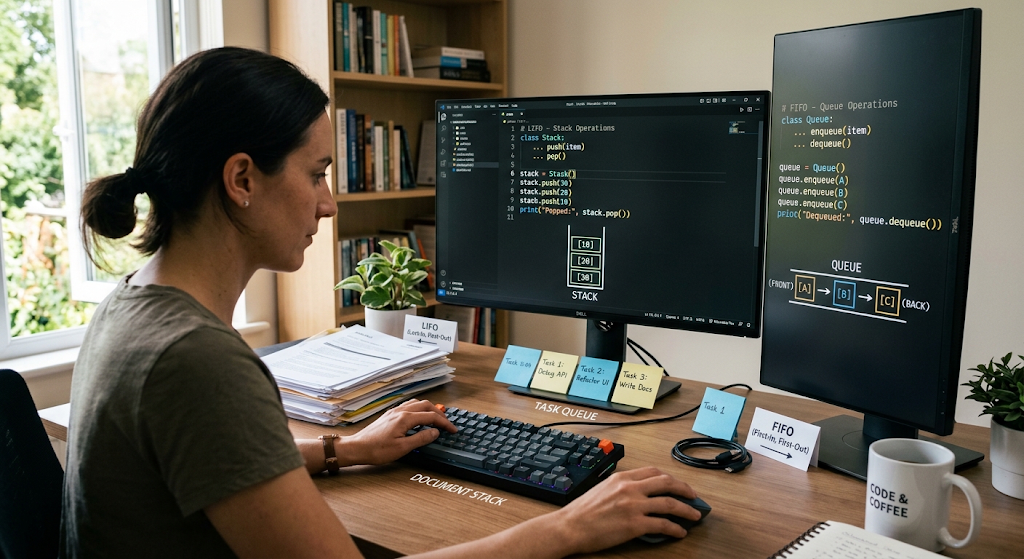
Application of Queues
Queues are used in various contexts in computing, such as task scheduling, message processing, network communication, printing systems, etc. For instance, a printer can print several documents while processing another document. The system can have pending jobs queued up rather than processed haphazardly.
Queues are also used in algorithms using depth-first search, which process nodes based on their discovery order. Queues can be used to decouple producers who produce work and consumers who consume it, and are useful in larger applications for building systems that can process or accept many tasks or requests.
Hash Tables
The information in a hash table is stored by means of keys that are mapped to positions by a hashing function. A program can use a key to get the value efficiently instead of serially searching the list. This is why hash tables are particularly useful in situations where quick look-up is required.
For instance, an application could use a user identifier to retrieve user data, a product identifier to fetch product data, or a word to get the count of its occurrences. Average-case hash table insertion, deletion, and lookup often have very good performance, depending on the quality of the hashing process and the way in which collisions are handled.
When to Use Hash Tables, and When we Don’t.
When data must be accessed via some special key or an identifier, hash tables are used. They have special applications like dictionary, cache, index, lookup table, counting applications etc. A programmer could use a hash table to check whether a user name has already been used for a program, to count the frequency of words in a document or to easily access information about program settings (key) from a setting name (value).
An important thing to note is that sometimes the same location can have different keys, which can be considered a collision. Therefore, hash-table implementations have to have methods for collision resolution and efficient performance.
Trees
The data in a tree is structured in a hierarchy of nodes and connections between the nodes and their children. A tree is a collection of nodes that form multiple paths, unlike a simple linear structure like an array or queue, etc. The node with no child nodes is called a leaf, and the top node is called the root. Trees are good in situations where information has a hierarchy of some sort, or when you need to search and organize hierarchical data.
In the real world, an example of a file system is a folder that can hold files and folders, allowing the organization to form a hierarchy. Trees also have applications in other software development areas, such as databases, search systems, compilers, and more.
Binary Trees and Binary Search Trees.
A binary tree is a tree where each node can have two branches. The binary search tree imposes an ordering rule that enables the values to be ordered in such a way that searching can be more efficient if the tree is well-structured. The balanced trees are more important as an unbalanced tree may become inefficient and act like a long chain of nodes.
A programmer is not always called for to code a tree, but he should be familiar with the principles of the tree. Trees are especially useful when you need to store data hierarchically, perform an efficient search, or keep data in an ordered structure.
Heaps
A heap is an unusual tree structure that allows efficient retrieval of the highest or lowest priority element. The smallest value always lies at the top of a min-heap and the largest value at the top of a max-heap. Priority queues are closely related to heaps, as they can be used to repeatedly extract the highest-priority item from a collection without having to sort the entire collection after each change.
This is helpful when the system needs to perform some action based on the urgency of the action and not in the order it is received. For instance, if a scheduling system has to run some critical jobs before normal jobs, then a priority based scheduling system is more suitable than a simple FIFO scheduling system.

Common Uses of Heaps.
Priority Queues are often implemented using heaps, scheduling algorithms use heaps, and the heap sort is one widely used sorting algorithm that utilizes heaps. They are also used in graph algorithms which require the subsequent item to be picked based on a varying priority. An advantage of using a heap is that it can be used efficiently to keep track of the priorities of the elements when they are inserted and removed.
A heap is not designed to be used as a general collection, though, since a heap can access the highest (or lowest) priority element in the collection, but cannot provide fast arbitrary searches. The difference between these is useful for a programmer to understand when deciding what structures to use in their program, depending on the most frequent operation it performs.
Graphs
A graph is a diagram that shows how things are related. It is made up of vertices or nodes, linked by edges. Graphs may be directed, un-directed, weighted or un-weighted depending on the problem they represent. For instance, a social network might be represented as vertices and relationships as edges. The locations can be represented as vertices, and the roads as edges, with distances or travel costs defined as weights.
Graphs are very useful since many real-world systems are not hierarchical, but instead are based on relationships. They allow the programmer to create a model of connections, then to search, analyze, optimize or navigate a search through those connections using algorithms.

Where Graphs Are Used
Navigation systems, telecommunications networks, recommendation systems, social networks, dependency management, and transportation planning are all use cases that involve graphs. A weighted graph can be used to represent locations and distances between them, and a recommendation system can be used to represent relationships between users, products, or content.
Graphs can also be used to show relations between software packages or software tasks in a project. Examples of common graph algorithms are breadth-first search, depth-first search, shortest-path algorithms, and connected-component algorithms. The algorithm used is dependent upon the type of graph and the question the application is trying to answer.
How to Choose the Most Suitable Data Structure
When deciding how to structure the data, first ask about what you want to do with the data in your program. When building an application, a programmer should think about if they need fast indexed access, need to insert and delete items often, need to find an item easily by key, need to process items in priority order, need to organize items in a hierarchy, and/or need to model relationships between items. The amount of memory required and the approximate size of the data set is also crucial.
For instance, an array might be suitable if data is being accessed by an array key, and a hash table may be appropriate if data is being accessed by key. A queue is used for processing tasks in an orderly fashion, while a graph suits complex relationships. It is not the aim to make the most sophisticated structure, but to make the one whose characteristics are similar to the problem at hand.
Consider the Operation First!
One approach to better decision making is to identify the operations that will be most common. Discuss if the program will primarily be for reading elements, insert new elements, delete existing elements, find elements, keep them sorted, or manipulate relationships.
When these requirements are understood, the right structures become more apparent. Also, note that the application also needs to scale with the data volume. A solution that is efficient with just a few dozen records might be inefficient with millions. Programmers can design easier-to-maintain applications that can process larger workloads by knowing these trade-offs.
Data Structures and Programming Skills
Data structures should not be studied as a standalone topic and stopped once the definitions have been learnt. The point is to share and use the structures in small projects, and to compare the behavior of the program based on various choices. Simple arrays and linked lists are the first structures that a beginner should learn, followed by stacks, queues, hash tables, trees, heaps, and graphs.
The practical programming problems are very useful since they compel the programmer to determine which structure is the best fit for a given problem. As time goes on, these choices start to feel natural, and the programmers start to notice patterns that occur in many different applications and technical interview questions.
Conclusion
Data structures are useful to the programmer in organizing and manipulating data; each structure has certain strengths and weaknesses. Arrays can be accessed in an indexed manner, linked lists can be used to capture the nodes of a collection in a flexible way, stacks can be used for LIFO processing, and queues can be used for FIFO processing. The hash table is used for fast key-based lookup operations, the tree is used for hierarchical data, the heap is used for efficient management of priorities and the graph is used to describe relationships between connected entities.
By comprehending these structures, programmers can better develop efficient code and solve problems systematically. A developer should not memorize all of the details of how to implement each structure, but should be able to find out what each does, what operations work well with each structure, and what are the times when each is most useful. From this base, selecting a suitable data structure becomes a more practical, than theoretical, aspect of everyday programming.