Introduction
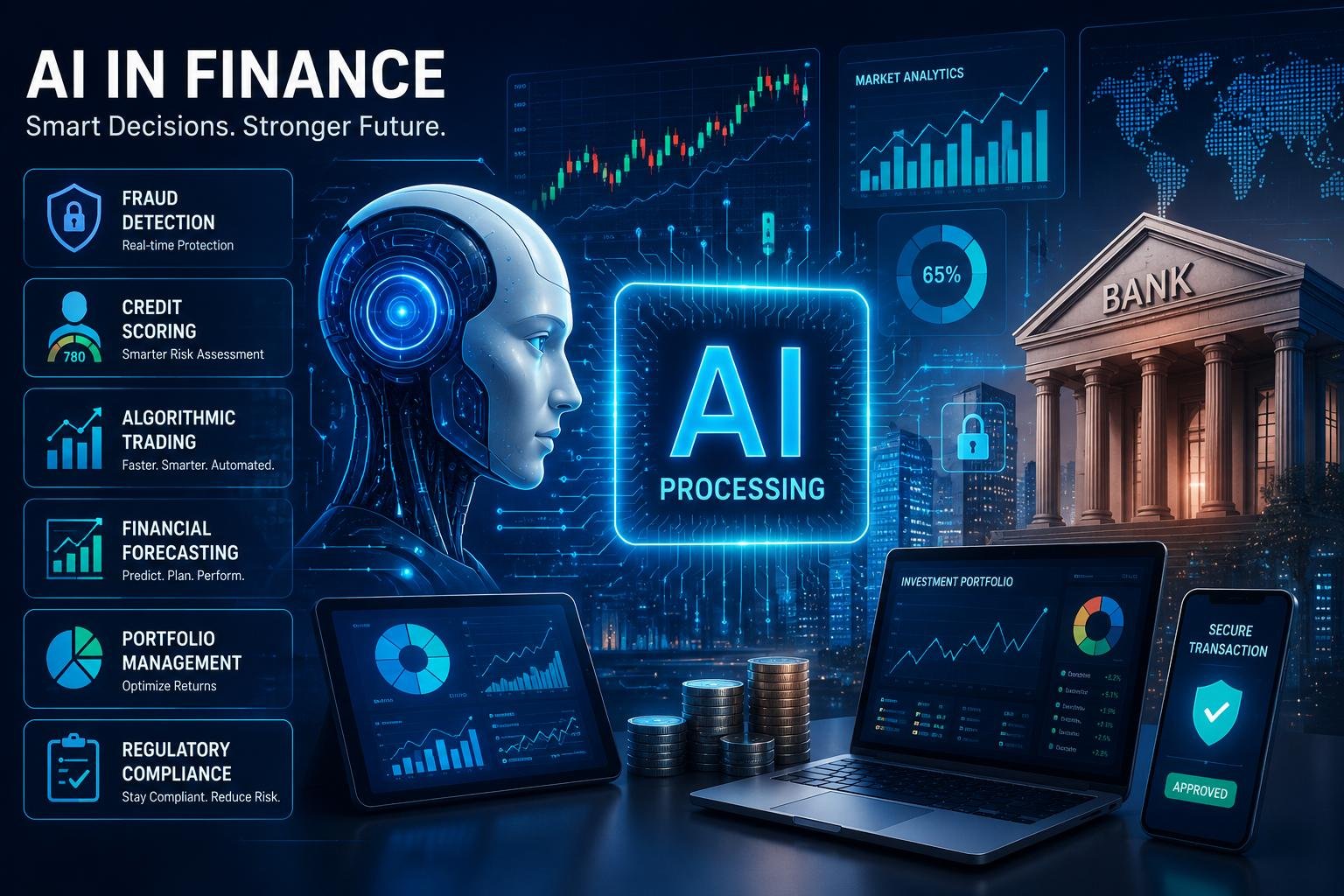
Artificial Intelligence (AI) is revolutionizing the financial industry, allowing institutions to handle vast amounts of information, recognize patterns, make decisions, and provide services at a level that would be challenging for humans. From the banks and investment firms to insurance companies and payment providers, and fintech businesses, artificial intelligence is the latest trend in financial institutions to boost their efficiency in navigating the complex financial world. AI systems can also be employed in financial forecasting to scrutinize historical data, market trends, economic indicators, and other pertinent factors, enabling companies to make better projections about future financial performance. AI is also being applied to financial forecasting, fraud prevention, credit scoring, algorithmic trading, customer service, risk management, and portfolio management and regulatory compliance, among other use cases at IBM. While the apps are promising to enhance the velocity and personalization of financial services, they also come with some problems in regard to privacy, bias, cyber security, transparency, and overreliance on algorithms for decision-making.
Applications of AI in the Finance Industry
Fraud Detection & Financial Security
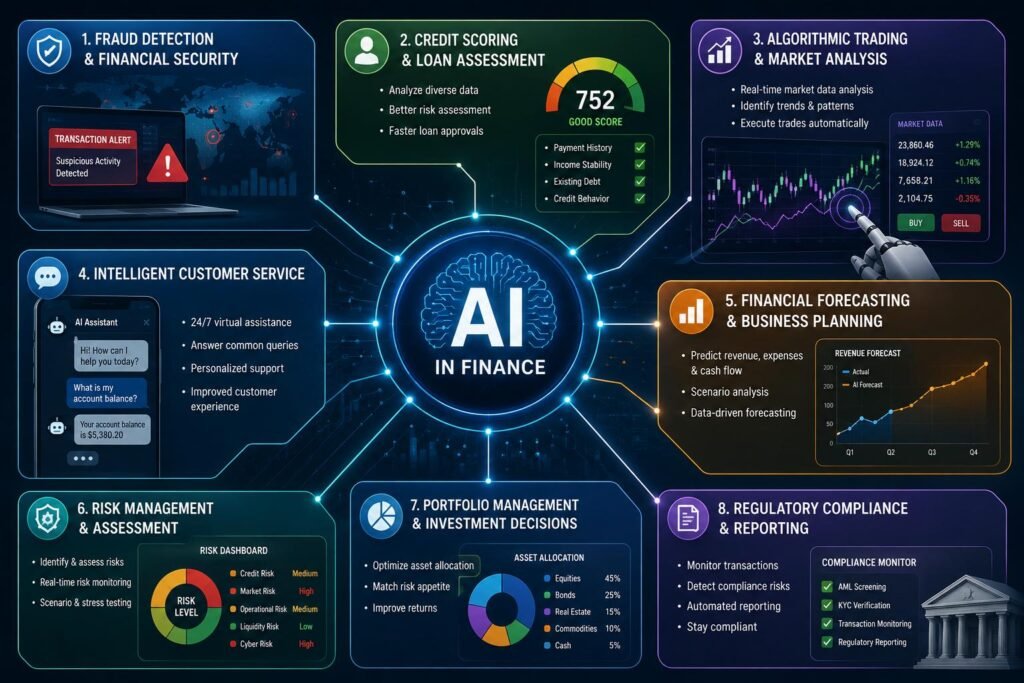
Fraud Prevention is among the most ancient applications of AI in finance, as financial institutions have to deal with many transactions, all of which should be tracked in real-time. Most rules-based fraud detection systems are based on either a minimum or maximum dollar amount or location of the transactions. AI can augment these methods by analyzing the vast amount of data and uncovering the unusual patterns that might point to fraudulent activities. Machine learning can be utilized to investigate if any anomalies exist with respect to the frequency of transactions, transaction timing, location, device or spending habits. In the event of a suspicious transaction, the system may issue an alert, request additional user authentication or temporarily block the transaction. This can help financial institutions to detect fraud more quickly and take appropriate measures to minimize damages. But, AI systems need to be vigilant, as sometimes the real transaction may be confused with fraudulent activity, leading to false positives that can create a hassle for customers.
Credit Score Assessment
AI is also revolutionizing the process of assessing borrowers and providing credit. Average credit scores include things such as debt, repayment history, income and credit history. An Artificial Intelligence (AI) loan system will have the ability to analyze far more in-depth and diverse sets of data that could identify relationships and allow lenders to assess the likelihood of a borrower paying back a loan. They can speed up application processing, help with administrative processes and enable customers with limited credit histories to get access to financial services. There is, however, an important challenge with the use of AI in the credit scoring arena: a model may generate discriminatory results even if discrimination was not a deliberate part of the model. If these are a part of a societal or economic inequity, the AI model may, inadvertently, perpetuate or amplify these inequities in the lending data. Financial institutions need to, therefore, build solid testing, right data governance, explainability and man-in-the-middle checking prior to implementing automatic credit options.
Algorithmic Trading and Detailed Market Analysis.
AI, in particular, has made a leap into the financial world and is most prominently used in algorithmic trading, where computer programs analyze financial market data and make trades according to certain algorithms. AI systems can process information that is much faster than the human trader, such as price action, trading volumes, economic data, company announcements, and more. Some more advanced systems employ algorithms based on machine learning to uncover trends and patterns that can reveal possible market opportunities or shifts in market dynamics. Derived from being able to process information quickly, this can aid in high volume trading and enabling the institutions to adapt to the changing conditions quickly. Another way that AI can assist analysts is by organizing the immense amount of market data and identifying correlations for further study. But, there are certain risks in automated trading, especially when the market conditions differ drastically from the data on which the models have been trained, they may behave in unpredictable ways. If there are many automated strategies trading based on the same indicators, however, poorly-designed systems can cause swift market changes, as well.
AI Applications in Customer Service and Financial Forecasting
Intelligent Customer Service
Another aspect that financial institutions are seeing the impact of AI is in customer service. Customer service is another place where AI is making an impact on financial institutions. AI-powered chatbots and virtual assistants are becoming a staple in the world of banking and fintech, capable of handling repetitive tasks like answering common queries, clarifying account details, guiding customers through services, and assisting them outside of office hours. These systems can use natural language processing (NLP) to interpret and respond to customer requests, regardless of what they type. AI can also be used to understand customer interactions and find common issues to help them improve their services. This can translate to faster responses and availability for customers, especially for those simple requests that don’t need the expertise of specialists. But, there are still some drawbacks with automated customer service. A chatbot might have a hard time deciphering a complex query or not understand what customer is going through if they are dealing with a serious financial issue. Systems should, therefore, offer obvious ways for customers to contact human representatives if they fail to find the assistance they need via the automated system.
Financial Forecasting and Business Planning
One such aspect where artificial intelligence can aid in decision-making is financial forecasting, which involves examining financial data and making predictions regarding future financial conditions. Whether it is a business or financial institutions, there are many factors that need to be taken into consideration and regularly forecasted, such as revenue, expenses, cash flow, investment performance, market conditions and others. AI can analyze vast amounts of data and uncover patterns that might not be apparent in traditional spreadsheet data analysis. Financial performance data and economic/market data can be combined into machine learning models and used to generate forecasts that can be refined as additional data is gathered. This can aid in the assessment of various scenarios and help managers determine budgetary, investment, staffing and resource allocation decisions. But predictive statements from AI tools can’t be predictions of the future. Patterns may not be as reliable as they may be in the past if things change in the real world, such as unexpected events, economic shocks, political developments, market disruptions or changes in consumer behavior. It is important to keep in mind that human judgment is still necessary when interpreting forecasts and when taking into account factors, which may not be sufficiently captured in the data available.
AI’s Application to Risk Management and Portfolio Management
Risk Assessment
There are several risks that financial institutions face, such as the credit risk, market risk, operational risk, liquidity risk, and cybersecurity risk. AI can be useful for risk management in identifying indicators of possible losses from a vast amount of information that is analyzed. In one instance, a bank might monitor consumer activity and behavior changes and apply machine learning to assess these changes and adapt their policies accordingly, or an investment firm might use machine learning to analyze data on market conditions and adjust policies based on the changes in risk factors. AI can also aid scenario analysis by assisting institutions to analyze what potential effects such diverse assumptions may have on their finances. The benefit of these systems is that they can process information in a real-time manner and they may be able to sense changes sooner than man. But the risk of money is still subject to unpredictable events, therefore even high level models may fail to work. Institutions need to be careful not to use an AI risk score as an ‘answer’. Instead, AI should be used to support existing risk frameworks and expert judgment, stress testing and appropriate governance processes.
Portfolio Management and Investment Decision-Making Processes
In the realm of portfolio management, AI can increasingly be seen being used to help investment professionals and automated platforms navigate the various types of investment risk in order to maximize investment returns. AI systems can analyze asset prices, economic indicators, company information, market trends, and investor preferences to assist in asset allocation decisions. Algorithms can be used to build and tweak portfolios based on an investor’s goals and comfort level with risk, on robo-advisory platforms. This can help to make investment management more accessible by making it possible to offer automated services without the need for each person to have a standard investment relationship with an individual advisor. AI can also assist business portfolio managers in keeping track of thousands of securities and pinpoint info that may be of interest. But, investment risk can’t be completely avoided by automated portfolio management. Models are based on assumptions and information, and circumstances may turn out to be different.
Regulatory Compliance and AI Governance
Regulatory Compliance
Financial institutions are regulated extensively to safeguard its customers, ensure the integrity of the markets and reduce the risk of activities that may include money laundering and financial fraud. AI can assist institutions in compliance by screening transactions, auditing documents, flagging communications for potential investigation and more. Machine learning can help combat money laundering programs by identifying red flags in transactions and prioritizing the cases for compliance staff. Another area where NLP can be beneficial for organizations is to review massive amounts of regulatory data and extract pertinent requirements. The ability to handle these capabilities will help save some time for compliance and will help experts concentrate on more severe cases. But, regulatory compliance is not just a technical process. Financial institutions are still accountable for ensuring automated systems comply with the relevant legal requirements and their internal policies.
Advantages of AI in Finance
AI’s application in the financial sector is promising for various reasons. For one, AI can enhance efficiency by automating activities that are repetitive and used to take a lot of employee time. Secondly, it can boost the rate of financial institutions’ information processing and reacting to shifts in markets and customer behavior. Thirdly, AI can help with personalization by leveraging customer information to offer more tailored financial products, recommendations and services. Fourth, ongoing monitoring can enhance risk detection capabilities of institutions against fraud, suspicious transaction, and new risks. AI can also be used to analyze datasets which would be too difficult for a human team to analyze manually. These features can help cut down on the cost of the business, and help employees do more work that involves communication, creativity, judgment and specialist knowledge. But the most valuable thing about AI is when it augments people’s abilities, not when it replaces all of them.
Risks and Challenges of AI in Finance
While AI offers promising benefits, there are some risks that financial institutions should be mindful of. There is a significant concern about data privacy as AI systems can often use a lot of personal and financial data. It is crucial for organizations to establish the proper collection, storage, processing and sharing of data in a responsible way that meets the requirements of privacy law. Another challenge is algorithmic bias historical data may have patterns of unfairness that can be reproduced by algorithmic models. The security of the network is also critical, as AI systems can be vulnerable to attacks, manipulation, or unauthorized use. Automated decision-making, too, is an issue. If a person’s loan application is rejected, the algorithm can flag details, or the algorithm can suggest an investment, the individual might wish to know why the algorithm made these selections. This can be challenging with very complex models. To ensure that financial institutions can leverage the advantages of AI, they must also have robust governance, a secure infrastructure, frequent model testing, human oversight, and transparency regarding accountability for AI-related decisions.
The Future of AI in Finance
Going forward, the potential for AI in finance is going to be the deeper integration of AI systems with financial platforms and human experts. As more knowledge-driven tasks like research, document analysis, financial reporting, customer communication, and others become more common, Generative AI can help employees. The more sophisticated predictive models may be able to help in real-time risk monitoring and financial planning in the context of new information. AI could also be more intricately involved in fraud prevention, personalized financial offerings, regulatory technology, and investment analysis. Meanwhile, regulators and financial institutions will also likely be more focused on responsible AI, transparency, cyber security, model governance, and explainability. Instead, the future will not be just about developing more powerful algorithms. It will also require finding out how to responsibly control, test, and utilize such algorithms. In an era of increasingly automated financial systems, companies that are able to harness the power of AI while minimizing the risks will have a strategic advantage in capturing benefits.
Conclusion
From fraud detection and credit risk assessment to trading securities, customer service, financial forecasting, risk management, portfolio management, and regulatory compliance, AI is now making an impact on the financial landscape. It can handle massive amounts of information quickly and efficiently, which can enhance the efficiency, speed and personalized financial experience. AI is not making financial transactions less uncertain and as it becomes more pervasive, issues of data privacy, algorithmic bias, cyber security, transparency and algorithmic decision making are increasingly a concern. The best way is to neither against the AI, nor relies on it without proper supervision. To leverage AI as a valuable technology complement, with Continuous human oversight, strong governance, security measures around data and a strong monitoring system.
Get more well researched information about Artificial Intelligence in Finance here.