Introduction
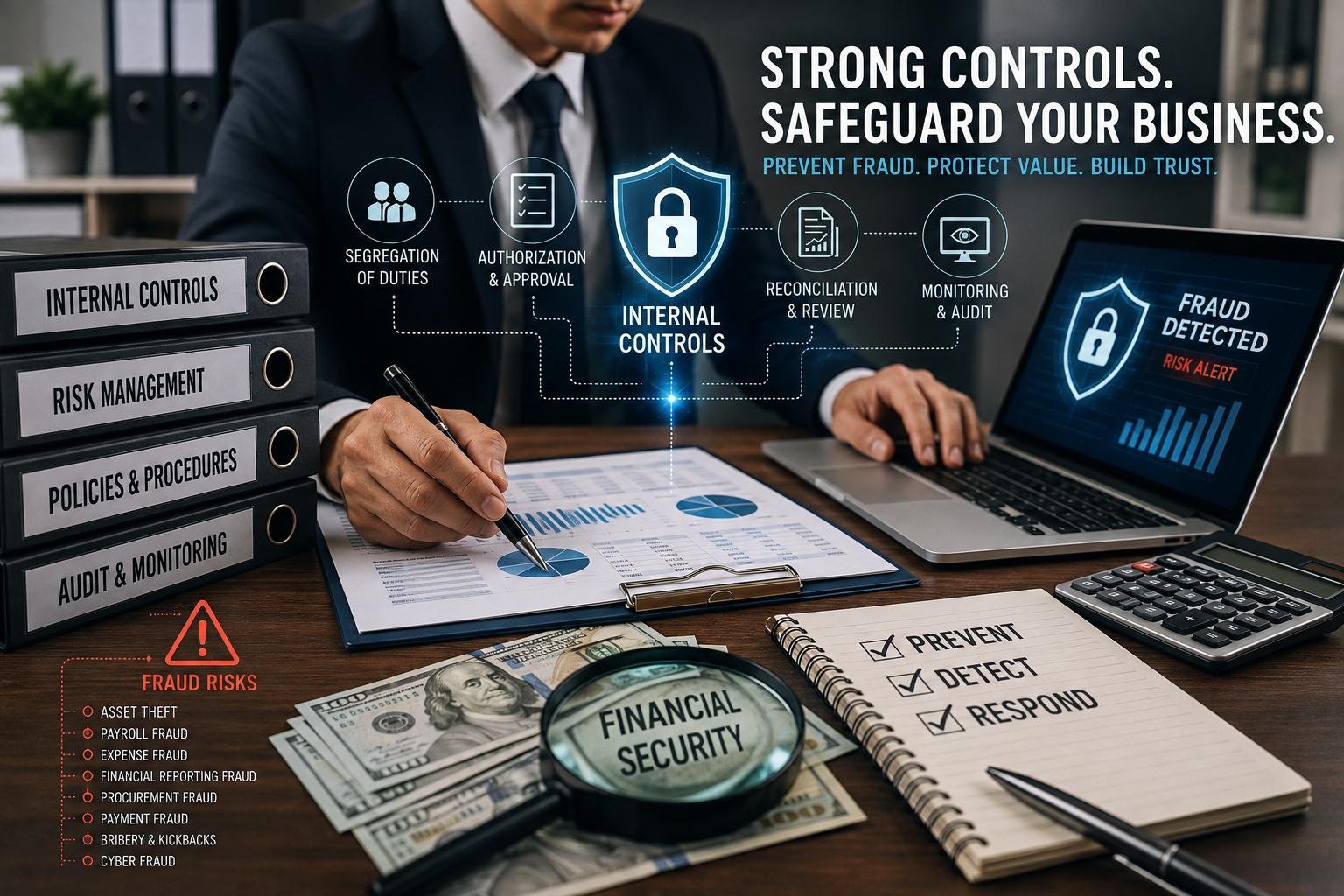
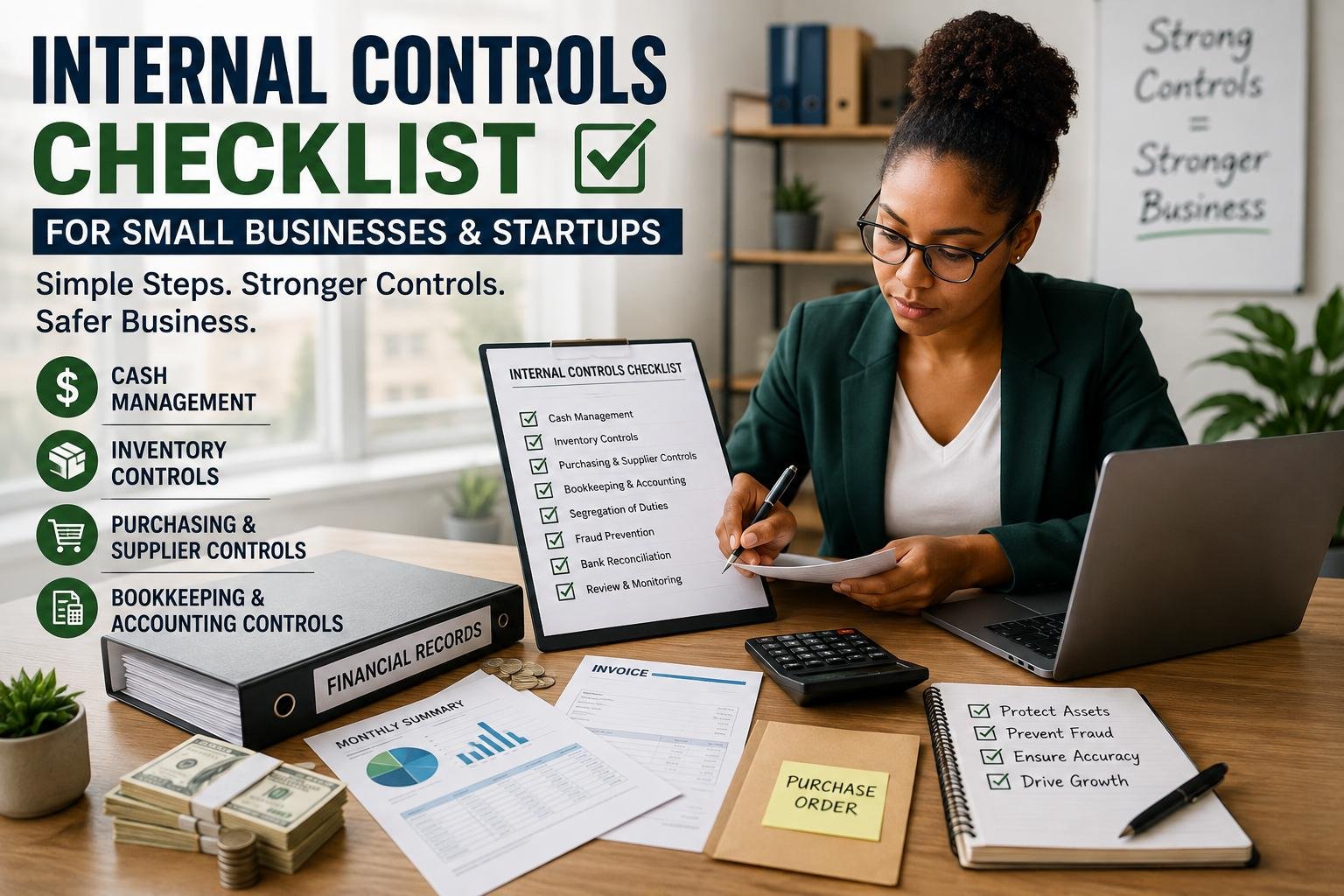
Small business owners face critical decisions regarding their business finances, stock, employees, suppliers, customers, and daily business operations, and typically don’t have the support of a large finance or compliance department. This is particularly significant since even a minor error, unauthorized transaction or dishonest practice could make a big impact on a developing firm. There’s no one right or wrong way to develop an effective internal controls checklist, and it needn’t be complex or costly. Rather, there are sensible processes that small companies can implement to allocate responsibility, get proper sign-off, safeguard assets and regularly audit financial paperwork. It is not about making things more complex, but it is establishing regularized safeguards which assist owners to understand where their money is going, if the transactions are valid, and if the business’s records can be believed.
Internal Controls
Internal controls are the policies, procedures, checks and routines that an organization implements to protect its assets, to keep accurate records, to prevent and detect fraud, to improve the efficiency of operations, and to assist in compliance with requirements. An internal control that can be implemented by a small business could be such a simple as having two individuals sign a large payment, monthly reconciliation of the bank account, management of the inventory or restricting access to the accounting software. These controls have been successful because they have added accountability to normal tasks. If not, one person could order the goods, approve the purchase, get the goods, pay for them and record the transaction and no other person would be aware of what had happened. This focus on responsibility amounts to unneeded risk. Good controls allocate vital responsibilities as widely as possible and provide evidence of key transactions being reviewed.
Internal Controls are Essential to all Small Businesses
Limited staff size may make controls more important in small businesses and startups, as they are often perceived as being more applicable to large corporations. In a small business, the same person might have to do a number of financial and administrative tasks as there is no point in hiring specialists for each of these as it is not possible in a small company. This can complicate the detection of errors and frauds. It is possible that an employee may be able to make a supplier without any independent supervision, approve an invoice, and arrange for payment without independent supervision. Likewise, a home owner that does not have someone else overseeing cash, inventory or bookkeeping could not discover discrepancies until they get considerable. Internal controls are a systematic method of minimizing these risks, but don’t require a large accounting department. While it may seem difficult to create meaningful safeguards when there are only 2 or 3 people available, owner reviews, approval thresholds, reconciliations, limited system access, documented procedures, and periodic checks are all ways that businesses can put in place meaningful safeguards.
Internal Controls Checklist for Cash Management
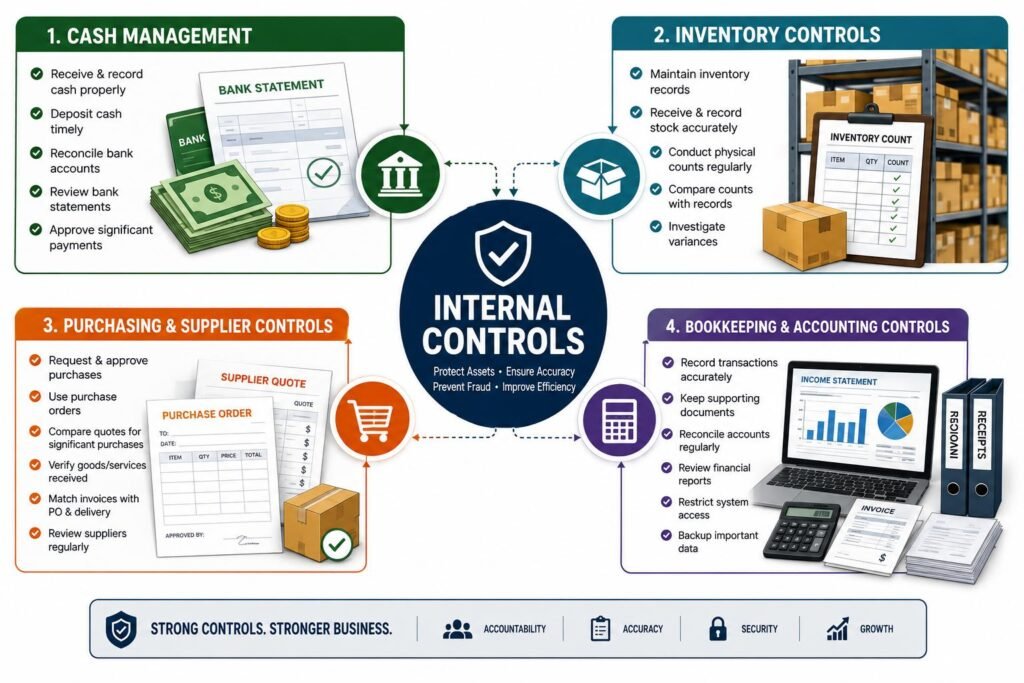
One of the first areas to be tackled should be cash as it is very easy to steal, pay out wrongly, record wrongly and misappropriate. Small companies need to take the time to set guidelines for receiving, carrying, depositing and spending cash. All transactions should be documented (receipts, invoices, P.O. or other suitable documentation) and cash receipts should be recorded as soon as possible, and not just remembered. If cash is accepted then there is a need to count the cash regularly in the cash register or cash box and to check the count with the recorded transactions. Such deposits need to be made in a timely fashion to avoid holding large sums of money on business premises unnecessarily. Owners should also check with the bank statements and get an idea of what any unusual transactions might have been, and it’s important to keep business and personal bank accounts separate. The simple controls establish a strong audit trail from the transaction to the accounting entries and bank statement.
- Provide receipt or keep e-records for cash sales.
- Count the actual cash frequently and include an investigation of discrepancies.
- Don’t let a large balance grow on your deposit account.
- Use separate bank accounts for business and personal purposes.
- Ensure payment approval of large, unusual, or significant payments.
- Review bank statements on their own from payments.
- Regularly reconcile business bank account.
- Look into any unauthorized withdrawals, transfers or discrepancies.
Inventory Controls for Small Businesses.
For anyone who deals in the sale of physical goods, whether they are retailers, wholesalers, restaurants, manufacturers or business owners, inventory can be a significant investment. Inadequate stock management may cause theft, product damage, incorrect financial records, stock shortages, ordering too much and storage expenses. Small business will need a minimal inventory record that reflects the presence of inventory, how much of each item is in stock, inventory purchases, sales, returns and adjustments. Periodic physical inventory should be taken and compared to the record, and if a big discrepancy occurs, it should be investigated and not just written down without a reason being given. Access to storage areas should also be limited where possible, especially for items which are of high value or are easily resold. Damaged, missing, expired or obsolete stock should be documented to allow for adjustments to be supported with evidence. A spreadsheet can be a good starting point even if it’s not done up to the minute, or even if it’s only maintained by the individual managing the stock.
- Update and maintain an inventory log.
- Assign to someone the responsibility of receive and record the stock.
- Inventorize physical stock on a regular basis.
- Compare physical counts and accounting or inventory records.
- Analyze odd or unintended stock shortages/surpluses.
- Control valuable and sensitive inventory.
- Record defective, out-of-date, returned and used goods.
- Prior to ordering new goods, review slow moving goods.
Purchasing and Supplier Controls
Businesses use the purchase of controls to help ensure that the business buys the appropriate products or services at fair and reasonable prices from reputable sources. Absence of a purchasing process can lead to unnecessary orders, higher prices, usage of unauthorized vendors, or personal orders. The procurement system doesn’t have to be highly complex for small businesses. A simple procedure can involve employees to explain why they are making significant purchases, getting approval before a purchase order is made and keeping supporting documents like quotations, purchase orders, invoices and delivery records. If it’s a large item, shopping around with other suppliers can be another safety measure. Additionally, supplier information should be checked regularly to look for duplicate suppliers, strange bank account changes or suppliers who have questionable relationships with employees. Where possible, the person ordering goods should not be the sole individual to check for goods delivery and approval of payments. These are fundamental measures that result in the separation of purchasing and financial disbursements.
- Have approval for major expenditures.
- Use purchase orders and written purchase requests, as appropriate.
- Get price estimates for significant or special items.
- Make sure that goods or services were received.
- Correlate invoices to purchase and delivery documents.
- Perform supplier review before adding supplier to the system.
- Check for odd or duplicate vendor changes.
- Purchases over predetermined limits will require extra approval.
Bookkeeping and Accounting Controls
The accuracy of bookkeeping is extremely important due to management decisions being based on accurate financial information. A regular procedure for keeping records of sales, expenses, purchases, payroll, loans, asset transactions and other financial transactions should be set up in a small business. Documents should be kept to trace back to an invoice, receipt, contract, bank transaction or any other document supporting the transaction. Regular bank reconciliation should be performed, and discrepancies should be resolved in a timely fashion, rather than waiting for an indeterminate period of time. It is important that the owner or another appropriate party review important financial reports regularly to check for unusual expenses, revenue changes, unanticipated balances and transactions that do not seem to be related to the normal business operations. Limiting access to accounting software should also be restricted based on job duties. Only those permissions that employees need should be given to them; administrator privileges must be carefully controlled. These practices not only enhance accuracy, but also accountability.
- Keep records up to date and regularly.
- Retain receipts, invoices, contracts and other documentation.
- Reconcile bank accounts on a regular basis.
- Check for unusual or unexpected transactions.
- Access to the accounting system is limited based on responsibilities.
- Ensure administrator passwords and login information is protected.
- Make copies of significant accounting data.
- Regularly review financial reports.
Segregation of Duties in the Absence of Staff
One of the most valuable internal control principles is segregation of duties, but this can seem challenging for a small business. The goal is to not allow one party in a transaction to have the total responsibility for it. Because of the limited number of employees in a small company, management review can be a critical compensating control as they may not be able to split responsibilities among different departments. For instance, one employee might do the preparation, and the owner check it and authorize it. One employee might receive the inventory while the other one might periodically compare the inventory receipts with the supplier’s invoice. When the bookkeeper is responsible for accountings and bank reconciliation, the business owner may be able to check the bank statement and bank reconciliation. The important thing to remember is that you don’t need to have an independent review in every aspect of the business, but rather in the areas that could pose the greatest threat.
Fraud Prevention and Detection Controls
Internal controls do not provide absolute assurance of fraud, but they may make it easier and more difficult to detect fraud. The following are areas where small business should focus on cash transactions, payroll, expense reimbursements, supplier payment, refunds, inventory adjustments, and company cards. All employees are to be aware of the following: Unauthorized transactions are not allowed and business expenses must be supported with documentation. Before the reimbursement of any expense claims, they should be reviewed, and it should be ensured that any changes to payroll are authorized. There should be spending limits on company cards and have well-defined acceptable uses. Owners should also audit all unusual transactions, not just assuming that all transactions reflecting in the accounting system are normal. When employees feel uncomfortable in discussing issues with a supervisor, a confidential reporting system can also be used to add an additional layer of protection. A strong control environment includes effective expectations, effective procedures, effective enforcement and management oversight.
Low-Cost Technology to Assist in Building Internal Controls
Internal controls can be improved with technology without a large investment in special systems. Cloud accounting platforms can offer transaction histories, user permissions, audit trails, bank feeds and financial reports to help monitor. Online banking systems can also set up alerts, payment limits and extra approvals for businesses. Stock control software or organized spreadsheets can aid in the monitoring of stock movement and potential discrepancies. Invoices, receipts, contracts, and approvals can be stored in a document storage system to be retrieved as needed to prove that it has been done. But technology is no substitute for management supervision. Improperly set up permissions can introduce new vulnerabilities, and a shared password can make it difficult to identify who performed a transaction. Businesses need to, therefore, ignore user access on a regular basis, revoke access once employees have departed, secure sensitive data, and use human supervision to verify that vital automated procedures are working.
How to Apply the Checklist without Complicating the Business
The key to a good internal control system is that employees are able to understand it and follow it regularly. Instead of implementing dozens of procedures at once, the first step for a small business is to determine what the most critical assets are and which the most critical processes are. Weaknesses in cash, bank accounts, purchasing, inventory, payroll and bookkeeping can lead to quick impacts on profitability and financial reporting. Weaknesses in these areas can quickly impact profitability and financial reporting, so begin with cash, bank accounts, purchasing, inventory, payroll, and bookkeeping. Then, determine who is responsible for each control, and when it should be conducted. This could be done as a daily cash count, weekly payment review, monthly bank reconciliation or quarterly inventory count, depending on the business. Written procedures must be expressed in simple terms to ensure that employees are clear of expectations. The controls should also be reviewed on a regular basis and management should question whether they are effective or not. Where a procedure is often overlooked because it is impractical, redesigning the procedure is a more effective solution than adding rules.
A Monthly Internal Controls Review in Practice
The monthly review will help ensure that your small business is disciplined and that you are aware of any existing issues before they get out of hand. The owner or designated reviewer has the ability to review bank reconciliations, unusual payments, large expenses, supplier changes, inventory differences, outstanding receivables and accounting adjustments. The reviewer should question if there is proper supporting documentation for transactions and if they were approved as per company policy. Comparisons are helpful between present and past results, and a study of large increases or decreases in revenue, expense, gross profit, cash position, or inventories is helpful. It doesn’t have to be a full system check for every transaction, rather it’s to highlight exceptions that need to be investigated. Companies can keep an easy control log which records that reviews were carried out, who undertook them, what problems were identified, and how they were dealt with. This builds accountability and offers helpful documentation that management is actively managing their internal control environment.
Conclusion
The efficient management of internal controls does not need to be a consequence of a large finance department, costly consultants or complex company procedures. There are a number of steps small companies and startups can take to minimize risk: Assign clear responsibilities, document transactions, keep the business and personal financial records separate, safeguard cash and inventory, audit purchases, reconcile accounts, limit access to the system and monitor accounts regularly. The number one rule is consistency, a control implemented is far more useful than a complicated control with no actual application. Business owners should start with areas that would have the most significant impact in the event of a loss, error or fraud and progressively build up their processes as their company grows. Small businesses can safeguard assets, enhance financial accuracy, boost accountability, and establish a solid base for sustainable growth by leveraging a practical internal controls checklist and tailoring it to the specific needs of their business.
Get more well researched information about Internal controls checklist for small businesses here.