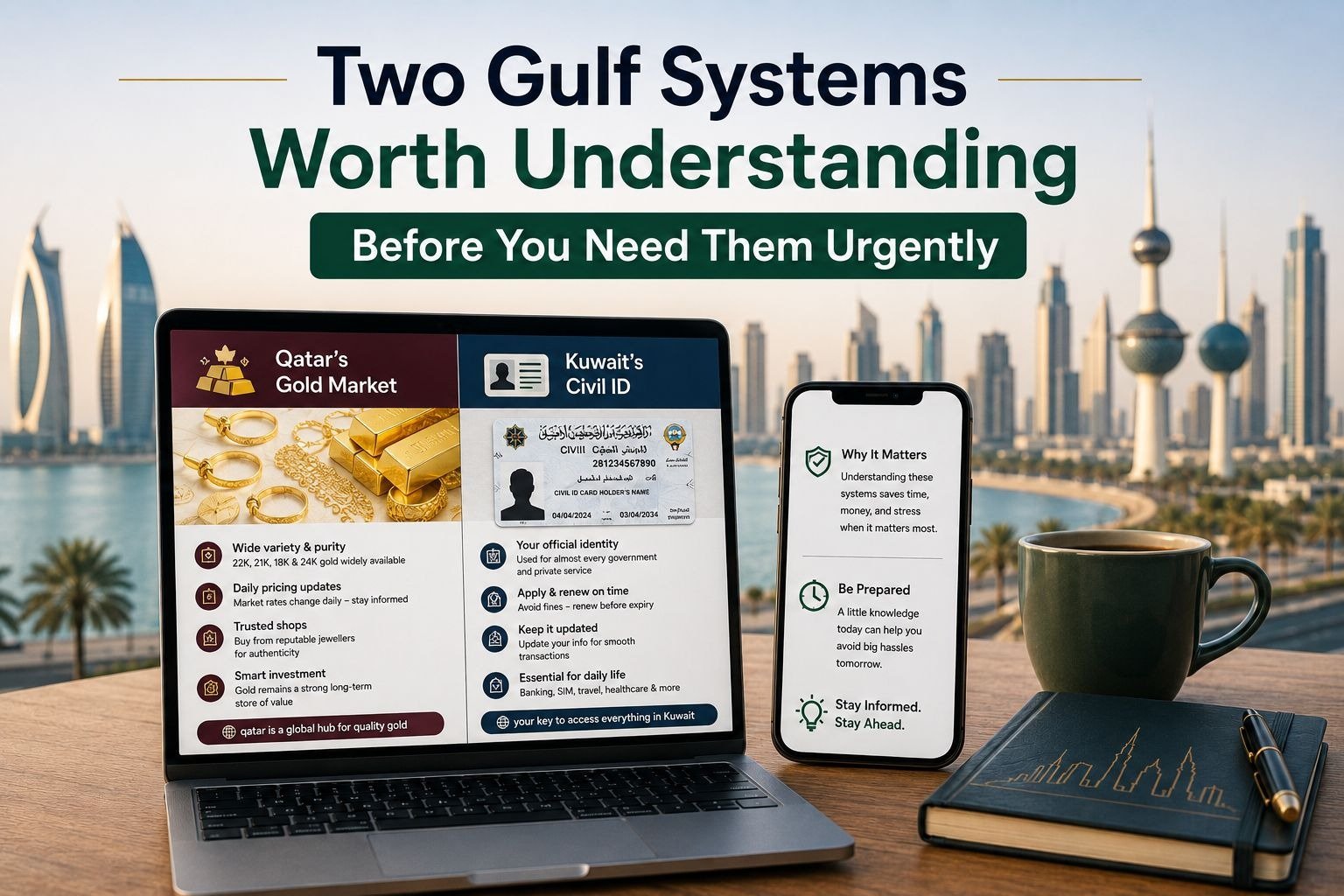
Across the Gulf, certain systems only become urgent the moment something goes wrong with them. A gold purchase decision made without checking the day’s rate. A government document status that turns out to be blocked right when it’s needed most. Both are entirely avoidable with a bit of upfront understanding — and both are worth walking through properly rather than learning the hard way.
Why Qatar’s Gold Market Rewards Informed Buyers
Qatar holds a distinctive position among Gulf gold markets, and understanding what makes it different is genuinely useful for anyone planning a purchase in the country.
The most significant advantage Qatar offers is structural rather than incidental: the country levies no VAT on gold purchases, keeping the effective cost of buying considerably closer to the raw international spot price than in many comparable markets. Combined with jewellery making charges that typically run between 2 and 5 percent above spot — competitive by regional standards — Qatar consistently ranks among the more affordable places to buy gold across the GCC.
Current pricing shows 24-karat gold in Qatar at approximately 509.36 riyals per gram, with 22-karat — the purity most commonly used in jewellery — at around 466.92 riyals, 21-karat at approximately 445.69 riyals, and 18-karat at roughly 382.02 riyals. These figures update every five minutes during market hours, tracking the international spot price through the Qatari riyal’s fixed peg to the US dollar at 3.64 riyals per dollar.
The market has shown real movement recently. Looking across the past month, the 24-karat rate moved from the high 450s in mid-July up to over 509 riyals by early August — a jump of more than 10 percent in roughly three weeks, with a particularly sharp single-day move of over 20 riyals between the 5th and 6th of August alone. For anyone timing a significant purchase, that kind of swing represents a meaningful difference in what the same piece of jewellery ends up costing.
Doha’s retail gold scene is concentrated around Souq Waqif, alongside major shopping destinations including City Center Doha and Mall of Qatar, all of which apply the same underlying spot price with only making charges varying by retailer. For anyone who wants the full picture, gold prices in Qatar are tracked live across every karat weight, with historical trend data and weight-based calculators removing the need to check multiple sources or rely on a rate that may already be outdated by the time a purchase decision is made.
Kuwait’s Civil ID System and Why Status Checks Matter
Shifting to an entirely different but equally consequential system, Kuwait’s Civil ID underpins nearly every formal transaction a resident in the country needs to complete. Employment processing, opening a bank account, renting property, registering a vehicle, accessing government services, and securing health insurance all depend on holding a Civil ID that shows an active, valid status.
The Public Authority for Civil Information, known as PACI, manages the system and provides several channels for checking status — the PACI website, which returns an instant result using just the 12-digit Civil ID number with no login required, alongside the Sahel app, the MOI Kuwait app, the Kuwait eGovernment Portal, and a dedicated phone line available during government office hours.
Understanding what the possible status outcomes actually mean matters considerably. A result showing “Ready for Collection” requires no further action beyond picking up the card within the specified window. “Under Process” generally means the application is progressing normally, with a typical turnaround of around fourteen working days before it’s worth following up directly. “Suspended,” however, is the result that demands immediate attention — it cannot be resolved online or by phone, and requires an in-person visit to a PACI office with supporting documentation, most commonly triggered by an outstanding renewal fine, a data mismatch between government systems, or residency that has lapsed without the Civil ID being updated accordingly.
No government service counter in Kuwait will process a transaction for a resident whose Civil ID shows a suspended status in PACI’s system, which makes checking status before any planned government visit a genuinely practical habit rather than an optional precaution. For anyone who needs the full breakdown, a Kuwait Civil ID status check guide covers every current checking method along with resolution paths for each possible outcome — considerably more clarity than piecing together the process from scattered or outdated sources.
What Connects Both Systems
Gold pricing in Qatar and Civil ID status in Kuwait sit in entirely different domains, but both reward the same underlying discipline: checking current, accurate information before acting rather than relying on assumptions carried forward from an earlier point. A gold rate checked days ago may already be measurably out of date given how quickly the market can move. A Civil ID assumed to be active without verification can derail a government appointment that took weeks to schedule.
For residents and buyers navigating either system, building the habit of verifying current status — whether that’s a commodity price or a government record — consistently prevents the kind of avoidable friction that comes from acting on outdated or assumed information, in two areas of Gulf life that otherwise have very little in common.