
Introduction: The Basics of Web Creation
To have a website on the internet, you need two things — domain name and web hosting. In the case of an online portfolio, blog, or ecommerce website, these two parts collaborate to make the site available to visitors from all over the world. The domain name is used by people to locate a website, and the web hosting is the place and technology used to save the files of a website and distribute them to the users who visit it. These two are essential for any website to be effective and to create a strong online presence.
One of the most common misconceptions of beginners is that they simply need to design a website and fill it with content. However, the technical underlying the website is just as important. Knowing about how web hosting and domain names work is useful for web owners in making the right decision in launching and managing website projects. Choosing the right web host can enhance the speed of your website, ensure it is more secure, reliable, and user-friendly, and can also reinforce brand identity and help your website stand out in the minds of visitors. Selecting the appropriate domain name can further help establish a strong brand identity and make your website more memorable.
Websites are a reflection of people, businesses, institutions and communities in today’s digital world. Slow or unreliable sites can adversely impact visitors’ trust, search engine ranking, and business opportunities. Hence, selecting the suitable hosting company, registering a successful domain name, securing the web site with security features, and knowing the significance of essential technologies like DNS and SSL certificates are crucial steps towards constructing a successful online presence.
What is Web Hosting and How Does it Function?
Web hosting is a service that makes it possible for any individual or organisation to publish websites via the Internet. A website that is created has a lot of files such as HTML documents, images, videos, databases, scripts, etc. These files must be kept in a powerful machine known as a server. They are owned and maintained through a web hosting company to ensure that the files associated with the site are accessible at all times when people type the web address of the site into their web browsers.
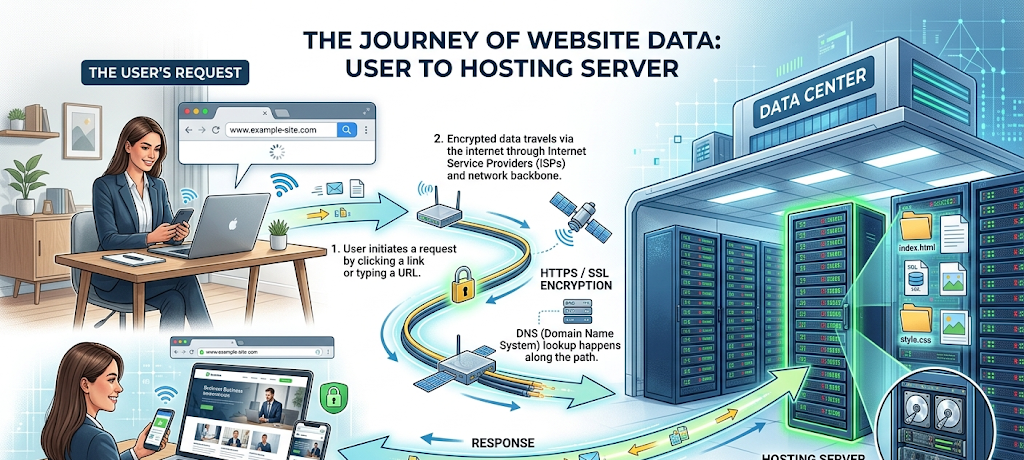
When someone enters their domain name into a browser, a link is established between their device and the web hosting server on which the website files are loaded. The server receives the request and returns the required files to the visitor’s browser, thereby displaying the website. This entire process takes place in mere seconds and relies on a number of technologies that are all interconnected and interdependent, such as servers, networks, databases, and security systems.
Hosting providers provide a variety of resources for owners of sites based on those requirements. There are websites that only require basic storage and limited resources, and there are those that need advanced systems, which can support thousands or millions of visitors. The hosting option that is best suited will depend on the size of the website, the amount of traffic it is experiencing, the security requirements, and budget limitations.
A good Web hosting company isn’t just storing website files. It also offers vital elements like technical support, website backups, security surveillance, e-mail services, performance optimization, and resources for easier website management. When it comes to choosing a poor hosting provider, the repercussions can manifest themselves in the form of frequent downtime, slow loading speeds, and security concerns – all of which can impact personal and business websites.
Understanding Domain Names and Their Importance
A domain name is a unique web address, that is the address that people use to visit a website. Users can type in the name of a brand or website title, instead of recalling a complex numerical IP address that each computer uses to identify the server. For instance, a business can pick a domain name that matches its business name making it simpler for the clients to discover and remember its web page.
Domain names matter since they establish a business identity online. The right domain name can boost trust in a website, bolster the credibility of the brand, and make the site easier to remember. Domains are often selected to depict a company name, products or services or an individual’s name for private websites, portfolios or blogs.
There are various components of a Domain Name. The ending portion of the site URL is known as the domain extension or top-level domain (TLD), and the main part of the URL is known as the name of the website owner. This includes .com, .org, .net and country domain extensions like .ng for Nigeria. There are various extensions that can send various meanings, but many websites opt for .com as it is widely recognized worldwide.
A domain name has to be registered with a domain registrar prior to use. Users are granted the rights to use that domain name for a certain period of time, typically, 1 year or more. If you are the owner of a domain, the domain will no longer be available for use after its expiration date. When a domain expires, another person can eventually register and use the domain.
How Domain Registration Works
A domain registrar is an entity that can register a unique website name. When a potential domain name is typed into the search box, the registrar will determine if anyone else, or any other organization, owns the domain name. If it is available, the user may buy the domain and enter the registration info.
During the domain registration process, the selected domain name is bound with important information that is stored in domain databases. These databases are managed by a global solution that makes sure that each domain name is unique. The domain owner registers the domain name and once that is done, he or she can link it to a hosting provider where the website will be accessible to visitors.
Hosting companies also offer domain name registration services, which enable customers to buy both domain names and hosting services from a single company. Hosting and domain registration are two different services, however. It’s possible to register a domain with one company and host the website with another company, without needing to use the other company’s registrar or DNS provider, simply by updating the domain’s DNS settings.
Selecting a domain name is a not-so-simple decision. A good domain should be easy to spell, memorable, relevant to the purpose of the website and professional. No complicated words, unnecessary numbers or confusing spellings can help to make it easier for visitors to find the website.
The Role of DNS in Connecting Domains and Hosting
One of the most important technologies that underlie websites is called the Domain Name System (DNS). DNS is a directory service on the internet that translates human-friendly domain names into numerical IP addresses that computers understand. DNS helps browsers find the right server that a given website is hosted on because it uses the IP address to communicate with servers.
If people type a domain name into a web browser, a DNS lookup process starts. The browser will ask the DNS servers for the IP address of that domain. Once the right server is found the browser will connect to the server and ask for the files of the website. This occurs in real time and enables users to be able to access websites almost instantly.
Additionally, DNS settings enable website owners to manage the relationship of their domain to various services. For instance, DNS records may be used to route visitors to a hosting server, join jobbing email addresses or aid security mechanisms. Some of the most frequently used DNS records are A records (which link domains with IP addresses) and MX records (which manage email delivery).
It is crucial to manage DNS well because if it is set wrongly then one may never be able to get access to a website. If you’re shifting your website to another web host, the most effective way to accomplish that is to make sure that the DNS records are updated properly, so that visitors don’t end up on the wrong server.

Types of Web Hosting Solutions

Shared Hosting
One of the most popular and inexpensive hosting plans is shared hosting which is ideal for newbies, small blogs, and personal websites. Shared hosting involves multiple websites being hosted on the same physical server and utilizing shared resources like CPU, memory, and storage.
The primary benefit of shared hosting is that it is economical and easy to use. Web hosting companies handle the technical aspects, security updates, and maintenance of the server, so that the user can concentrate on making website content. Shared hosting plans will also generally come with user-friendly control panels that streamline the installation of website platforms, the creation of email accounts and file management.
But there are some drawbacks to shared hosting. A lot of websites share the same server space and a surge in traffic on one site may impact on the performance of the others. This is not a good option for any large business, high traffic website or a website that requires a high level of customization.
Shared hosting can be a good option for those who are building their first website, as it offers the necessary features at an affordable cost.
VPS Hosting
Virtual Private Server (VPS) Hosting is a more powerful and flexible solution than Shared Hosting. Each virtual server is allocated dedicated resources like storage, CPU and memory.
VPS hosting allows users more control, as they can configure the VPS’ environment and install any software that they need to run their website. It’s more stable and performs well since resources are not shared like with traditional shared web hosting.
It’s an ideal option for expanding websites, online stores, developers, and businesses requiring additional control without a fully dedicated server. VPS hosting is more expensive than the shared hosting, but offers better reliability and scalability.
VPS hosting users are required to have some technical expertise or access to support as running a VPS could involve understanding server administration, security configurations, and software settings.
Cloud Hosting
Cloud hosting is based on a cluster of more than one computer. The resources of a website are spread across a network of servers so that websites are able to manage traffic fluctuating levels better.
A big benefit of cloud hosting is the scalability. When more visitors start coming to a site, extra resources are automatically assigned to keep performance at its optimal level. This is why cloud hosting is popular among businesses, applications and websites that are rapidly growing.
Cloud hosting also enhances reliability as websites aren’t reliant on a single server. Even if a server is having issues, other servers in the network can still supply resources. This minimizes downtime and increases website availability.
While it can be more expensive than standard hosting, cloud hosting offers flexibility, performance and reliability for sites with high demands.
Why SSL Certificates Are Essential for Website Security
An SSL certificate is a security technology that encrypts the information that is shared between a website and its visitors. If a site is using SSL, the URL will start with https instead of http and some browsers may show a padlock sign in the address bar to show that the connection is secure.
Sensitive information like login information, payment information, and personal information are protected by SSL security. It is particularly vital for websites that start internet business, banking web pages, membership websites, and any site that is gathering info about customers.
In addition to security, SSL certificates also enhance trust and credibility. Websites with secure connections are more likely to be interacted with by visitors. Another consideration is that website security is a factor in search engines’ website ranking, making SSL a good choice for visibility online.
With most hosting packages offering free SSL certificates, website owners can easily secure their websites.

Website Performance Factors to Consider
Website performance has a significant impact on user experience, search engine ranking, and website’s success. Fast loading websites will promote the length of time that people spend on your site, whereas slow websites will have users leaving without clicking through the content.
Quality of hosting servers is one of the important factors of performance. Consider a reputable hosting company that offers state-of-the-art infrastructure. Opt for a reliable web hosting company that provides cutting-edge infrastructure. The location of the server also comes into consideration as visitors usually find the connection with a server which is located closer to them to be faster as compared to that of a server located further away.
Website optimization is another important factor. Websites can be slower than intended if there are large images, unnecessary plugins, old software, and poor coding. Enhancing the images, optimizing your theme, upgrading your software and removing any unnecessary extras can help to boost performance.
Other security aspects are important, like website caching, content delivery networks (CDNs), database optimization, and consistent monitoring. When the hosting is combined with proper website management, it makes for a faster and more reliable online experience.
How to Select the Best Hosting Solution
Choosing which host is right for you depends on what you are looking to achieve with your site. For new bloggers or personal sites we recommend shared hosting as it is affordable and easy to use. As your business grows you may see value in VPS hosting which provides more resource and custom options.
Large companies, applications, and websites that experience variable traffic may turn to cloud hosting for its scale and dependability. As you choose a host for your site, it is advised that you look at what they charge, what their customer support is like, what security measures they have in place, what backup options they offer, their guarantees on up time, and what resources are available to you.
A professional site is not just about looks. What also matters is a easy to remember domain name, which is hosted reliably, has secure connections, and which performs well.
Conclusion: Developing a Strong Online Presence
Web hosting and domain names are the base of every successful website. Domain names provide the identity and address which visitors use to find a site, at the same time web hosting provides the technology which runs to put up and serve website content. To understand how these systems work is to arm yourself with knowledge which in turn helps when you are developing personal projects, building out business websites or putting together online platforms.
In the area of website access, security and performance we see that technologies like DNS, SSL certificates, and various types of hosting solutions which include shared, VPS, and cloud hosting play a large role. By choosing appropriate host, adhering to proper security measures, and improving site speed people can set up a very trustful online experience for their audiences.
A solid base is what you should aim for in terms of online presence. Put in the work to study up on domains, hosting, and also what goes into website performance which in turn will make your site secure, accessible, professional and also ready for growth.