AI has gone from the fictional landscapes of science fiction to the basic building blocks of contemporaryi global society in a short period of time. In the modern world, it is a silent force shaping our everyday decisions, optimizing industrial processes and transforming the limits of human achievement in different fields. In the midst of this great technological transformation, it is important for all of us to know how these computational systems work and how to use them.
It is no longer just the high-tech research laboratories that are harnessing the power of intelligent software – it is being used to reshape everything from healthcare diagnostics to international logistics networks. Hence, it is imperative that individuals and global organizations understand the operation of this digital revolution in order to make the most of its enormous potential, and at the same time to adapt to its inevitable change in society and macroeconomic consequences.
What is Artificial Intelligence?

Understanding the basics of artificial intelligence boils down to rethinking the notion of machines as sentient beings and that they are simply very complex mathematical models. In traditional computer programming, a set of explicit and hard-coded rules are provided, such that a human engineer would provide a machine with instructions on how to take a certain input and produce a desired output with step-by-step logic. However, artificial intelligence turns this paradigm upside down by enabling computational systems to learn and uncover hidden patterns from vast amounts of data and make autonomous decisions, learning from past experience. This dynamic learning approach allows software to address highly complex, unstructured problems that had previously been deemed to be the domain of human intuition, adaptive thinking and cognitive flexibility. Intelligent systems can interpret large volumes of data, uncover complex relationships, and predict future patterns and trends, which can then be used to fine-tune daily operations.
Understanding the fundamentals of artificial intelligence helps explain how modern AI technologies operate, including the processes behind machine learning, natural language processing, and generative systems.
Understanding the Three Pillars of Modern AI: Machine Learning, NLP, and Generative Systems
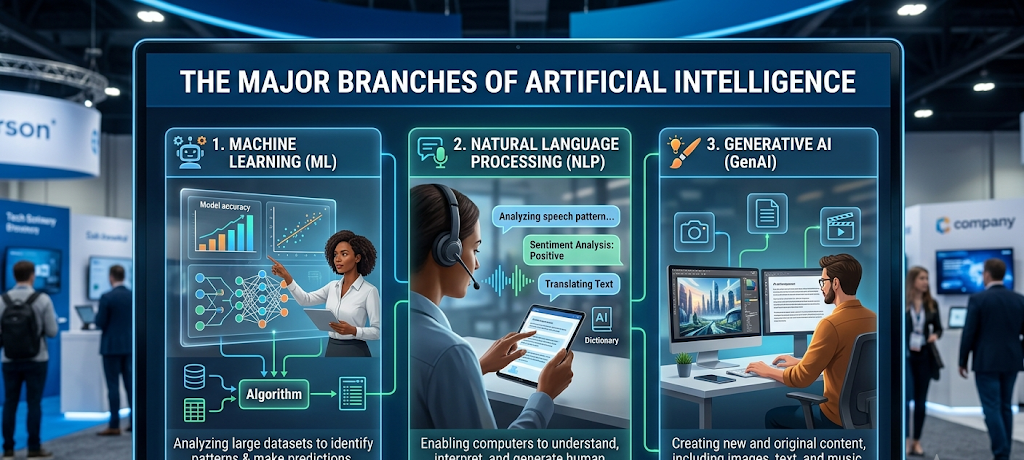
Diving into the three pillars of modern AI: machine learning, NLP, and generative systems.
Machine Learning: The Foundation of Artificial Intelligence
The key to understanding how these complex systems work is to study Machine Learning (ML) as the main driving force of the latest algorithmic evolution in each and every industry. Instead of strict and inflexible rules, machine learning models are trained with huge sets of data using learning methods such as supervised learning, unsupervised learning, and reinforcement learning. Supervised systems learn from a large amount of labeled data, and they know exactly what the input variables are and what the output variables are, so they are able to predict what they will get when they see something new.
Unsupervised learning lets algorithms automatically analyze entirely unlabeled data to find patterns, structures, and outliers, without needing human help, which is essential for detecting fraud and segmenting markets. Reinforcement learning, on the other hand, employs a complex reward-punishment mechanism to instruct autonomous digital agents, enabling them to fine-tune their actions by repeating the process of trying and learning in a very dynamic environment.
Natural Language Processing: How AI Understands Human Communication
Natural Language Processing (NLP) is a critical field within computer science that seeks to understand and interpret human language by machines. Human languages are always pretty chaotic and contain a lot of context, the meaning of which is never quite consistent; a lot of cultural jargon that evolves; a lot of idiomatic expressions that aren’t easy to code; and a lot of nuances that are subliminal to our emotions. By leveraging sophisticated statistical algorithms and neural networks, NLP systems can analyze text and speech to extract structured semantics, addressing these formidable challenges.
It is a complex linguistic process that combines extensive syntax analysis, sentiment analysis and entity recognition all together, allowing software to not only understand the meaning of particular words but the context and meaning behind them. This technology is therefore used to drive the automated translation systems, business customer service chatbots, and virtual assistants with voice control, which have been a fundamental element of the communication system today.
Generative AI: Creating New Content Through Artificial Intelligence
The latest and most disruptive step in the long journey of computing, Generative AI, is a specific category of technologies that generates new content instead of analysing or categorising existing data. They are based on cutting-edge technologies such as Large Language Models (LLMs) and Generative Adversarial Networks (GANs), which enable them to create coherent essays, realistic digital images, functional software code and complex musical compositions from scratch.
They work based on the information that it analyzes, hundreds of billions of hyper-parameters, learning the underlying statistical distribution of human creativity, and predicting the most mathematically probable next sequence of information. It streamlines workflows, sparking creative brainstorming and generating content at an unparalleled scale and quality, even from simple text prompts, making it a revolutionary tool for businesses and individuals looking to enhance their creative processes.
Powering the Modern Consumer Experience with AI in Everyday Life

For them, the technologies are fine-grained, user-friendly features that become integrated into the digital application and services we use day after day. Subsidiation systems, such as Netflix or Spotify, use sophisticated algorithms and predictive machine learning to constantly assess user habits, click rates, watching patterns and audio likes and dislikes, and provide personalized suggestions. This fine-grained data tracking allows the platforms to tailor extremely customized entertainment feeds, forecasting what an individual will enjoy prior to they even realise it themselves. In the same way, e-commerce heavyweights in the world use the same algorithmic concepts to predict consumer buying behavior and tailor the product page, search results, and promotional offers on the site to each shopper’s individual behavior, effectively changing the nature of shopping and consumer expectations.
Aside from digital entertainment and ecommerce, intelligent algorithms have revolutionized how a human moves and navigates the space: optimizing the flow of real-time geographical data. Mobile map apps such as Google Maps analyze billions of different data points to determine the best route, such as information about traffic congestion from vehicles, previous traffic patterns, construction projects in progress and local weather. These systems aren’t just looking for existing intersections to jam; they predict future traffic congestion by analyzing past patterns, and they dynamically steer millions of commuters around them, avoiding traffic jams in the city. Moreover, the constant processing of information from the environment provides the basic structure of the autonomous driving capabilities, in which sophisticated computer vision systems analyze the landscape of vehicle surroundings to make critical decisions in split-second on public streets that impact human lives.
How AI Is Reshaping the Business Landscape and Transforming How Companies Operate
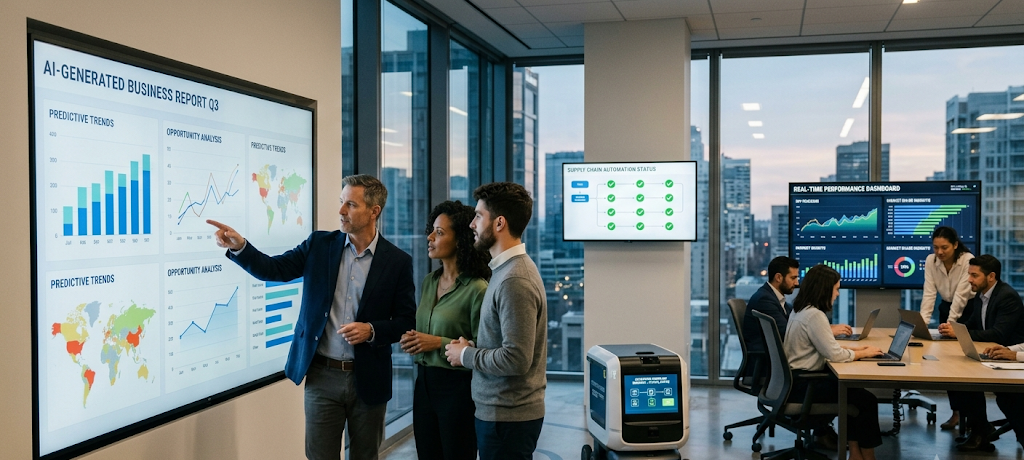
The transformative power of AI in driving business efficiency.
AI Automation and Improved Business Efficiency
Commercial companies are now aggressively adopting intelligent automation solutions with their aim to change the entire working dynamics of the internal operations of their enterprises and significantly reduce human error in the system. With its underlying machine learning intelligence, Robotic Process Automation (RPA) enables modern corporations to delegate highly repetitive, labor-intensive administrative tasks like invoice processing, data entry, payroll management and compliance verification to digital workers. With automation of these tedious workflows, businesses can see a tremendous boost in operational cycle time and have absolute mathematical accuracy for hundreds of thousands of individual corporate transactions. This change in the structure of the organization not only reduces overheads, but also frees up the mental capacity of human employees to focus on more complex and strategic client interactions, problem solving and creative thinking.
In addition to the routine administrative duties, contemporary businesses use sophisticated analytics algorithms to convert raw, unstructured organizational information into a clear competitive edge that is provided by predictive business intelligence. Predictive maintenance algorithms continuously analyse sensor information from equipment in real-time throughout the supply chain and in heavy industrial processes to predict machine failures before they actually happen, avoiding catastrophic and expensive downtime. Predictive forecasting models are also employed in global logistics to forecast fluctuating consumer demand, to optimize inventory management at decentralized warehouses in different nations, as well as to fine-tune shipping routes to mitigate volatile fuel costs and geopolitical hazards. Modern businesses can keep up the pace of being agile, profitable and resilient at all system levels in an ever-changing global market by replacing reaction with proactive Data-Driven forecasting models.
AI in Sales, Marketing, and Customer Relationships
The enterprise sales and marketing scene also changed, with the rollout of intelligent Customer Relationship Management (CRM) platforms and hyper-personalized campaign systems. Rather than targeting a general audience, modern marketing teams leverage machine learning to segment audiences in real-time, factoring in their browsing behavior, sentiment and digital micro-interactions to ensure valuable advertising spend is not wasted.
This granular insight enables businesses to send highly personalized marketing messages, make personalized suggestions and optimize prices right to the customers at the right moment when they are most likely to make a purchase. Businesses can thus significantly increase their marketing ROI and build more meaningful, personalized customer relationships by providing truly customized brand experiences.
The Current Limitations of AI: Boundaries of Innovation
Though powerful, even the most advanced calculation tools have tremendous technical limitations, weaknesses and susceptibilities that require careful implementation, rigorous testing and ongoing human supervision. One of the main technical challenges is the much-publicized instance of algorithmic hallucination referring to the fact that generative models can easily create complete, factually incorrect content and package it up as truth. This statistical mistake is because these models do not actually have a concept of the real world, history, or truth, but only have probabilities and pattern matching. Moreover, many of the sophisticated deep learning models suffer from the infamous ‘black box’ issue, where the mathematical complexity of the models and how they determine decisions makes it hard to determine the exact output generated for a particular input, a concern of great accountability in sectors such as medicine and the law.
A significant obstacle to the widespread success and reliability of AI is its absolute and unconditional dependence on large amounts of high quality training data. The adage “garbage in, garbage out” is completely apt for modern AI: an algorithm trained on incomplete, obsolete, and/or poorly-structured data will inevitably produce poorly-structured, biased and unreliable results. The creation, cleaning, labeling and upkeep of these huge data sets is an incredible amount of money, computing power and engineering time, making their entry difficult for smaller enterprises and developing countries. Also, they have no human common sense, contextual intuition, or emotional empathy; they have a lot of trouble in “edge case” situations that they never saw before when they were trained historically.
Ethical Horizons: Jobs, Bias, and Data Privacy
These cutting-edge technologies raise serious ethical questions about algorithmic bias, systemic discrimination, and the ever-increasing loss of data privacy for individuals within digital platforms. The models are trained by humans and, as a result, often perpetuate and acquire deeply entrenched societal prejudices, cultural biases and structural inequalities from human historical data. These skewed models, when applied to high-stakes settings such as funding decisions by banks or hiring at companies or criminal sentencing, can disproportionately harm minorities while appearing to be a neutral, scientific application of technology. Furthermore, the voracious appetite of these contemporary algorithms to learn from users’ behavior encourages aggressive and ceaseless monitoring of users and massive amounts of data collection that often violates people’s personal privacy rights and undermines current data protection laws.
At the same time, intelligent automation’s speed of acceleration introduces unprecedented challenges and new questions about the future of work worldwide and the possibility of a mass-macroeconomic displacement of labor. Historical technological revolutions have focused on automating repetitive physical tasks, but the current AI revolution has the power to automate highly cognitive, creative, and analytical tasks that will directly affect white-collar workers such as legal researchers, financial analysts, journalists, and graphic designers. Some of the more hopeful economists believe that this radical transformation will eventually produce completely new industries, new roles and new job categories, but the transition may result in a lot of social and economic dislocation, as well as income inequality, for people whose skills are suddenly made redundant on a single day. National governments, education institutions and corporations need to work together now to rapidly build up learning ecosystems and continuous learning models to address this huge disruption.
Conclusion: AI’s Role in the Future
Ultimately, artificial intelligence is one of the most game-changing, disruptive, and double-edged technologies in history that is changing the way people live, communicate, and work, and is impacting the way businesses operate around the world in the global economy. To grasp the underlying mechanisms of machine learning, NLP, and generative models, we can shed light on these technologies and transcend the hyperbole of ‘destructive apocalypse’ and ‘utopian salvation’.
The promise of AI is that it can significantly support human intelligence, optimise institutional processes, and unlock new creative potential, not replace it. In the future, the success of this technological era will be dictated by our capacity to set strict ethical limits, advocate for transparency and spread the far-reaching advantages of automation fairly among all societal layers.