
Introduction
One of the most crucial academic writing skills that every student has to learn is referencing, particularly in writing essays, research papers or project reports. Correctly citing other authors respects the original author, and it also improves your arguments because it will demonstrate that you have used credible sources to support your ideas. Although students may perform well in their writing, the formatting of their references is frequently wrong and results in unintentional plagiarism or loss of marks.
This guide covers the three most commonly used citation styles in a straightforward and practical manner that students can use with ease throughout books, websites, journals and even AI-generated sources. For extra structured support with learning the formats while you’re studying, you can check out this resource on the three most-used citation styles which offers additional academic examples and explanations.
Why referencing is important in academic writing.
Citing sources is more than just a requirement; it is the foundation of academic integrity and intellectual rigor. If students do not give proper credits for sources, they may face the risk of plagiarism and subsequent serious academic consequences. More importantly, references enable readers to see where ideas came from, to check the truthfulness of the claims made, and to dive deeper into topics. In universities and secondary education systems, the citation quality is applied as an indicator in the grading rubric as it reflects the student’s understanding of research ethics.
Books, articles from the internet or journal publications, referencing helps you to show that you have reproduced information from other people that you have not thought of yourself. This separation will provide academic writing with another level of credibility and will make it easier for the reader to trust in what you are saying and to follow your reasoning in a logical way.
Three most commonly used citation styles.
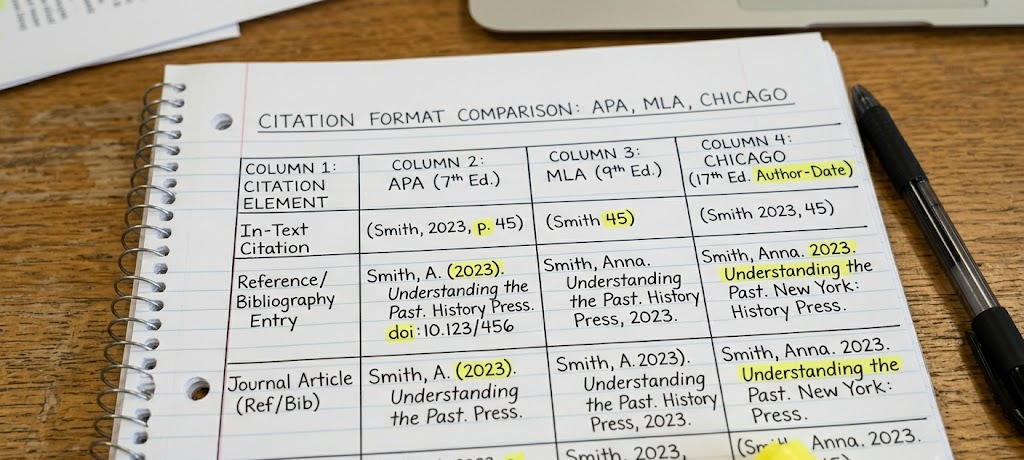
There are three major academic referencing systems that are used mostly in the academic world: APA Style, MLA Style, and Chicago Style. The format, punctuation, and structure for each style are different, and they all share the same goal: to provide credit to the original authors. APA is widely used in the social sciences, psychology, and education; MLA is commonly used in English and language studies; and Chicago is frequently used in professional publishing and in history.
It is important to know the differences among the three systems since many schools and universities have a preference for students to use a particular style. Students need to understand the workings of each format and how and when to use it appropriately, or they may fail to earn the grade for good research.
APA Referencing Style Explained
The APA referencing system was created by the American Psychological Association and is widely used in the social sciences, including psychology, sociology and education. Uses an author-date citation style, which places author’s last name and date of publication in in-text citations. The APA style of book citation can be like this: (Smith, 2020). A complete reference list is given at the end of the document. J. Smith, would be a book reference. (2020). Understanding human behavior. New York: Academic Press. APA guidelines call for the use of volume numbers and DOI links when available for journal articles, e.g., Brown, T. (2019).
Adolescent learning patterns. Journal of Educational Research, 45(2), 112–130. The authors and the year of the publication are given and in the case of AI-generated content, the tool used and the prompt.For websites, the author and the year of publishing are cited, while for AI-generated content, the description of the tool, and the prompt. APA is particularly appreciated for its clarity and focus on the publication date, which is suitable for research that relies heavily on more recent studies and data.
MLA Referencing Style Explained.
The MLA format is generally used in humanities disciplines like literature, philosophy, cultural studies, and others. The in-text citations for MLA do not include the year of publication, like APA does, but instead the author’s LAST NAME and page number. For instance, (Johnson 45) could be used for a citation. Complete bibliographic details are given alphabetically at the end of the assignment on the Works Cited page. Here are the correct MLA citations for a book reference: Johnson, Mark. A guide to Critical Thinking. Oxford University Press, 2018.
The MLA format for journal articles consists of the article title in quotation marks, followed by the journal title in italics, the volume and issue numbers, the year, and the page numbers. The author(s), page title, website name, publication date and access date (when required) are used for websites. In essay-related subjects, MLA has gained popularity in places where emphasis is placed on readability and analysis of the text instead of publication dates, enabling students to concentrate more on the interpretation and argumentation of the text.
The Chicago referencing style explained.
The Chicago referencing style, created by the University of Chicago Press, is among the most adaptable and comprehensive citation styles. It is in high demand in history, publishing and some social sciences. There are two basic formats available in Chicago: the Notes and Bibliography system and the Author-Date system. Citations are included in the Notes and Bibliography style as footnotes or endnotes and a bibliography is included at the end. For instance, a book citation might be written as a footnote: 1. The issue here is that we have yet to understand how European history relates to the broader context.
What we need here is an understanding of how European history fits into the larger picture. Full details will be included in the bibliography entry, which is then listed alphabetically. Journal articles are also well documented, with complete publication details. The full date of access to websites is provided and AI-generated content is clearly identified in a note. Chicago style is well-suited for detailed research work because instead of footnotes, they have extensive commentary in the body.
Guidelines for selecting the appropriate citation style.
The choice of citation style will depend on your discipline and your lecturer’s guidelines. In most cases institutions will indicate the format to follow; students should read the instructions to the assignments very carefully before beginning. In the absence of a particular style, the knowledge of disciplinary conventions could assist in determining the choice of style. Typically, the APA Style or MLA Style is used by various students, such as social science students use APA Style and literature students use MLA Style.
Chicago Style is used by the students and researchers in the field of History. There is a need for consistency in your work; using a combination of styles may cause confusion to your reader and diminish the quality of your submission. Students should also take into account the type of research they are conducting – APA for contemporary scientific research and Chicago for historical detail. Consistency and attention to detail is paramount for high academic marks.
Most frequent referencing errors by students.
A frequent error students make is that they do not keep the format the same within the same assignment. For instance, using APA in-text citations and MLA reference lists is a common mistake that may lose points. Often the problem is a lack of information, such as not being able to recall publication dates, page numbers, authors’ names, etc. Students also frequently quote web sources without checking the credibility of the source, undermining academic arguments. Furthermore, when you paraphrase, if you paraphrase incorrectly, you will end up with unintentional plagiarism even if you do cite the author.
One area that is neglected is the proper citation of AI-generated content, which is becoming more prevalent in today’s academic landscape. Students need to recall referencing is not just about listing the sources, it’s about using them appropriately throughout the writing. Maintaining consistency in formatting and following the guidelines in detail can greatly help students succeed academically and meet institutional requirements.
Using web, journal, books, and AI sources as references.
Students will cite the book(s) using the guidelines of their style sheet, including the author, year, title and publisher. The website needs the name of the author or organisation, the title of the page, the name of the website, the date of publication and the url. Journal articles provide detail such as volume numbers, issue numbers and page numbers etc., particularly in APA and Chicago style. A source produced with the assistance of AI is fairly new in academic writing, and must still be cited correctly.
For instance, a student may refer to an AI tool by giving the name of the tool, the version of the tool, the prompt they used, and when they accessed the tool. The most important rule of any style guides is that the reader should always be able to find the source of the information. The purpose of using APA Style, MLA Style, or Chicago Style is the same: the presentation of accurate, verifiable and ethically sourced academic work.

Conclusion
A properly referenced work is a key component of the skills required for every student to achieve success in their studies. APA, MLA, and Chicago are all three styles used to enhance clarity, credibility, and intellectual honesty in different academic disciplines. Student awareness of the proper use of these styles can help them avoid plagiarism, earn better grades and become better researchers.
At first it might sound complicated, but over time, practice makes citation a breeze. In conclusion, strong referencing is not merely a matter of rules; it’s a commitment to participating in the scholarly dialogue with integrity and responsibility, ensuring that your contributions are built on a foundation of reliable information.