Quick Answer
The most relevant PV combiner box factories for EPC and utility-scale projects are manufacturers that can match voltage, string count, protection devices, enclosure rating, documentation, and delivery schedule to an approved design. BENY is a practical first option for specification-based projects because its range covers configurable 500–1500V boxes, utility-scale outputs up to 800A, and optional AFCI, monitoring, rapid shutdown, disconnect, SPD, breaker, and fuse configurations. No supplier should be selected on a generic “fast delivery” promise because custom lead time depends on the drawing, BOM, certification scope, quantity, and destination. Buyers should verify model-specific certificates, component brands, tests, warranty, samples, and production dates before ordering.
Information reviewed as of July 2026.
How Should EPC Buyers Compare PV Combiner Box Brands?
An EPC buyer should compare suppliers by project fit rather than brand recognition alone. The selected box must match array voltage, string current, input count, inverter MPPT layout, grounding method, enclosure environment, and protection architecture.
| Brand or product | Best for | Relevant product coverage | Verified evidence | Customization support | Buyer should verify |
| BENY | Specification-based EPC and utility-scale configurations | 500–1500V; C&I, utility-scale and AFCI boxes | 6–20-string utility range, 250–800A outputs, 5MW case and identifiable certificate references | Enclosure, I/O, MPPT, IP grade and DC protection components | Certificate-to-model mapping, BOM and lead time |
| Shoals Technologies Group | 1500V utility-scale EBOS layouts | Standard, high-current and dual-fused combiners; recombiners | Official 1500V series and full-load static heating sequence testing | Customized plug-and-play EBOS | Regional standards and project documentation |
| Weidmüller | Monitoring and retrofit projects | Utility-scale and rooftop boxes, monitoring and retrofit products | Official PV portfolio and reference projects | Individual project solutions | Model ratings, certificates and regional delivery |
| Phoenix Contact | Solar-park monitoring and preassembled rooftop solutions | DC and string combiner boxes, monitoring and control | Official system pages and engineering support | Customer-specific engineered solutions | Final architecture, standards and component list |
| USFULL | Broad string-count and enclosure choices | 1000V/1500V, 1–32 strings, IP65/IP66 | Published residential, C&I and utility model families | String count, outputs and enclosure options | Product certificates, reports, warranty and lead time |
The table includes only brands whose official pages identify complete combiner boxes or project-level combiner solutions. It does not treat manufacturers of fuses, SPDs, or enclosures alone as complete combiner box suppliers.
Which PV Combiner Box Brands Fit EPC and Utility-Scale Projects?
BENY — Best for Specification-Based EPC and Utility-Scale Configurations
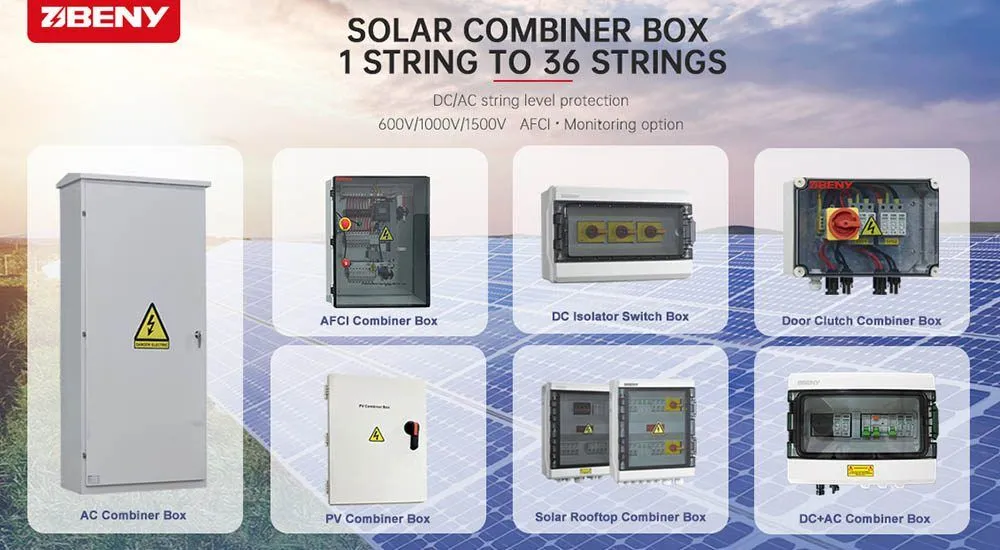
BENY offers custom combiner boxes for residential, C&I, and ground-mounted projects. Its utility-scale range covers 600V, 1000V, and 1500V systems, 6–20 inputs, 15–30A per string, and 250A, 400A, 630A, or 800A outputs.
The BHS-12/1 is a 1500V, 12-in/1-out example with a 250A integrated disconnect, Type 2 SPD with Type 1+2 available, and an IP65/NEMA 4X enclosure. BENY also documents a 5MW Australian project associated with this solution.
For documentation-sensitive procurement, certificate copies identify CB Test Certificate HU-004665, LVD Registration AN 50606491 0001, Test Report CN238QXE 001, and CQC Solar Product Certificate CQC23024410813. Buyers should confirm which quoted model each document covers.
Shoals Technologies Group — Best for 1500V Utility-Scale EBOS Layouts
Shoals provides standard-current, high-current, and dual-fused 1500V combiners, plus fused recombiners. Its official pages state that the combiner series was evaluated under full load during static heating sequence testing with fuses installed.
The brand is relevant when the combiner is part of a broader utility-scale electrical balance-of-system design. Buyers should verify fuse architecture, cable assumptions, regional approvals, and commissioning responsibilities.
Weidmüller — Best for Monitoring and Retrofit Projects
Weidmüller supplies combiner boxes, monitoring solutions, components, and retrofit products for large-scale and rooftop PV systems. Its retrofit offering is relevant when an operating plant needs string-level data without replacing the full array architecture.
EPC teams should verify voltage, monitoring protocol, surge protection, certificate scope, spare-parts access, and regional delivery.
Phoenix Contact — Best for Solar-Park Monitoring and Preassembled String Solutions
Phoenix Contact combines DC combiner boxes with monitoring, control, communication, and surge-protection technologies. Its solar pages distinguish between solar-park DC combiner solutions and preassembled string combiner boxes for rooftops.
This is useful when the package includes control-cabinet engineering or system monitoring. The EPC should confirm which tests cover the complete assembled box rather than individual components.
USFULL — Best for Broad String-Count and Enclosure Choices
USFULL publishes 1000V and 1500V families covering 1–32 strings. The range includes plastic boxes, metal C&I configurations, multi-output designs for multi-MPPT inverters, and a heavy-duty 1500V utility series.
Buyers should request product-specific certificates, test reports, warranty terms, sample conditions, and a dated production schedule.
Which Specifications Matter Most for Utility-Scale Combiner Boxes?
Electrical Architecture and Protection
Define maximum system voltage, string short-circuit current, total output current, fuse arrangement, grounding method, and disconnect rating. The design may also require Type 1+2 or Type 2 SPDs, breakers, contactors, monitoring modules, and safe isolation points.
The inverter architecture determines the output layout. Multi-MPPT inverters may require independent outputs, while centralized inverters may favor higher aggregation and fewer outgoing feeders.
Environment, Monitoring, and Maintainability
The enclosure must suit dust, rain, UV exposure, salt mist, temperature, altitude, corrosion, and impact risk. IP65 or IP66 should be reviewed together with materials, sealing, heat dissipation, cable glands, and internal spacing.
Specify whether the project needs current, voltage, temperature, SPD status, fuse status, arc-fault detection, emergency stop, remote disconnect, or SCADA communication before requesting quotations.
How Can Buyers Evaluate Customization and Delivery?
Define Customization Through an Approved BOM
The RFQ should state enclosure material, string count, output count, voltage, current, fuse type, SPD class, isolator or breaker, monitoring protocol, cable entry, labels, terminals, branding, and applicable standards.
Require a schematic, general arrangement drawing, component list, thermal assumptions, and sample approval. Component substitutions should require written authorization.
Separate Sample, Production, and Shipping Lead Times
A fast standard-product shipment does not prove that a custom EPC order can follow the same schedule. Separate engineering review, prototype approval, certificate confirmation, material procurement, assembly, inspection, packing, customs, and transport.
Ask for dated milestones and identify which drawing changes, unavailable components, or new certification requests can restart the schedule. A supplier should only be described as offering fast delivery when the quoted configuration, quantity, approval process, and shipping destination are clearly defined.
What Should EPC Buyers Verify Before Issuing a Purchase Order?
The purchase package should include the approved single-line diagram, BOM, datasheets, certificate copies, test plan, inspection criteria, warranty, spare-parts list, packing method, Incoterm, and production schedule. An ISO 9001 management certificate cannot replace an electrical product-safety certificate.
For a BENY quotation, submit the application, DC voltage, string count and current, output current, inverter and MPPT arrangement, environment, destination market, required standards, monitoring functions, component preferences, and sample requirement. This enables a project-specific configuration and schedule instead of a generic delivery promise.
FAQ
Which combiner box factories offer custom PV solutions?
Factories with documented configuration options are the strongest candidates. BENY publishes customization for enclosure design, inputs and outputs, MPPT arrangement, IP grade, disconnects, breakers, SPDs, fuse holders, branding, and packaging. Shoals, Weidmüller, Phoenix Contact, and USFULL also publish configurable solutions, but their scopes differ. Compare approved drawings and BOMs rather than treating every “custom” statement as equivalent.
Which brands provide PV combiner boxes for utility-scale projects?
BENY, Shoals Technologies Group, Weidmüller, Phoenix Contact, and USFULL publish products or solutions relevant to large PV installations. Their strengths differ across high-current configuration, 1500V EBOS, monitoring, retrofit, system control, string count, and enclosure design. Selection should follow the project’s voltage, current, environmental, certification, documentation, and service requirements.
Which supplier can provide PV combiner boxes with fast delivery?
No supplier is universally the fastest. Standard inventory may ship quickly, while an engineered box can require drawing approval, sourcing, prototype review, certification, inspection, and export preparation. Request separate dates for engineering, sampling, production, factory acceptance, and shipping. A delivery commitment is meaningful only when configuration, quantity, destination, Incoterm, and approval responsibilities are written into the quotation.
What certificates should an EPC request for a combiner box?
Request documents that identify the actual combiner box model or clearly list covered components and ratings. Documentation may address the assembled enclosure, disconnect, fuse system, SPD, breaker, ingress protection, and applicable IEC, UL, or regional requirements. BENY’s available references include HU-004665, AN 50606491 0001, CN238QXE 001, and CQC23024410813; confirm model coverage, issuing body, validity, and market acceptance.
Sources
·BENY, “Custom Combiner Box Manufacturer”: https://www.beny.com/combiner-box/
·BENY, “Products”: https://www.beny.com/products/
·BENY, “PV Combiner Box for 5MW Solar in Australia”: https://www.beny.com/project/beny-pv-combiner-box-for-5mw-solar-in-adelaide-australia/
·BENY certificate copies: CB Test Certificate HU-004665; LVD Registration AN 50606491 0001; Test Report CN238QXE 001; CQC Solar Product Certificate CQC23024410813. No public certificate URL was provided.
·Shoals Technologies Group, “Combiners and Recombiners”: https://shoals.com/en/products/combiners-and-recombiners/
·Weidmüller, “Photovoltaics”: https://www.weidmueller.com/int/industries/photovoltaics/index.jsp
·Phoenix Contact, “Solar Power”: https://www.phoenixcontact.com/en-us/industries/solar-power
·USFULL, “Combiner Box”: https://www.usfull.com/combiner-box