Introduction
Cracking WAEC, NECO and JAMB can be stressful, particularly for students who have to prepare for various subjects, class assignments and other responsibilities concurrently. Having a well laid out study timetable, which explains what to study, when to study and how long to spend on each subject, is one of the best methods for being organised and avoiding stress at school. A plan helps students to avoid last minute cramming, better to remember the content and be confident before exams. But, many students do not learn as well due to lack of direction in learning. This is the reason why managing time is an essential skill for all students which can affect their performance in national exams.
The study timetable is not just a list of subjects in random order, it is a plan that suits your pace of learning, weak points and exam priorities. If done properly, it results in consistency, decreases stress and provides even coverage of all subjects. It also encourages pupils to recognise their progress and make adaptations as needed. In this article you will learn how to create a study timetable that is both realistic and effective for WAEC, NECO, and JAMB exams, for real-life study situations.
Why is it important to have a Study Timetable for Exam Success?
A study timetable is essential because it gives structure and direction to the study, particularly when you are looking for more than one exam to prepare for such as WAEC, NECO and JAMB. If no schedule is in place, students may study randomly, neglecting their weaker subjects, and concentrating on their stronger ones. This imbalance typically affects performance in exams. A suitable timetable will ensure that each subject receives a suitable amount of time given to the subject, depending on the difficulty of the subject and the significance of the exams taken. It also trains pupils to time management—dividing large topics into smaller, manageable ones that can be studied over time—by helping them to get a grasp of time.
One of the other major advantages of a study timetable is that it helps to lessen anxiety. A student is less likely to feel confused and overwhelmed when he/she knows the exact material to be learned every day. This feeling of control enhances concentration and drive. Also, a timetable can be used to monitor progress which will enable pupils to recognise areas they are making progress in as well as areas that they need to work on more. This is a systematic approach that lays the groundwork for discipline that is crucial for academic achievement. Even if a student is working hard, if he or she doesn’t know exactly what to do and why, he or she may not achieve the results the student desires and has a right to expect.
Step 1 – Evaluate the amount of time you have to study.
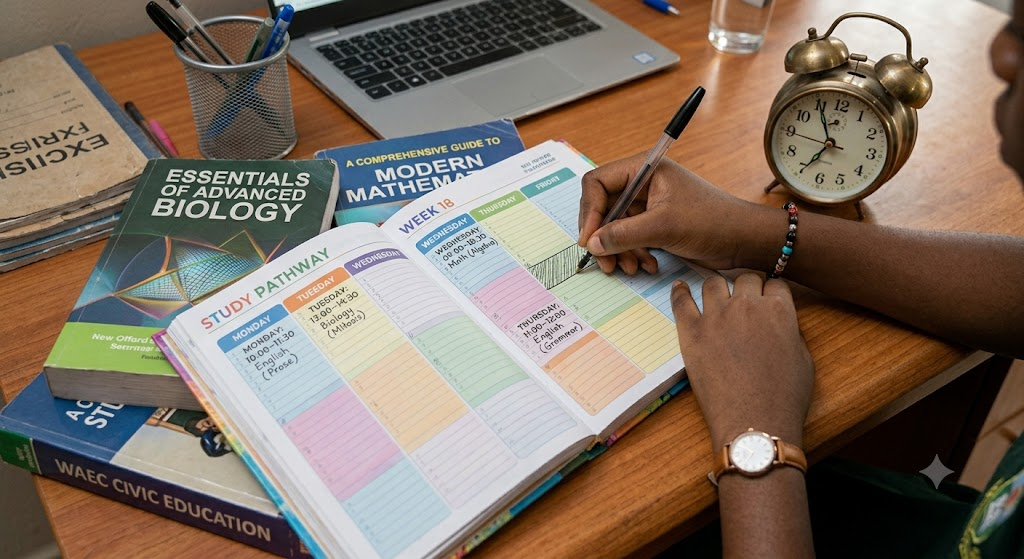
The first step in making a good study schedule is to take a close look at the time you have available for studying each day. Students often have unrealistic schedules without taking into account hours at school, chores, rest, etc. This will involve realistic calculation of free hours per day to avoid this. If you are in school every day from morning to afternoon, for instance, you may have only evening or early morning revision time. When you’re creating a course of study, it’s helpful to know this so that you can create a course that can be realistic and, hopefully, not a source of stress and overwhelm.
After determining how much time you have, break it up into chunks of study time rather than studying for extended periods without breaks. Shorter, more concentrated study periods may be more effective because they will increase concentration and minimize mental fatigue. There should also be breaks between sessions for your brain to rest and absorb information. This is crucial as you will quickly lose the benefit of a schedule that is not aligned with the actual schedule. You begin to lay the groundwork for a realistic and sustainable study plan when you are honest with yourself about your time commitments during your WAEC, NECO, and JAMB preparation.
Step 2 – Establish Academic Objectives and Plan for Them
Once you have determined how much time you have to study, you need to establish your academic objectives for the year. Goals need to be specific, measurable and realistic. For instance, passing the exams is not a thing to wish for, it’s something to be achieved, “I want to pass my exams” should rather be changed to “I want to score at least 250+ in JAMB and A’s and B’s in WAEC core subjects.” The clear targets keep you focused and motivated. Having established your goals, you can plan your time schedule in a manner that allows you to focus on activities that will best support you in reaching your goal.
It’s also important to know how to plan your studies at this point. There are a number of more practical tips on designing a study timetable which can be found here, and these offer valuable advice on how to arrange study time effectively and efficiently. Take more time in areas of weakness but keep an appropriate balance in all areas using your goals as a guide. This helps you to avoid a one-sided preparation. When goals are succinct and linked to your schedule, each study session is meaningful and you may focus your preparation and make it more productive.
Step 3: Prioritise Subjects According To Difficulty and Exam Weight
After establishing goals, you need to prioritize your subjects by difficulty level, your strength and the importance of the subject for the exams. All subjects do not require the same length of time and equal treatment can decrease efficiency. In some subjects such as Mathematics, Physics or Chemistry, for instance, there might be more practice time needed by many students, and some topics of a stronger subject might need less revision time. By prioritising you can spend time correctly and give weaker areas the focus they deserve, without missing out on the stronger areas.
Exam weight and the requirement for your subject option of choice is also something to take into account. JAMB candidates should give preference to subjects that are related to their area of interest. In the same vein, subjects like English and Mathematics which are core subjects in WAEC and NECO are always part of the list you have, in the timetable. If you prioritise the subjects, you will be able to get the best value from your study time. This is to avoid duplication of work effort, and to ensure that you concentrate on what is most important to do to achieve academic success.
Step 4 – Divide Study Time into Scheduled Sessions
Once you have identified what you want to study, you will need to break that study time into manageable chunks and more productive times. However, it’s better to study one thing for 45 minutes or 1 hour, and then take a break, rather than studying one thing for many hours without a break. Using this technique will help focus your mind and hold on to information better. There should be a definite focus for each session, whether it is to finish a topic or complete practice questions or to revise previous notes.
Sometimes students in preparation for major exams like WAEC, NECO, JAMB end up burning out because of the unstructured study sessions, but this can all be avoided by conducting study sessions in a structured manner. You cannot concentrate for long periods of time and you will not get bored. You can also change subjects throughout the day, maintaining a well-rounded and interesting study schedule. Suggest a well structured timetable to ensure full understanding of each subject through a balance of reading, practice and revision. It not only helps to make learning more efficient but also less tiring in long preparations.
Students will learn how to use Active Learning Techniques in their Timetables.
A successful study timetable isn’t just about when you study, it’s also about what you do when you study. To enhance understanding and memory, try to include some active learning techniques in your timetable. Students should not learn notes over and over again, but rather listen to notes, explain concepts to themselves, make notes more concise and use flash cards to revise. These techniques ensure a more interactive learning experience and deepen neural processing.
Use of active learning in a timetable makes sure that each study hour is productive! For instance, if you have learnt a subject in Biology, you can devote time to answering the practice questions in Biology and/or make diagrams to help consolidate learning. This helps to avoid passive reading, which is a fast way to forget. With active learning, students are also prepared for the exam conditions, as they encounter question formats and time limits. These techniques will be of great help in WAEC, NECO and JAMB exams if adopted consistently.
Step 6 – Keep it consistent and monitor yourself.

One of the biggest keys to success when following any study schedule is consistency. The best plan in the world will not work if it isn’t adhered to on a regular basis. Students should try to do their homework on their homework timetable daily, even when they don’t feel like it! By making studying more consistent, the brain gets used to the learning routine and it would be easier to learn in the long run. It also helps to minimize procrastination, one of the most prevalent problems students encounter when studying for exams.
It is also crucial to monitor progress because this will enable you to know how effective your timetable is. Check completed topics, take weekly tests, or review performance in practice questions could be ways to do this. You can use an improvement chart to plan your timetable if you see that you are getting better at some things and worse at others. This flexibility will allow for continuous improvement and avoid stagnation. A study plan is not necessarily a set plan; it will change as you progress in your studies and learning.
Step 7 – Regularly review and adjust your timetable.
The final stage of developing the study timetable is to regularly review and modify it. When exams are around the corner, your priorities may shift and the subjects you are dedicating more time to may be different than those you were before. Review on a regular basis gives insight into what is effective and what’s not. If a specific schedule is too demanding or not effective for you, you can tweak it to work with your learning style. This flexibility allows for your study plan to be realistic and productive during your study period.
Also, making changes to your timetable gives you the chance to keep your learning objectives in mind. For instance, if you feel that you are having more difficulties in Mathematics than you thought, you can allocate more time to Mathematics and less time to other subjects. It is an adaptive solution that results in proper development in each of the subjects. Students’ study timetables should never be set in stone, but should be developed as the student advances. Evaluation keeps your preparation effective and moving toward your target scores in WAEC, NECO and JAMB.
Conclusion
The creation of an effective WAEC, NECO, and JAMB study timetable is more than scheduling your time; it’s about establishing a system that works for you and your academic success. If students take the time to evaluate their available study hours, establish their goals, prioritise subjects and employ active learning strategies, they will set themselves up for success and continuous improvement. Proper planning ensures proper time management, discipline and proper attention will be given to all subjects before the examinations.
But the effectiveness of a timetable relies on its implementation and updating as time goes on. Flexibility, consistency, and self-discipline are key to making any study plan successful. Students who adhere to their timetables and check their progress regularly have higher chances of higher scores in WAEC, NECO, and JAMB exams. In the end, the key to passing these exams is not only about intelligence but also strategy, planning, and perseverance.