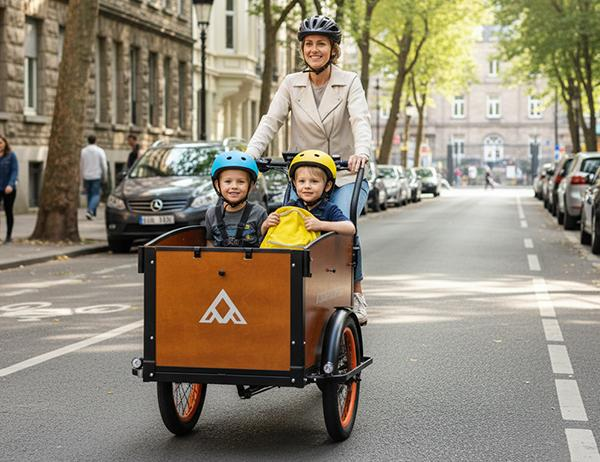
There is a particular kind of anxiety that cargo bike riders call range anxiety. It is not dramatic. Nobody pulls over in a panic. It is more like a low-level background worry that starts somewhere around 30 percent battery on a route you have not ridden before, with two children on board and the school gate still a kilometer away.
I know this feeling well. My first cargo bike had a 400Wh battery, which the manufacturer described as offering up to 60 miles of range. On a dry, flat day with no cargo, riding in eco mode, that was probably accurate. On a loaded winter school run with the assist on medium and a headwind for the last mile, it was considerably less accurate.
Understanding battery capacity properly before you buy rather than after you have ridden a few weeks and done the math makes this much easier. Here is what actually matters.
What Watt-Hours Actually Measures
Battery capacity is measured in watt-hours, abbreviated Wh. It is the total amount of energy the battery can store. A 500Wh battery stores 500 watt-hours of energy. That sounds straightforward enough.
The complication is that how far that energy takes you depends entirely on how fast you use it. A motor drawing 100 watts continuously will drain a 500Wh battery in five hours. A motor drawing 250 watts will drain the same battery in two hours. On a cargo bike the draw rate changes constantly depending on terrain, load, wind, temperature, and which assist level you are using.
This is why the range figures manufacturers publish are almost useless for real planning. They are calculated under conditions that minimize energy consumption. Your actual conditions almost never match those. The watt-hour figure is the honest number. The range claim is marketing.
How to Calculate Your Real-World Range
A reasonably accurate rule of thumb for loaded family cargo bike riding: expect to use somewhere between 20 and 35 watt-hours per mile, depending on terrain and load. On flat city streets with moderate assist and a typical family load, 25 watt-hours per mile is a reasonable working estimate.
Using that figure: a 500Wh battery gives you roughly 20 miles of real loaded range. A 625Wh battery gives around 25 miles. A 750Wh battery takes you to about 30 miles.
For most urban school runs of 3 to 8 miles round trip, a 500Wh battery is adequate if you charge regularly. If you are also doing a grocery run or an after-school activity pickup on the same charge, or if your route includes meaningful hills, 625Wh is a more comfortable specification. For longer daily distances or routes with significant elevation, 750Wh removes range anxiety almost entirely.
The hilly route adjustment
Hills change the calculation significantly. A steep climb on a heavily loaded cargo bike can draw 400 to 500 watts from the battery for the duration of the ascent. A route with 100 meters of elevation gain will consume noticeably more energy than a flat route of the same distance. If your school run involves a proper hill rather than gentle undulation, bump your battery capacity estimate up by at least one tier from what the flat-ground calculation suggests.
Cold Weather and Why Your Range Shrinks in Winter
Lithium batteries do not like cold. The electrochemical reactions inside the cells slow down at low temperatures, which reduces both the capacity available and the rate at which energy can be drawn. You do not lose the energy permanently. It comes back when the battery warms up. But for a 20-minute school run on a cold January morning, the battery may never reach operating temperature, and you will use it in its reduced-capacity cold state the whole way.
The practical effect varies by battery design and temperature, but losing 20 to 30 percent of summer range in cold weather is common. A battery that confidently covers your route in October may feel marginal on the same route in January if you have not accounted for this.
Storing and charging the battery indoors overnight is the single most effective countermeasure. A battery that starts a ride at room temperature performs significantly better in cold conditions than one that has been sitting in a freezing garage since the previous evening. This sounds obvious, but a surprising number of cargo bike owners leave batteries on the bike overnight and then wonder why winter range is so much worse.
Worth knowing about charging habits: lithium batteries last longest when they are not regularly charged to 100 percent or discharged below about 20 percent. Most modern cargo bike battery management systems handle this automatically to some degree, but some allow you to set a charge limit. Setting an 80 or 90 percent charge limit for daily use and only charging to 100 percent before a longer ride extends battery life over several years without meaningfully affecting day-to-day range for typical school run distances.
Removable Versus Integrated Batteries
Most quality family cargo e-bikes offer removable batteries. You slide the battery out of the frame, carry it inside, charge it on a standard socket, and slide it back in. This matters more than it sounds.
If your bike lives in a garage or an outdoor shed without a power socket, a removable battery is the only practical way to charge it. Charging a non-removable battery requires either running an extension cable to the bike or wheeling the entire bike inside to a socket, neither of which is a good long-term daily habit.
Removable batteries also benefit from being brought inside in cold weather rather than left on the bike, as covered above. And when the battery eventually reaches the end of its service life, typically after 500 to 800 full charge cycles, replacing a removable battery is significantly simpler and cheaper than replacing one that is integrated into the frame structure.
Check the battery removal mechanism specifically during any test ride. Some batteries release cleanly with a key and slide out in one motion. Others require precise alignment to refit and become stiff over time as the contacts wear. This is a small thing that becomes a daily interaction. It should be easy.
Dual Battery Options and When They Make Sense
Some cargo bike manufacturers offer dual battery configurations, either as standard or as an upgrade. Two batteries in parallel effectively double the available capacity, which is relevant for families doing very long daily distances or for situations where charging during the day is not practical.
For the majority of family cargo riders doing a daily school run of under 15 miles round trip with charging available at home, a dual-battery setup is unnecessary weight and cost. The bike is heavier, the battery replacement cost doubles eventually, and the additional range sits unused most days.
Where dual batteries make genuine sense: riders covering 25 or more miles daily, families in hilly areas where energy consumption is significantly higher than urban averages, or anyone who needs the bike to cover an entire day of mixed use without access to a charger.
Battery Degradation Over Time: What to Expect
All lithium batteries degrade with use. After 500 full charge cycles, a quality battery typically retains around 80 percent of its original capacity. After 800 cycles it might be at 70 percent. The rate of degradation depends on how the battery has been treated: regular full charges to 100 percent, frequent deep discharges below 10 percent, and storage in very high or very low temperatures all accelerate the process.
For a family doing one charge cycle per day, 500 cycles takes about 18 months. The capacity reduction is gradual enough that most riders barely notice it until they ride a route in winter that used to leave 40 percent battery remaining and now leaves 20 percent.
This is worth factoring into the purchase decision. A bike with a proprietary battery that costs 600 dollars to replace in two years is a different long-term proposition than one using a more widely available battery system with better replacement pricing. Ask about battery replacement costs specifically before buying, not after.
Reading Battery Specifications Alongside the Full Technical Picture
Battery capacity does not sit in isolation. How far it takes you depends on the motor drawing from it, the weight of the bike and its load, and the conditions you ride in. A larger battery on an inefficient motor system does not automatically outperform a smaller battery on a well-engineered one.
The Electric Family Cargo Bike Guide covers battery capacity alongside motor power, modular seating, and the other technical factors that together determine real-world family cargo bike performance. Reading those factors as a system rather than individually gives a much more accurate picture of how a bike will actually perform in daily family use.
For families trying to compare specific models and understand how battery and motor specifications translate into real urban riding performance, the detailed guide to Urban Family Cargo Bikes puts technical specifications into the context of actual city riding conditions, which is where most family cargo bikes spend their entire working lives.
The Honest Answer to How Much Battery You Need
If your daily round trip is under 10 miles on mostly flat ground and you can charge at home every night, a 625 Wh battery is enough.
If your route has hills or your round trip is 10 to 20 miles, or you cannot always charge every day, buy a 625 Wh minimum.
If you are doing long daily distances, live somewhere genuinely hilly, or want to ride confidently through winter without thinking about range, 750 Wh is the way to go.
Buy slightly more capacity than you think you need today. Routes change, habits change, and a battery that feels generous in September starts to feel tighter in January. The extra cost of one tier up in battery capacity is considerably less than the frustration of range anxiety on a loaded cargo bike with children on board.