Introduction
Oral diseases like dental caries, periodontal disease and oral infections continue to be amongst the most prevalent non communicable conditions of populations in the world. Although they are preventable to a large extent, they still constitute a heavy burden on people, health service and economy. Epidemiology—the science of understanding disease distribution and determinants in a population—is a useful tool to help better understand the etiology and the effective and efficient prevention and control of these diseases at a population level.
In the field of oral health, the concepts of epidemiology enable oral health practitioners to shift from an individual focus to a focus on patterns of disease at a community level. Population-level information and the characteristics of individuals at risk can be utilized to inform the development of strategies to reduce the incidence of oral disease and enhance long-term oral health outcomes. Perhaps the most effective use for these principles is the creation of preventive public health community fluoridation programs, that have had great impact on the prevalence of dental caries in a number of areas.
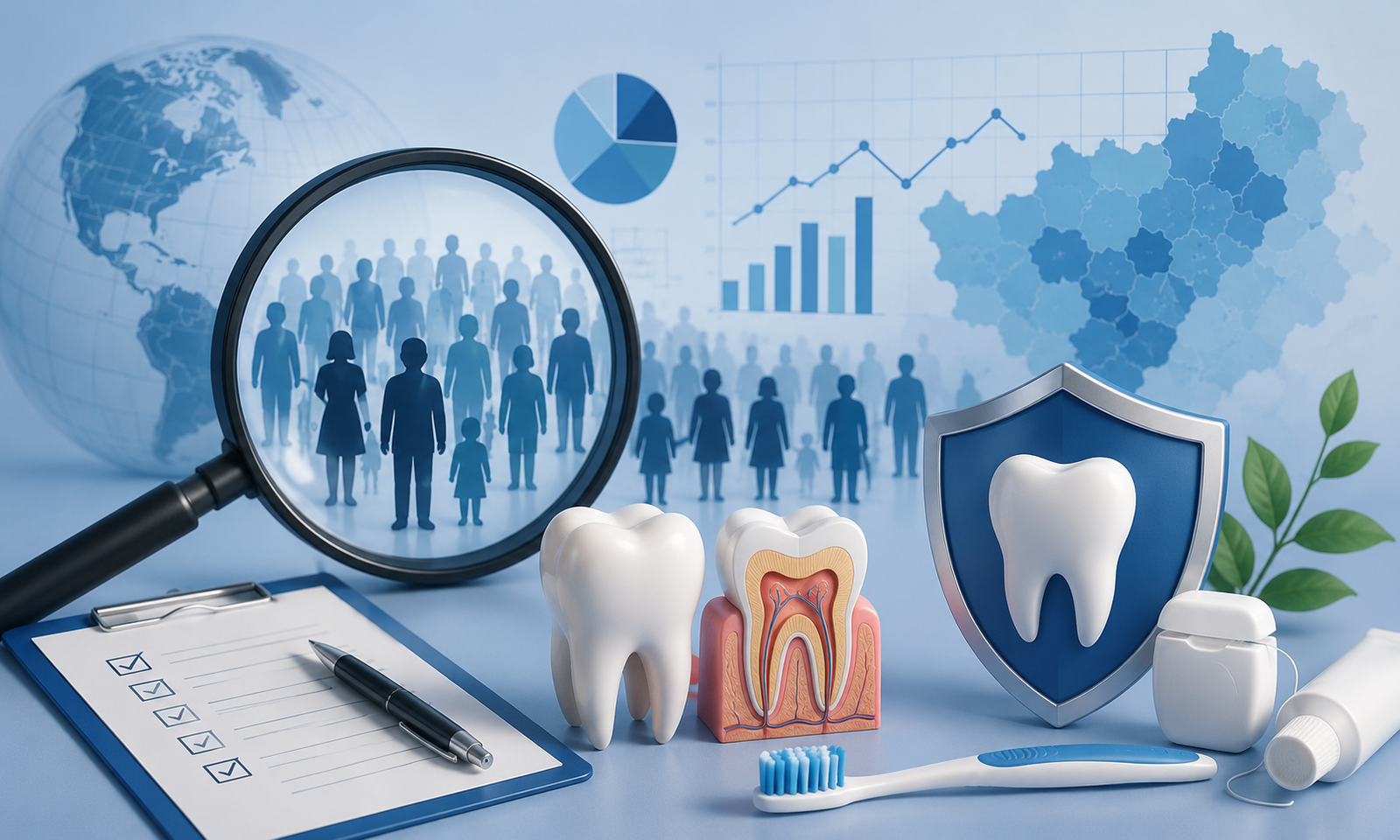
The article reviews the concepts used in epidemiology and how they have been applied to oral disease prevention and health promotion with a focus on utilizing population data, conducting risk assessments, and implementing interventions which are capable of decreasing the burden of oral disease.
Understanding epidemiology in oral health?
An oral epidemiology purviews the determinants, on the group level, of who is affected by oral diseases, where they are and what precipitates them. A population approach is necessary for recognizing trends and gaps in oral health outcomes.
For instance, one would find higher prevalence of caries in untreated tooth surfaces in lower income groups than in higher income groups in the epidemiologic survey. These results suggest that social determinants of health, such as access to fluoride, diet, education, and access to health care, have a significant impact.
The Centers for Disease Control and Prevention (CDC) and the World Health Organization (WHO) regularly collect and analyze oral health data as a means of providing prevention guidance. The use of such data sets is at the foundation of evidence-based decision-making in Public Health Dentistry.
Risk Assessment in Oral Disease Prevention.
Identifying the risk factors and vulnerable groups is a major tenet of epidemiology that analyzes population data to detect them. A risk assessment in oral health is through assessment of biological, behaviour and environmental risk factors for disease.
NRF’s identified through epidemiology.
- Eating too much sugar and munchies
- Failure to practice good oral health habits.
- The fluoridation of water systems is limited.Very limited exposures to fluoride.
- The use of tobacco and alcohol.
- Limited access to dental care services
Epidemiologists can use these factors to determine populations risks and make classification of communities based on these risks. At-risk populations can include the younger and the older residentially aged populations not receiving services as well as those with less access to preventive services.
A targeted intervention is also based on the risk assessment. The focus for example in schools within a high caries zone can be on supervised toothbrushing programmes or fluoride varnish applications and at the community-wide level, water fluoridation or community public education campaigns can be part of the package.
Community Fluoridation Programs as a Preventive Strategy.
The best illustration of the use of the epidemiologic concept in oral health is water fluoridation. The data from population studies over the past few decades has demonstrated that fluoride in community water supplies is an effective way in reducing prevalence of dental caries across all ages.
The use of community fluoridation programs is based on consistent epidemiologic evidence of fluoride’s effectiveness in preventing tooth decay in communities that have a fluoridated water system versus non-fluoridated communities. These programs are excellent examples of primary programmes for population level interventions.
- Epidemiology helps determine:
- Level of fluoride in water sources.
- Long-term effects on other populations
- Cost effectiveness relative to person-by-person treatment options
- Decreased oral health inequities
Public health officials can quote data from the population as evidence for the safety, effectiveness and equity of fluoridation policies. Furthermore, unlike other disease control strategies that depend on personal behavior, fluoridation does not require behavioral changes in individuals and is thus particularly useful in reaching under-resourced populations for disease prevention or oral hygiene education.
Early Intervention Initiatives in Oral Health
One more example of epidemiologic concepts is early intervention. It involves recognising if a disease is present, or if it may be present in the future, and taking measures to prevent it getting to a later stage.
Early Intervention Strategies:
- Fluoride varnish during early childhood.
- Ensuring that molars of children are targeted in sealant programs
- Early parental advice on feeding, hygiene routines.
Epidemiologic surveillance is used to aid in determining vulnerable age groups and vulnerable populations in order to implement these interventions at the appropriate time. Research indicates that childhood caries have a strong relationship, for example, with long duration of bottle-feeding and sugar consumption. The ability to understand this will enable health professionals to develop interventions for prevention and health education in babies and toddlers’ care.
Early intervention can help to lower the prevalence of disease and also lower long-term medical costs. Healthcare systems can improve by changing the management of oral health from restoring to preventive by tackling issues at an early stage.
Converting Epidemiologic data into Public Health Policy.
The impact of epidemiology is at the heart of local, national and global oral health policy. Surveillance data and research findings is used to allocate resources and prioritize interventions used by policymakers.
Key Policy Applications
- Communities in which there is a high prevalence of tooth decay have fluoridation programs established.
- There needs to be integration of oral health into primary health care systems.
- Funding for school based preventive dental programs.
- The establishment of national oral health monitoring systems continues.National oral health monitoring systems are being developed.
It is ideal when epidemiologic information indicates there may be fair discrepancies in the occurrence of oral health problems to help governments tailor interventions. For instance, areas that have population-level problems with untreated dental decay may be allocated more funds to offer more preventive care services or mobile dental units.
Public health authorities like the World Health Organization promote linking oral health into health promotion policy agendas for non-communicable diseases, because oral health is linked to overall health and well-being.
Selecting and comparing preventive strategies
One of the great features of epidemiology is being able to examine interventions over time and assess their efficacy. In oral health, it involves tracking the changes in disease status (prevalence) and treatment requirements (need), as well as changes in the behavior of the population.
Methods of Evaluation
- Before/after comparisons of disease rates using cross sectional surveys
- Oral health outcome studies in the longitudinal design with multiple data collections over the years of duration.
- Cost benefit analysis of prevention programs
- Monitoring of fluoride exposures and occurrence of caries.
For instance, communities that implement the water fluoridation can see significant reduction in dental caries rates in a matter of just a few years. Epidemiologic evaluation helps to keep such programs effective, safe and relevant.
The absence of this feedback loop means that public health interventions would not be accountable or be constantly improved. By using epidemiology, oral health programs adapt and change according to what is actually happening in the real world – not what people think should happen.
Epidemiology has been one of the most valuable additions to the operational tools that highlight health inequalities. Oral diseases are not equally distributed in the population, but disproportionately affect disadvantaged populations.
These inequalities can be attributed to:
- Socioeconomic status
- Geographic location
- Education level
- Ensuring access to preventive services.
- Cultural dietary practices
Epidemiology can help inform the creation of health policies that address these inequities. Interventions to address disparities in oral health outcomes include community-based programs, mobile dental, and reimbursement for preventive dental care.
Reducing the disparities in health is not just a clinical issue, but a public health one. Promoting equity leads to lower longer-term health care expenses and better health.
Importance of epidemiology to oral disease prevention in practice
The value of epidemiology in oral health is its applicability to turning data into action. It offers a link between research and practice, and informs prevention, allocation of resources and policy development.
Key benefits include:
- Effective knowledge of disease occurrence patterns.Better knowledge of disease occurrence patterns.
- The identification of high risk groups.Identification of high-risk populations.
- Evidence-based preventive strategies
- Effective use of health care resources;
- Numerous benefits for reduced overall disease burden.
The inclusion of epidemiologic principles in the definition and practice of oral health ensures preventing the disease from becoming a reality. This adjustment is vital to attain long term enhancements in oral health of the population.
Conclusion
Epidemiology is a key area of study to the prevention and control of oral diseases. It is used in analyzing population characteristics, risk factors and interventions to create effective and equitable oral health strategies.
Epidemiology serves as the scientific basis of contemporary preventive dentistry, used in both risk assessment and early intervention as well as at the community level, in community fluoridation programs. It assures that the policies on oral health are based on scientific evidence and responsive to population needs.
Finally, by incorporating epidemiologic concepts into clinical oral health care work, communities can benefit from improved prevention, better health burden and a better quality of life for everyone.