Introduction
Operative Dentistry encompasses many clinical techniques and procedures that can restore the function, structure, and esthetics of caries, trauma, or wear to the tooth. They involve rotary instruments, sharp hand tools and use sprays of water, and the dental team will be physically close to the patient. There are a high number of microorganisms in the oral cavity, making dental clinics an area where infectious diseases may be the source of great contraction if precautions are not maintained. Infection prevention is therefore not just a nice to have treatment, it is a critical part of the job of a dentist that helps protect both patients and providers.
With the rise of knowledge in modern dentistry about communicable diseases like Hepatitis B, Hepatitis C, tuberculosis, influenza and COVID-19, the value of maintaining high-level infection control measures has become more apparent. All surgical intervention can possibly pose a risk of cross-infection via saliva, blood, airborne droplet, contaminated surgical equipment, or failure to clean surfaces properly or disinfect. One time an error occurs in the protocol can create a great health risk to the patient and the dentist as well, and can hurt a dentist’s professional image and reputation.
Today’s infection control practices rest on three pillars: scientific evidence, guidelines established by regulators and universal precautions. A dental practitioner should presume that all patients have infectious pathogens in their mouths even when considering the patient, their medical and dental histories, and their appearance. Thus, the same safety measures will always be employed in every clinical situation. CDC dental infection control guidelines, call for PPE, sterilization, environmental disinfection, hand hygiene and instrument handling procedures to achieve successful infection control in dentistry.
When you are using the conventional dentistry treatments that are sure to produce aerosols and come in contact with body fluids, you need to obtain the safety standards right to ensure better dentistry treatment results and improve patient confidence. When dentist care providers adopt open and neat displays of clinical systems and proper protective clothing, patients are more likely to believe in their treatment providers. Meanwhile, practitioners enjoy less occupational exposure as well as better workplace safety. It is, therefore, important that these principles are understood and applied by all dental students, assistants, hygienists and clinicians who treat restorative care.
Infection Risks Associated with Operative Dentistry.
The mouth has bacteria, viruses and fungi naturally occurring that can cause harm if they are transmitted between people. Instruments are very commonly exposed to blood and saliva during various operative procedures like cavity preparation, placement of crowns, restoration and management of roots. High-speed handpieces and ultrasonic devices generate other aerosols that stay suspended in the air for long periods of time, which allows an extended period of time for airborne spread of contamination around the operatory—including the entire operating room.
There are several possible routes of cross-infection in dental settings. Direct contact transmission occurs through contact with broken skin or mucous membranes with contaminated blood or saliva. Indirect transmission involves the transmission of microorganisms by contaminated instruments, surfaces and dental materials. During aerosol-generating practices – such as during dental treatment – airborne spread becomes especially relevant, particularly in inadequate-ventilated clinics. Operative dentistry is one of the infection-sensitive aspects of oral healthcare practice due to these risks.
Numerous infectious agents are potential occupational hazards for dental health care workers. Prolonged contact with blood or other body fluids, as well as accidental needle-stick injuries or contact with sharp objects that may be contaminated with blood, can allow clinicians to come into contact with BBPs. Sterilization may not be fully implemented or reused or incorrectly, posing a risk to the patient. Frequently touched items like dental chair handles, curing lights, X-ray equipment, and computer keyboards may be contaminated with microorganisms if they are used during patient visits without being disinfected.
One other major worry is the appearance of super-viruses that are highly contagious, and resistant to the antibiotics used against them. HAPIs are infections that occur when bacteria or other germs from the healthcare environment are exposed, grow, and cause infection on clinical surfaces or equipment because these surfaces may not be completely disinfected during the clean-up process. This highlights the importance of the concept of infection control as a continuous system and not a single act. All patient care areas of the practice from the reception provided to the provision of treatment must be under preventive measures that are guided through a structured approach that is designed to break the microbial chain of transmission.
Why use Standard Precautions?
The basis of contemporary dental infection-control procedures is the application of standard precautions. The following precautions are meant to minimize the potential for transmission of infectious agents from both known and unknown sources. In operative dentistry, where oral fluids contact the treatment site are a normal part of the dental practice, these measures are practiced with all patients, irrespective of their medical history.
Hand hygiene is a critical aspect of standard precautions. Handwashing is an important way to minimise the spread of microbes between people by washing hands before and after touching a patient. Hand rubs and soaps containing antimicrobials are typically used with alcohol sometimes according to clinical circumstances. Hands should also be cleaned out right after gloves are removed because the glove may have microscopic tears that will allow contamination of hands. The length of all fingernails will be short, clean and free from artificial nail polish – this can contain microorganisms which are hard to completely kill.
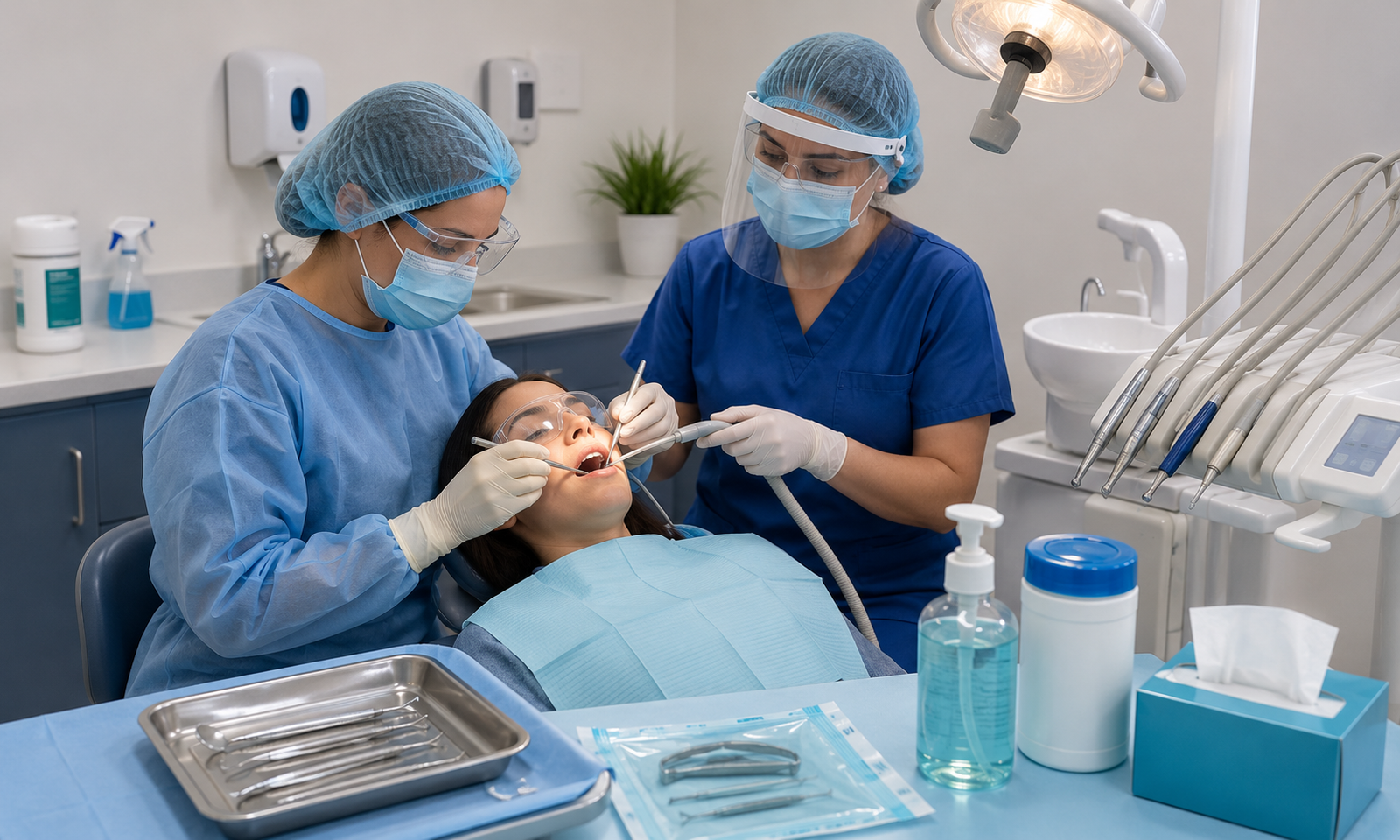
Personal protective equipment (PPE): is used as a barrier between the clinician and infectious material. During operative procedures full-length gowns, gloves, masks, protective eyewear and face shields are vital garments. Gloves are to be changed between patients and should not be reused. Masks needs to adequately cover the nose and mouth and should be changed when they get wet during treatment and are aerosol-generating. Eye protection guards the eye from splashes and flying debris, and clinical gowns keep the skin and clothing from getting contaminated.
Using respiratory hygiene is also an important infection prevention measure. Identify any patients early that may have respiratory symptoms and treat them carefully to reduce the spread of the disease. These actions, combined with adequate ventilating equipment and high-volume evacuation equipment, and aerosol reduction techniques, are helpful to improve the quality of the air inside the operatory. These actions have become particularly relevant during the COVID-19 pandemic, underscoring the significance of dental spaces being highly prone to airborne pathogens.
The other main factor of standard precautions is vaccination. All dental professionals should be immunized against hepatitis B, influenza and other pertinent diseases. It is not only health-care workers who are protected when they are vaccinated, it is also the risk of transmission of the infection to susceptible patients which is minimised. Therefore, updating immunization history should be part of the everyday clinical responsibilities of the health care professional.
Sterilization and Processing
The operative aspect can involve one of the most important procedures in sterilization since the instruments used are reusable and tend to be in direct contact with blood and the oral tissues. The appropriate processing of an instrument makes sure that all microorganisms, including bacterial spores, are destroyed that might be left in instruments for reuse on a different patient. Correct sterilization will lead to no or little cross-contamination and healthcare-associated infections.
Cleaning and decontamination are the first steps in the instrument processing cycle. The first step is to take instruments safely in puncture resistant, non-damaging containers; so as to prevent injuries. Prior to sterilization, common methods for debris removal are by use of ultrasonic cleaners and automated washer-disinfectors. Scrubbing by hand should be avoided if possible as this entails a higher risk of contact with contaminated sharps and splashes.
Once cleaned instruments are dried and packed and ready for sterilisation. The packaging materials prevent the contamination of the sterile instruments until they are used. The most popular sterilization method today for dental offices is Steam Sterilization which uses autoclaves. For certain instruments appropriate dry heat and/or chemical vapor sterilization will be used according to the manufacturer’s specifications. Biological, chemical, and mechanical indicators are used to monitor sterilization cycles to ensure consistency of sterilization.
It is necessary that the complex designs of operative dentistry instruments, such as burs, hand pieces, condensers, excavators, and matrix retainers need special attention. Dental handpieces should be cleaned, lubricated and heat sterilized between each patient. Wiping down external surfaces by itself does not ensure that the internal parts will be clean, as there can be contaminants remaining on internal surfaces. No single use item such as saliva ejector and some applicators should ever be reused.
Also, maintaining sterilized instruments is crucial. To avoid contamination prior to clinical use, sterile packs should be stored in clean dry areas. Worn or sufficiently damaged packaging needs to be reprocessed right away. Stabilization documentation also plays a crucial role in clinics’ quality assurance and regulatory compliance efforts and assures patients of safety.
Water Systems Management and Maintenance
Within the operatory, touching environmental surfaces during a dental procedure can easily lead to the microorganisms getting on them. Dental chair controls, counter tops, light handles, radiography devices, instrument trays, etc., can also serve as reservoirs for organisms when they are not disinfected in an appropriate manner between patients. Surface management is thus a significant part of infection control measures in Operative Dentistry.
clinical surfaces should be covered with disposable barriers or disinfected with approved hospital grade disinfectant at the end of each patient visit. Barrier protection is also effective for surfaces that are difficult to clean, such as switch plates, computer keyboard and curing light handles. Any barriers that are to be removed should be replaced carefully to prevent contamination of the recovable by the process used to remove the barrier.
Floors, sinks, and other surfaces the staff members interact with as they function in the home should also be cleaned routinely, but are not typically as likely to cause infection as direct surfaces. Blood and potentially infectious materials should be cleaned up immediately, and proper disinfectants and protective equipment should be used to handle spills. Hygiene plays a major part in ensuring that the clinical area remains a clean and safe place for the patient to go, and encourages their trust.
Cleaning up the water lines is another important safety factor for operative dentistry. If not properly maintained, dental unit water lines can become fouled with harmful micro-organisms. Safe water delivery during procedures is achieved through regular flushing, chemical treatment and water quality monitoring. Surgical use of sterile water is even more essential to reduce the risk of infection.
Waste disposal requirements also need to be carried out according to safety protocols. Needles, blades etc should be disposed of in puncture proof bins after use. Biohazardous waste is waste infected with body fluids or blood and must be segregated and disposed of following local guidelines. Safe waste disposal means safe environmental health and a safer environment for healthcare workers.
Patient safety and professional responsibility
Preventing infection isn’t the only way to maintain patient safety. Good communication, ethical responsibility, ongoing learning and education are all necessary for providing high standards of care in operative dentistry. The patient should be given confidence that all of his/her well-being is being protected during treatment. Patients are more likely to trust and have less anxiety about treatment when there is a clear practice of infection control standards.
Patient history is an important component in the process of making a diagnosis, particularly for infectious diseases or diseases whose primary symptom is a weakened immune system. Assessing the health condition of the patient enables physicians to fine-tune treatment regimens and take extra caution, if needed. Despite any illness or disease being revealed, however, normal care should be taken with all.
There is a need for continuous professional training due to changing recommendations for infection control. Dental practitioners need to keep abreast of new guidance, novel infectious diseases and developments in sterilisation procedures. Continuous training among staff to reinforce safe practice and promote awareness and understanding amongst the dental team.
There is also a need for documentation and quality assurance systems. The ability to document the monitoring of the sterilisers, vaccination information, equipment maintenance, and incident reporting shows accountability and can help with regular compliance with regulations. Established Infection Control Programs increase the odds of safe, efficient and legally compliant care.
Within a dental practice, one of the most important contributors to culture of safety is the leadership role in the practice. Dentists and all staff members should set examples in proper hygiene practices, and should be open to discussing concerns with patients. Rules are followed more robustly and long-term in a clinical setting when safety is everyone’s responsibility.
Conclusion
One of the most important duties in operative dentistry is the prevention of infection. There is always the possibility of any disease transmission due to proximity of the patient, aerosol and oral fluid exposure in restorative procedures. These risks can be reduced and a healthier atmosphere for both the patient and the dental care worker is created with strict infection control measures in place.
A multi-faceted approach to successful infection control relies on the use of standard precautions, appropriate sterilization techniques, cleaning-up, use of personal protective equipment, and ongoing professional learning. Patient care at every level should adhere to a strict protocol which includes safety precautions to avoid cross-contamination and ensure optimal treatment. This is especially crucial as these minutes could affect patient health and practitioner safety when they look back on them later.
In the modern world, dentistry is still evolving with the advancements in science and public health awareness. Dentists should be proactive about adopting evidence-based safety strategies and continuous learning to address unknown and emerging infectious risks. With strict infection control measures, operative dentistry treatment can continue in the same manner and preserve the wellness of all in the clinical environment.