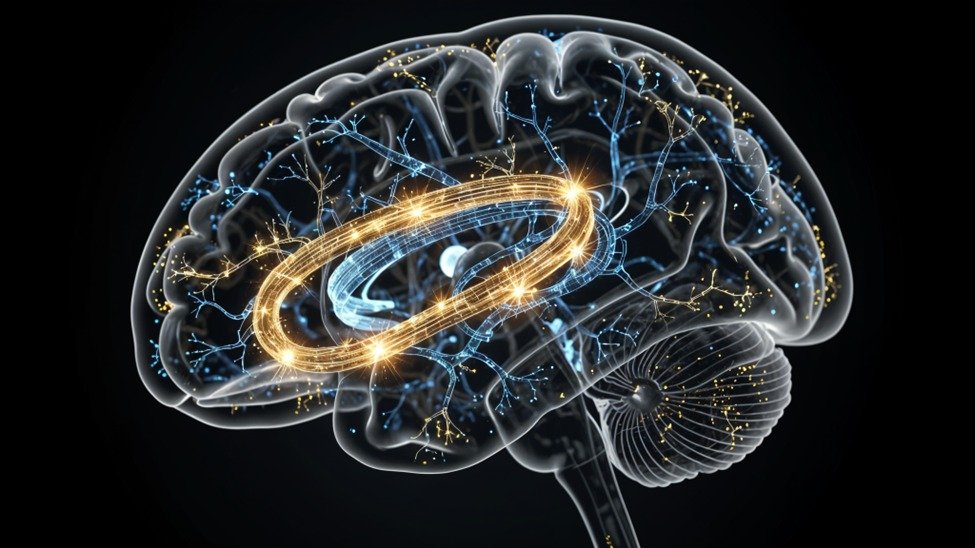
In the early 1990s, researchers at MIT placed rats inside T-shaped mazes, tucked a piece of chocolate at one end, and recorded what happened inside their brains. What they found redefined how neuroscience thinks about behavior. As each rat learned the route—hear the click, sprint down the corridor, turn left, eat the chocolate—activity in the basal ganglia spiked initially, then gradually compressed into a streamlined neural signature. The brain was packaging an entire sequence of actions into a single automatic chunk. For anyone seeking evidence-based insights into brain-behaviour connection, this experiment remains one of the most vivid demonstrations of how habits literally rewire neural circuitry.
The Cue-Routine-Reward Loop
Charles Duhigg popularized the term “habit loop” in his 2012 book The Power of Habit, but the underlying science traces back to neuroscientist Wolfram Schultz’s dopamine research in the 1980s and ’90s. Schultz recorded neurons in monkey brains while the animals learned to associate a tone with a squirt of juice. Initially, dopamine surged when the juice arrived—a straightforward reward signal. But after enough repetitions, something shifted. The dopamine spike migrated backward in time, firing at the cue (the tone) rather than the reward (the juice). The brain had learned to predict the reward, and that prediction became the motivational engine.
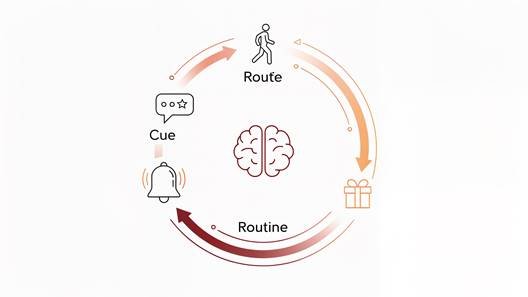
This is the architecture that Duhigg organized into three stages. A cue triggers the behavior—a time of day, an emotional state, a location, the sight of your running shoes by the door. The routine is the behavior itself, which can be physical, mental, or emotional. The reward is whatever the brain gets out of it: sugar, social validation, a reduction in anxiety, a nicotine hit. Over dozens or hundreds of repetitions, the loop hardens. The prefrontal cortex, which handled all the deliberate decision-making early on, gradually hands control to the basal ganglia. What once required conscious effort becomes automatic.
Chunking: How Your Brain Automates Behavior
Neuroscientists call this process “chunking.” Ann Graybiel, who led the MIT rat studies, showed that as a habit forms, basal ganglia neurons fire strongly at the start and end of the behavioral sequence—marking the boundaries of the chunk—but go relatively quiet in the middle. Think of it like compressing a folder of files on your computer. The individual steps still exist, but the brain treats them as one unit, freeing up cognitive resources for other tasks.
This handoff from the prefrontal cortex to the basal ganglia is why you can drive a familiar route while carrying on a complex conversation, or tie your shoes while planning your afternoon. The prefrontal cortex is the brain’s executive—slow, deliberate, and energy-hungry. It burns through glucose and oxygen at disproportionate rates relative to its size. The basal ganglia operate more like a well-oiled assembly line: fast, efficient, and largely unconscious. Habits are the brain’s way of conserving mental bandwidth, and from an evolutionary perspective, this efficiency was a survival advantage. An ancestor who had to consciously deliberate every step while fleeing a predator wouldn’t have lasted long. And this isn’t trivial—a 2006 paper by David Neal and Wendy Wood at Duke estimated that roughly 40 percent of daily actions are habitual rather than consciously decided.
How Long Does It Really Take to Form a Habit?
Forget the “21 days” myth. That number originated from a 1960 observation by plastic surgeon Maxwell Maltz, who noticed patients took about 21 days to adjust to a new face. It was never a controlled study on habit formation. The most rigorous data comes from Phillippa Lally and her colleagues at University College London, who published their results in the European Journal of Social Psychology in 2009. They tracked 96 participants as they tried to adopt a new daily behavior—things like eating fruit at lunch or running for 15 minutes before dinner.
The average time to reach automaticity was 66 days. But here’s the part that most summaries leave out: the range was enormous, spanning from 18 days for simpler habits to 254 days for more complex ones. The type of behavior mattered significantly. Drinking a glass of water after breakfast became automatic far faster than doing fifty sit-ups before dinner. Lally also found that missing a single day didn’t derail the process—a reassuring finding for anyone who treats one slip as total failure. The trajectory toward automaticity was a curve, not a cliff.
Breaking Habits: Extinction Versus Counterconditioning
If forming a habit means strengthening a neural loop, breaking one is frustratingly not the reverse. Neuroscience suggests that old habit pathways don’t get erased; they get overwritten or suppressed. This creates a tension between two strategies that psychology and behavioral science have debated for decades.
Extinction is the classical approach: remove the reward, and eventually the behavior fades. Pavlov’s dogs stopped salivating when the bell no longer predicted food. But extinction is fragile. Stress, context change, or the passage of time can trigger spontaneous recovery—the old habit surging back as if it never left. Anyone who has quit smoking for six months only to relapse at a party understands this viscerally.
Counterconditioning offers a more durable alternative. Instead of simply removing the reward, you replace the routine with a new behavior that delivers a similar payoff. Craving a cigarette after dinner? Substitute a five-minute walk that still gives you a break from the table and a hit of fresh air. The cue and the reward stay intact; only the middle piece changes. This is the approach most cognitive-behavioral therapists favor, and it aligns with what Graybiel’s research predicts: because the basal ganglia encode the full loop, swapping the routine while preserving the cue-reward bookends is more sustainable than trying to silence the loop entirely.
Building Better Habits: Implementation Intentions and Habit Stacking
Knowing the neuroscience is useful, but practical psychology tips for actually changing behavior are what most people need. Two research-backed strategies stand out.
Peter Gollwitzer, a psychologist at New York University, introduced the concept of implementation intentions in the 1990s. The format is deceptively simple: “When situation X arises, I will perform response Y.” A meta-analysis of 94 studies, published by Gollwitzer and Paschal Sheeran in 2006, found that implementation intentions had a medium-to-large effect on goal achievement. The power lies in pre-loading the decision. Rather than relying on willpower in the moment, you delegate the choice to an environmental cue, effectively programming a new habit loop from the top.
BJ Fogg, a behavioral scientist at Stanford, built on this with his Tiny Habits method. Fogg’s core insight is that new behaviors should be absurdly small at the start—two push-ups, not twenty. He also advocates “habit stacking”: anchoring the new behavior to an existing habit. “After I pour my morning coffee, I will write one sentence in my journal.” The existing habit acts as a reliable cue, and the tiny size of the new behavior minimizes resistance. Fogg’s research, along with clinical applications of his method, shows that once the sequence is established, people naturally scale up the behavior on their own. The bottleneck was never motivation; it was initiation.
Why Some Habits Refuse to Die
Not all habits are created equal. The ones that resist change most stubbornly tend to share two features: variable reward schedules and deep ties to personal identity.
Variable reward schedules—a concept B.F. Skinner mapped out in the 1950s—are the engine behind slot machines, social media feeds, and compulsive email checking. When the reward arrives unpredictably, the dopamine system stays perpetually engaged. Fixed rewards (“every time I press the lever, I get a pellet”) produce steady but extinguishable behavior. Variable rewards (“sometimes I get a pellet, sometimes I don’t, sometimes I get three”) produce behavior that is extraordinarily resistant to extinction. This is why scrolling through Instagram can feel so much harder to stop than, say, a nightly vitamin. The unpredictability of interesting content keeps the basal ganglia loop firing.
Identity adds another layer. James Clear, in Atomic Habits, argues that the most persistent habits are those woven into a person’s self-concept. A smoker who says “I’m trying to quit” is still identifying as a smoker. One who says “I’m not a smoker” has shifted the identity, and research in self-perception theory supports the idea that behavior follows identity labels. When a habit becomes part of who you believe you are—”I’m a runner,” “I’m someone who meditates”—it gains a gravitational pull that mere routines lack.
The psychology of habit formation sits at the intersection of neuroscience, behavioral research, and practical self-improvement. Your basal ganglia don’t care whether a habit is “good” or “bad”—they just automate whatever loop gets repeated with a reward attached. The tips that actually work—replacing routines rather than fighting them, stacking new behaviors onto old ones, starting absurdly small, and rewriting the identity story—aren’t gimmicks. They’re strategies built on decades of psychology research, from Schultz’s dopamine-recording electrodes to Lally’s automaticity curves. Understanding the machinery doesn’t guarantee change, but it removes the mystery. And once the mystery is gone, the path forward gets a lot clearer.