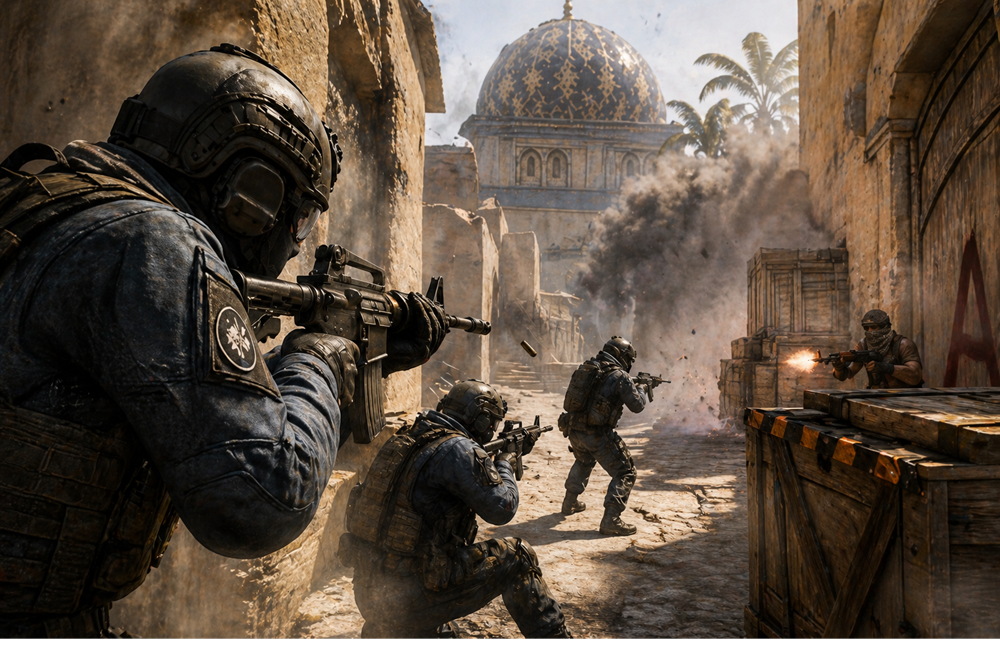
The trajectory of competitive gaming was forever altered in the late 90s when a humble modification for Half-Life emerged as a global sensation. Today, even with modern sequels dominating the market, many purists still prefer to download counter strike 1.6 to experience the mechanical precision that defined the tactical shooter genre. This version serves as the bedrock of FPS history, offering a gameplay loop that rewards individual skill and team coordination in equal measure. Its simplicity—pitting two teams against each other in objective-based rounds—is exactly what has allowed it to remain relevant across multiple decades.
For players looking for the most stable and authentic experience, finding a clean CS 1.6 english version is paramount for competitive integrity. While the industry has moved towards complex character abilities and high-fidelity graphics, the original Counter-Strike focuses on the fundamentals: crosshair placement, spray control, and economic management. This article explores the cultural and technical impact of the franchise, examining why it continues to be a staple in the world of esports and a favorite among dedicated gamers worldwide.
The Philosophy of Round-Based Tactics
Counter-Strike’s genius lies in its high-stakes environment. Unlike many shooters where players respawn instantly, CS introduced a system where death is permanent for the remainder of the round. This mechanic creates a unique psychological tension, forcing players to value their digital lives and communicate effectively with their team. Every corner cleared and every flashbang thrown becomes a tactical decision, turning a fast-paced shooter into a strategic game of cat and mouse. This ‘one-life-per-round’ philosophy is what eventually paved the way for the professional esports scene we see today.
Map Design: The Geometry of Fair Competition
The maps of Counter-Strike are legendary. Names like de_dust2, de_inferno, and de_nuke are studied by level designers for their perfect balance and ‘three-lane’ layout. These maps ensure that neither the Terrorists nor the Counter-Terrorists have an overwhelming advantage, making every match a fair test of skill. The familiarity of these layouts allows for the evolution of complex strategies, as professional teams develop ‘lineups’—specific positions to stand in to throw smoke grenades or flashbangs into precise locations from across the map.
Economic Management: The Game within the Game
One of the most distinctive features of the series is its in-game economy. Players do not start with their best equipment; they must earn currency through kills and objective completions. This introduces a strategic layer where a team must decide when to ‘save’ (buy nothing to save money) or ‘force buy’ (spend their last remaining funds on low-tier gear) to break an opponent’s momentum. Managing the team’s shared bank account across a 30-round match is a mental challenge that requires foresight, trust, and a deep understanding of the game’s ebb and flow.
Movement and the Art of Counter-Strafing
Mastering the weapons in Counter-Strike is only half the battle; the other half is movement. To fire with 100% accuracy, a player must be standing perfectly still. This led to the development of ‘counter-strafing’—the technique of tapping the opposite movement key to stop momentum instantly before pulling the trigger. High-level play also involves techniques like ‘bunny hopping’ and ‘air strafing,’ which utilize the game’s physics engine to maintain speed and reach unexpected positions. This high skill ceiling ensures that there is always room for a player to improve, regardless of their experience level.
The Legacy of the Major Championships
The story of Counter-Strike is inextricably linked to the rise of professional gaming. From the early LAN cafes to the sold-out arenas of the modern era, the ‘Major’ championships represent the pinnacle of competitive play. These events, sanctioned by Valve, draw millions of viewers and offer life-changing prize pools. The legends of the game, players who have spent tens of thousands of hours mastering their craft, are celebrated as global icons. These tournaments are not just about the game; they are about the stories of underdogs rising to glory and the pursuit of digital excellence.
Conclusion: The Future in a New Era
With the release of Counter-Strike 2, the franchise has stepped into a new technological era. While the move to the Source 2 engine brought volumetric smoke and improved lighting, the core ‘soul’ of the game remains untouched. It continues to be a pure test of aim, strategy, and teamwork. As the world of gaming continues to evolve, Counter-Strike stands as a testament to the power of a solid mechanical foundation and a dedicated community. Whether playing on a legacy client or the latest update, the thrill of the defuse remains universal.