Introduction
One of the key areas of concern in accounting is income measurement theories since it dictates the manner in which financial performance of a company is reported and interpreted. The term income might appear simple; revenue, less expenses, but in practice, it is influenced by some underlying theory and assumptions that affect the valuation of assets and liabilities, the timing of recognition of revenue and the matching of expenses.
The financial outputs of different measurement methods of income can vary drastically even with the same business under analysis. These differences impact on people (stakeholders) like investors, creditors, managers, and regulators, who use the financial statements to make wise decisions.
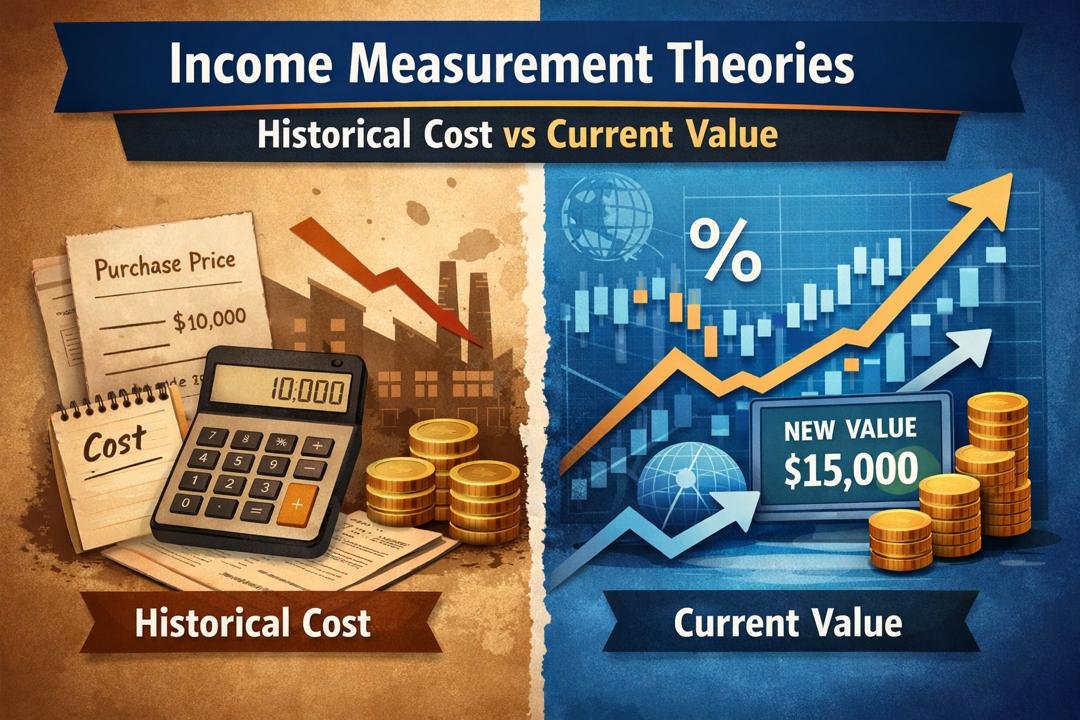
This article discusses the key theories of measuring income with reference to the historical cost and current value methods. It looks into their conceptual basis, their practical uses and their implication on financial statements. In order to gain a clearer insight into the conceptual framework, you may consider this elaborate guide on income measurement theories, which puts their development and the way they are relevant in the contemporary accounting into perspective.
Concept of Income in Accounting
It is necessary to elucidate the meaning of income in accounting before taking into plunge on theories. Generally, income can be defined as the growth in economic benefits within an accounting period in the form of inflows or an increase in the assets or a decline in liabilities.
The income measurement theories, however, will be determined by how we measure capital and how we deal with the changes in the value of assets. There are two basic opinions that pervade this debate:
- Capital Maintenance Concept
- Income as a Residual Concept.
Capital Maintenance Concept
This idea considers income as the sum that can be given to owners without decreasing the capital of the entity. It has two forms:
- Financial Capital Maintenance: The amount of income is realized when the net increase in the financial (monetary) value of the net assets is realized.
- Physical Capital Maintenance: The Income is only recognized after the maintenance of the productive capacity of the entity.
The decision between these notions affects greatly the measurement and reporting of income.
Overview of Income Measurement Theories
Income Measurement Theories give guidelines towards the calculation of income. The differences between these theories primarily lie on how they would value assets and liabilities and how they would treat value change.
These two main strategies are:
- Historical Cost Accounting (HCA).
- Current Value Accounting (CVA)
Both methods have their strong and weak sides and consequences to financial reporting.
Historical Cost Accounting (HCA)
Definition and Concept
Historical cost accounting is a method of asset and liabilities accounting based on their initial purchase value. The computation of income is done on the basis of realized transactions i.e. the revenues are recognized on the basis of the earnings and the expenses are recognized on the basis of the incurred costs of the assets by use of the original cost of the assets.
Key Features
- Assets are valued at purchase price.
- Depreciation is on historical cost.
- Gains are realized when gained.
- Emphasis on objectivity and verifiability
Measurement of Income under HCA
Under the historical cost accounting, the revenues are matched with historical costs incurred to earn the revenues. This is referred to as matching principle.
For example:
When a machine is bought at the cost of $10,000 and revenues are obtained in a span of five years, the costs are divided into those years with the help of depreciation. The difference between income and this cost allocated to it is calculated.
Advantages
- Objectivity and Reliability: The basis of historical cost is actual transactions and it is therefore easy to check.
- Simplicity: It is simple to use and comprehend.
- Consistency: Financial statements are the ones that are not sensitive to market conditions as the value of assets does not change over time.
Limitations
- Ignores Inflation: During periods of increasing prices, historical costs can greatly defraud the value of assets.
- Outdated Information: The assets that were bought several years ago can be valued at a much lower price than its current price.
- Distorted Income Measurement: The old costs that are matched to the current revenues may result in false profit figures.
Current Value Accounting (CVA)
Definition and Concept
The current value accounting is a method of determining the value of assets and liabilities as of their current value as opposed to their historical value. This method will be used to capture the economic reality of evolving market conditions.
Key Features
- Assets are considered at the current market prices or replacement prices.
- Gains and losses can be realized even unrealized.
- Concentrate on economic pertinence and not historical accuracy.
Types of Current Value Approaches
- Replacement Cost Accounting: The value of the assets is considered to be the replacement cost at the current prices.
- Net Realizable Value (NRV): The value of assets is set at the price of selling it, less the selling expenses.
- Fair Value Accounting: Measurement of assets and liabilities is on market-based values.
Income Measurement under CVA
The income is computed both on the realized and unrealized losses or gains. An example is when an increase in the value of an asset is realized, it can be considered as income, although the asset is not sold.
Advantages
- Relevance: Gives current data that is in line with the latest economic trends.
- Better Decision-Making: Past values provide investors and managers with a better understanding of the present values.
- Improved Comparability: Financial statements indicate actual changes in the economy as opposed to old expenses.
Limitations
- Subjectivity: The estimation of current values can be judicious and assumptions may be taken.
- Volatility: Market changes can cause a significant change in financial statements.
- Complexity: Needs more advanced methods of valuation.
Historical Cost vs. Current Value Comparisons
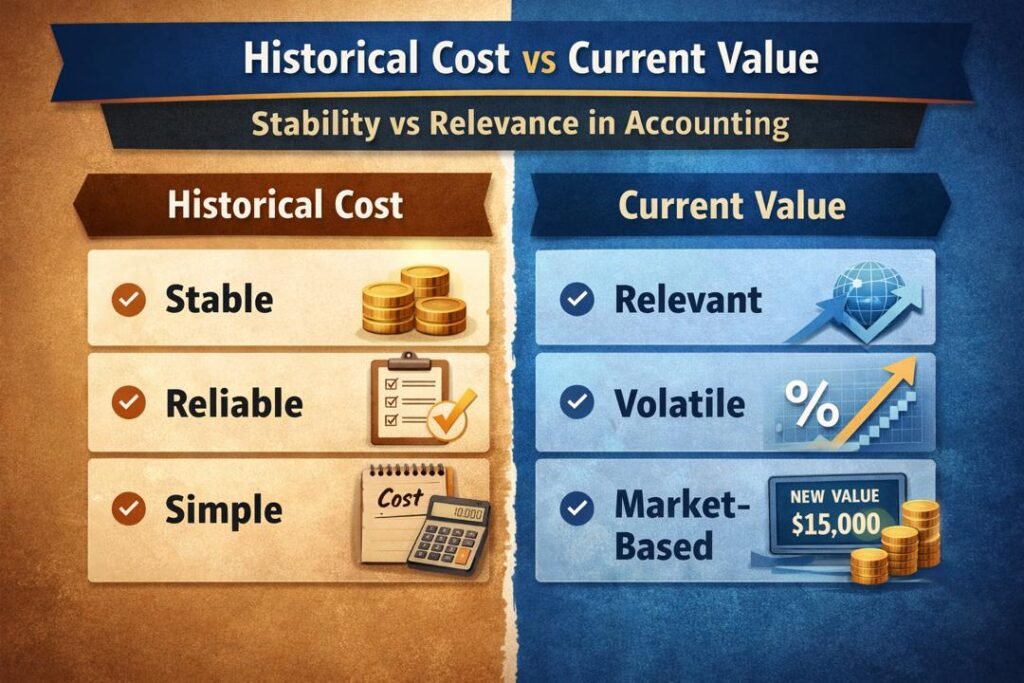
| Aspect | Historical Cost | Current Value |
| Basis of Measurement | Original cost | Current market value |
| Income Recognition | Realized gains only | Unrealized and realized gains. |
| Reliability | High | Moderate |
| Relevance | Low during period of low inflation. | High |
| Complexity | Simple | Complex |
| Stability | Stable | Volatile |
The trade-off between reliability and relevance, which is the focus of the income measurement theory, is reflected in this comparison.
Impact on Financial Statements
The decision on the income measurement theory has a significant effect on financial statements such as the income statement, the balance sheet and the cash flow statement.
1. Effect on Income Statement.
Under Historical Cost
- Income is more stable and smooth.
- Expenses can be underestimated since they are based on outdated costs.
- The profits can be exaggerated in case of inflation.
Under Current Value
- Income is a reflection of the real-time economic alterations.
- There can be a high level of fluctuation in profits.
- Included are unrealized gains and losses.
2. Effect on the Balance Sheet.
Historical Cost
- Assets are underpriced in the long run.
- Liabilities are fairly accurate.
- Equity might not indicate the actual economic value.
Current Value
- Assets are adjusted to the market conditions.
- Equity is brought to life.
- Balance sheet gives improved financial status.
3. Financial Ratios Impact.
The income measurement will impact major ratios such as:
- Return on Assets (ROA)
- Return on Equity (ROE)
- Profit Margin
As an illustration, historical cost of undervalued assets can inflate ROA giving an illusion of efficiency.
Implications for Stakeholders
Investors
Investors need to know the correct measurement of income in order to determine the level of profitability and growth.
- Historical cost can be a downplay of risks.
- Current value gives more useful information, but can be less reliable.
Creditors
Creditors are interested in how a firm can pay off debt.
- Constant earnings in the regime of HCA might be less risky.
- CVA can disclose financial weaknesses.
Management
Financial statements help managers make decisions and to plan.
- HCA aids in long term stability.
- CVA assists in making decision in real time.
Regulators
The goal of the regulators is to provide financial reporting transparency and fairness.
- The conclusion is that, they usually need a combination of both methods.
- Standards like IFRS have an element of fair value.
Hybrid Approaches in Practice
The truth is that the majority of the accounting systems employ both the historical cost and current value approach. For example:
- Property, plant and equipment can be recorded at historical cost although revalued periodically.
- Financial instruments are mostly quantified at fair value.
This mixed method strives to offer a balance between reliability and relevance.
Role of Accounting Standards
The accounting standards are essential in providing the direction in terms of measuring income.
International Financial Reporting Standards (IFRS)
- Emphasizes fair value measurement
- Encourages transparency and comparability.
Generally Accepted Accounting Principles (GAAP)
- Conventionally prefers historical cost.
- Progressively adding fair value components.
These standards are evidence of the continuous development of the theories of measuring income.
Challenges in the Measurement of Income
Nevertheless, there are still a number of issues:
1. Inflation: Increased prices will cause the historical cost measurement to be distorted thus reporting an inaccurate income.
2. Subjectivity in Valuation: The determination of fair values is subject to assumptions and this can be biased.
3. Earnings Management: There are various methods of measurement that can be controlled to affect the income reported.
4. Lack of Uniformity: Different methods may be used in different companies making them less comparable.
Practical Example
Take the case of a company which bought land ten years ago and paid 50,000. Today, the land is worth $150,000.
- Under Historical Cost: Land is still at the books at 50,000. There is no income recognized.
- Under Current Value: The land is revalued to $150,000, and a gain of $100,000 may be recognized.
This scenario demonstrates that various theories can have radically different financial results.
Importance of Understanding Income Measurement Theories
The knowledge of income measurement theories is crucial in:
- Correct interpretation of financial statements.
- Making informed investments.
- Evaluating company performance
- Understanding accounting policies
Lack of this knowledge can lead to poor decisions by the user since they will not be able to understand financial information.
Future Trends in Income Measurement
Income measurement is a developing field because of:
1. A higher use of Fair Value: The trend in modern accounting is towards fair value measurement in order to make accounting more relevant.
2. Technological Advancements: Valuation methods are being enhanced with data analytics and AI.
3. Global Harmonization: There is an attempt to harmonize accounting standards in the global context.
4. Sustainability Reporting: There are new frameworks that are being created to quantify the environmental and social impacts as well as financial income.
Conclusion
Income measurement is not merely a technical accounting procedure, but it is a basic concept that influences the way the financial performance is viewed and assessed. A trade-off exists between reliability and relevance between historical cost and current value approaches.
Historical cost is more stable and objective and can be not reflective of current economic realities. Conversely, the current value accounting provides more up to date information and adds subjectivity and volatility.
In reality, a mixed method is frequently employed in order to strike the balance between these conflicting aims. The knowledge of these theories can help stakeholders to interpret the financial statements in a better way and make superior decisions.
With the ever-changing nature of accounting, the significance of the theories related to income measurement will only increase, particularly in a dynamic global economy whereby, relevant and accurate financial information is paramount.
Get more well researched information about Income Measurement Theories here.