Introduction
Accounting is a language of business which it should be for the simple fact that it puts out a structure to record, analyze, and report financial information. As a student, entrepreneur, or up and coming accountant what you put into this is that which you will get out of it, which is why it is so important to have a grasp of the basic accounting concepts. These principles are what support financial reporting which in turn presents financial statements that are the same, reliable and easy to compare across any company and time period.
At first it may appear that accounting is a technical and complicated field. But in fact when you break it down into basic concepts which we relate to every day, it becomes much more approachable. In this article we introduce the main accounting concepts which include the business entity concept, going concern, accruals, and consistency. These principles detail how transactions are recorded and recognized which in turn present the financial health of a business.
At the beginning of your journey, study of the basic principles of accounting will give you a strong base for in depth study of financial and business topics.
What Are Accounting Concepts?
Accounting principles are the foundation which we build the recording and reporting of financial transactions. They see to it that financial info is put out in a form which is relevant and valuable to users like investors, managers, creditors, and regulators.
Without those concepts financial reports would be disorganized and inconsistent. Different companies may record transactions in very different ways which in turn makes it hard to compare performance or assess financial health.
In other words accounting concepts answer questions like:
- When do we record a transaction?
- How should it be measured?
- How should it be presented?
Here are some that are very important.
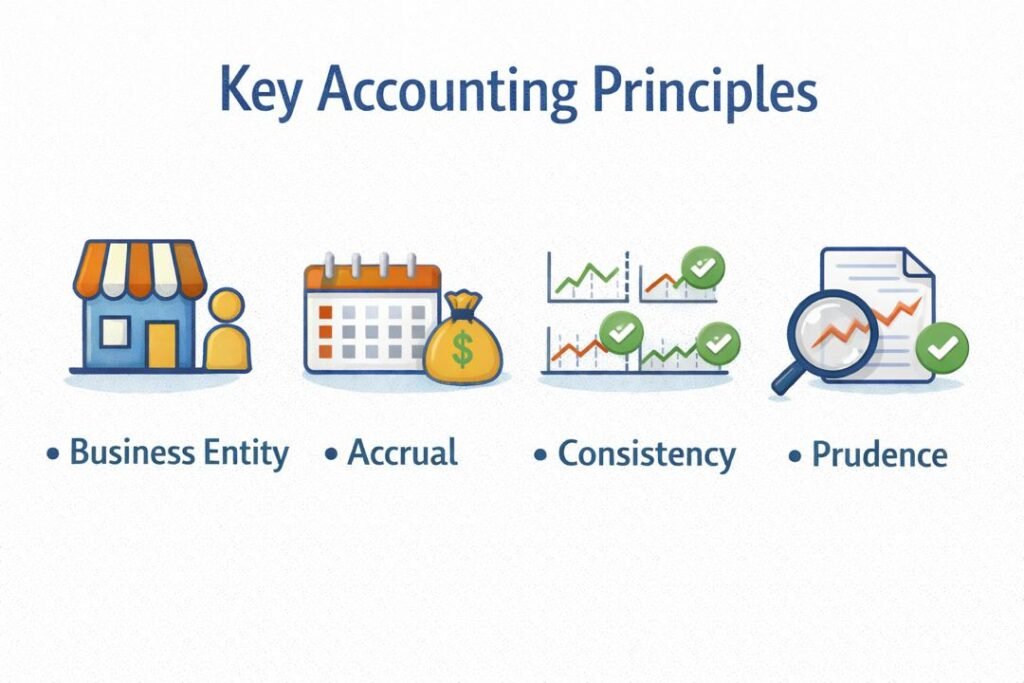
The Business Unit Concept
Definition
A business entity is a separate legal and financial entity from its owner or owners which means that the financial transactions of the business must be kept separate from the personal transactions of the owner.
Why It Matters
This concept is about clear and accurate financial reporting. Also without it personal and business finances will mix which in turn will make it hard to determine the business’ true performance.
Example
As a small scale baker you may notice that when you put in money for personal things at home with your groceries that isn’t a business expense. Also if the bakery generates income, that is to be recorded as a separate entity from your personal income.
If from the business you take out money for your own use that is recorded as a drawing which is different from a business expense.
Key Takeaway
Keeping your business and personal finance separate does:
- Maintain accurate records
- Evaluate business performance correctly
- Avoid issues during audits or tax assessments.
Going Forward Concept
Definition
The business is assumed to be in operation for the foreseeable future and has no plan or need to liquidate its assets.
Why It Matters
This assumption which in turn determines the way assets and liabilities are reported we see that if a business is to go on operating as going concern then assets are recorded at historic cost as opposed to liquidation value.
Example
Sup into a business that buys outfit of ₦2,000,000 the company based on going concern principle will use the machine for many years which is that cost is to be passed on over the machines’ useful life through the process of depreciation.
However, at the time of closure the machinery may be valued at what it could be sold for which is sometimes much lower.
Key Takeaway
The going concern concept: Going concern principle:
- Supports long-term planning
- Justifies the use of depreciation
- Provides stability in financial reporting
The Going Concern Concept
Definition
In the accrual system we record income and expenses in the period they are earned or incured which may not coincide with the time of cash flow.
Why It Matters
This concept is that financial reports present the real financial performance of a business for a given period.
Example
In the month of December we may finish a project for a client but get paid in January. Based on the accrual system we record the income in December as that is when the service was performed.
In addition if you get a bill for the electricity used in the past, say December while you pay it off in January, which should be reported in December.
Accrual vs. Cash Basis
- Accrual Accounting: Records occurrences of transactions.
- Cash Accounting: Records when money changes hands.
Most firms use accrual accounting which in turn gives a better picture of financial performance.
Key Takeaway
The accrual concept helps the going in concept of which helps:
- Match income with related expenses
- Present accurate profit figures
- Improve decision-making
The Consistency Concept
Definition
The consistency principle is that which businesses apply the same accounting policies and practices from one time period to another.
Why It Matters
Consistency in reporting allows users of financial statements to see trends over time. If a company often changes its accounting methods what we are left with is a picture that doesn’t tell the full story of their progress.
Example
If a company reports via the straight line method of depreciation it should continue with that for future periods. To change to a different method without cause may present distorted financial results.
Exceptions
A business may switch to a different accounting method if:
- The new method reports more accurate results.
- The change is reported in financial reports.
Key Takeaway
Consistency:
- Enhances comparability
- Builds trust in financial reports
- Reduces confusion for stakeholders
Prudence Concept
Definition
Prudence is a requirement which of course accountants must put in practice; it means out that they have to be very careful in their estimates which should not result in an overstatement of assets and income or an understatement of liabilities and expenses.
Why It Matters
This concept is to protect users of financial reports from aggressive positive presentation.
Example
If at some point a business determines that not all customers will pay what they owe it will create a provision for those doubtful debts instead of thinking all payments will be received.
Key Takeaway
Prudence ensures:
- Realistic financial reporting
- Protection against potential losses
- Credibility of financial statements
The Matching Principle
Definition
Expenses are to be reported in the same accounting period as the revenues they produce.
Why It Matters
This is a related concept which we use in determining accurate profit.
Example
If in March a business puts out ads and sees a rise in sales that same month then the expense of the ad and the revenue should be recorded in March.
Key Takeaway
Matching:
- Ensures accurate profit calculation
- Links costs to benefits
- Improves financial analysis
Materialism Concept
Definition
Materiality is that which we report in financial statements only which will in turn affect the decision of users.
Why It Matters
Not all financial data is of equal importance which is a principle that accountants use to report on major items and pass over minor details.
Example
A business may write off small office supplies as an expense at purchase instead of classifying them as assets which is true for items of little value.
Key Takeaway
Materiality:
- Simplifies accounting processes
- Focuses on relevant information
- Enhances clarity in reporting
The Historical Value Cost Concept
Definition
At time of purchase, assets are to be recorded at their original cost.
Why It Matters
This concept provides data that is objective and beyond manipulation.
Example
If a company purchases land for ₦5,000,000, at that value the land will be recorded and should its market value to increase over time that is a separate issue.
Key Takeaway
Historical cost:
- Ensures reliability
- Avoids subjective valuations
- Provides a uniform base for recording assets.
Why These Concepts Are Important
Comprehension of these concepts goes beyond the accountant it is a requirement for anyone in business or finance.
1. Exact Financial Reporting
These principles make that financial reports present the true financial health and performance of a business.
2. Improved Decision Making
Investors, managers, and stakeholders depend on accurate information for decisions. Without these elements financial data may be misrepresentative.
3. Comparative Analysis
Consistency and standardization enable the comparison of financial reports across various companies and time frames.
4. Transparency and Confidence
Adherence to the accounting principles, which in turn builds stakeholder’s confidence including that of investors, lenders and regulators
Real-Life Application
Here is a basic example which we will use to tie everything together.
Suppose you start a small fashion business:
- You put in of capital of ₦500,000 (also note that this is for the business which is separate from your personal finances).
- We purchase sewing machines (at historical cost).
- You operate for years (going concern principle).
- In December we issue the sales but get paid in January (accrual concept).
- You always use the same approach for cost calculation (consistency principle).
- You allocate funds for return customers (prudence concept).
By application of these principles what you get is accurate and reliable financial records.
Conclusion
Accounting fundamentals are the base of financial literacy. We see in the principles of the business entity, going concern, accruals, and consistency not just theory but practical tools which do indeed make financial info accurate, meaningful, and trustworthy.
At the start of your journey to business understanding these basic accounting concepts is key. They put forth a structure for recording transactions, preparing reports, and making informed decisions.
As you move along in your accounting or business career these principles will be a constant. With a strong base of knowledge in place it will open up more complex topics which you will find easier to grasp and at the same time your skill in analysis of financial info will see great improvement.
In today’s age of growing financial importance what we see is that out of which basic accounting concepts are understood is a requirement.
Get more well researched information about the Basic Accounting Concepts here.