Picking a centre based on how the foyer looks is more common than anyone admits. A fresh mural and a smiling receptionist feel reassuring — but neither tells you what happens once the door closes behind you. When families search for childcare centres in Gold Coast, the instinct is often to trust first impressions — the tidy sign out front, the laminated welcome pack, the educator who remembers your name on the second visit. None of that is meaningless, but none of it is the point either. The questions worth asking are the uncomfortable ones. How does the room leader respond when a child is falling apart and the rest of the group still needs managing? What happens when the centre’s approach and a parent’s expectations genuinely collide? These moments expose whether a centre is well-run or just well-presented. Most families never think to ask until something has already gone sideways.
Why Educator Turnover Costs More Than People Realise
Australia’s early childhood sector has a staffing problem that rarely makes headlines. Educators are among the lowest-paid qualified professionals in the country, and on the Gold Coast, where living costs have climbed hard, turnover in some rooms is relentless. For children under three especially, this matters in a way that is painfully concrete. Young children build trust with specific people. When that person leaves and is replaced, and then replaced again, the settling process restarts from scratch each time. A child who seems fine at drop-off may simply have stopped expecting consistency from adults. Before enrolling, ask how long the current room leader has been in that role. Tenure in a room tells you more than the centre’s rating ever could.
Outdoor Learning Here Is Not What It Looks Like
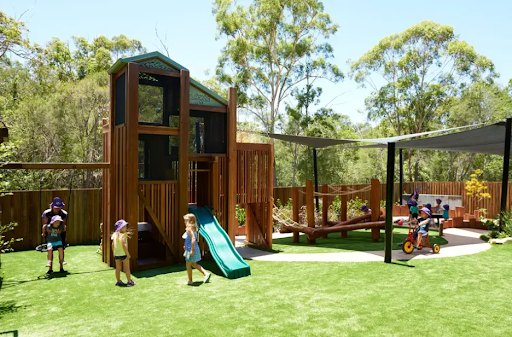
The Gold Coast climate is a genuine advantage. But a large grassy yard does not mean outdoor learning is actually happening. There is a real difference between children being sent outside to run off energy and children working through nature-based experiences with an educator who knows exactly what they are doing. The second version involves loose materials, open questions, and deliberate links between what happens outside and what gets reflected on back inside. Childcare centres on the Gold Coast that genuinely embed this into practice can show you documentation — children’s observations recorded, educator reflections written, learning connected back to the framework. If the outdoor space is just where kids go before lunch, that is useful to know before enrolment, not after.
Routine Done Wrong Looks Identical to Routine Done Right
Every centre runs a structured day. Far fewer will tell you that a rigid, inflexible timetable — one where a child’s genuine need gets overridden because it is not scheduled — can be just as destabilising as no structure at all. A child absorbed in building something complicated should not have that concentration snapped simply because the clock says it is transition time. Good educators know the difference between a routine that creates safety and one that creates compliance. One produces children who explore independently. The other produces children who sit and wait to be told what comes next. On a tour day, these two outcomes look almost exactly the same.
The Documentation Most Families Scroll Past
Educators in approved settings are required to build individual learning portfolios for every child. Most parents glance at these occasionally. A smaller group engages with them properly — responding to observations, sharing what is happening at home, treating the whole thing as a conversation rather than a bulletin. That distinction matters more than it seems. Children whose families engage actively with documentation start to hear adults talking about their thinking, their strategies, their growth — not just their behaviour or compliance. That shift in how a child understands themselves as a learner does not stay in the childcare room. It follows them into school and keeps going from there.
Conclusion
A centre that photographs well and returns calls promptly is not automatically a centre that serves a child well. The gap between a compliant early learning service and a genuinely good one is real, and it is not always visible on a first visit. Families who ask harder questions — who check the public rating, watch how staff talk to children when nobody important appears to be watching — tend to find it. That is exactly the kind of scrutiny that childcare centres in Gold Coast worth choosing will not flinch at. The ones that do flinch are also telling you something.