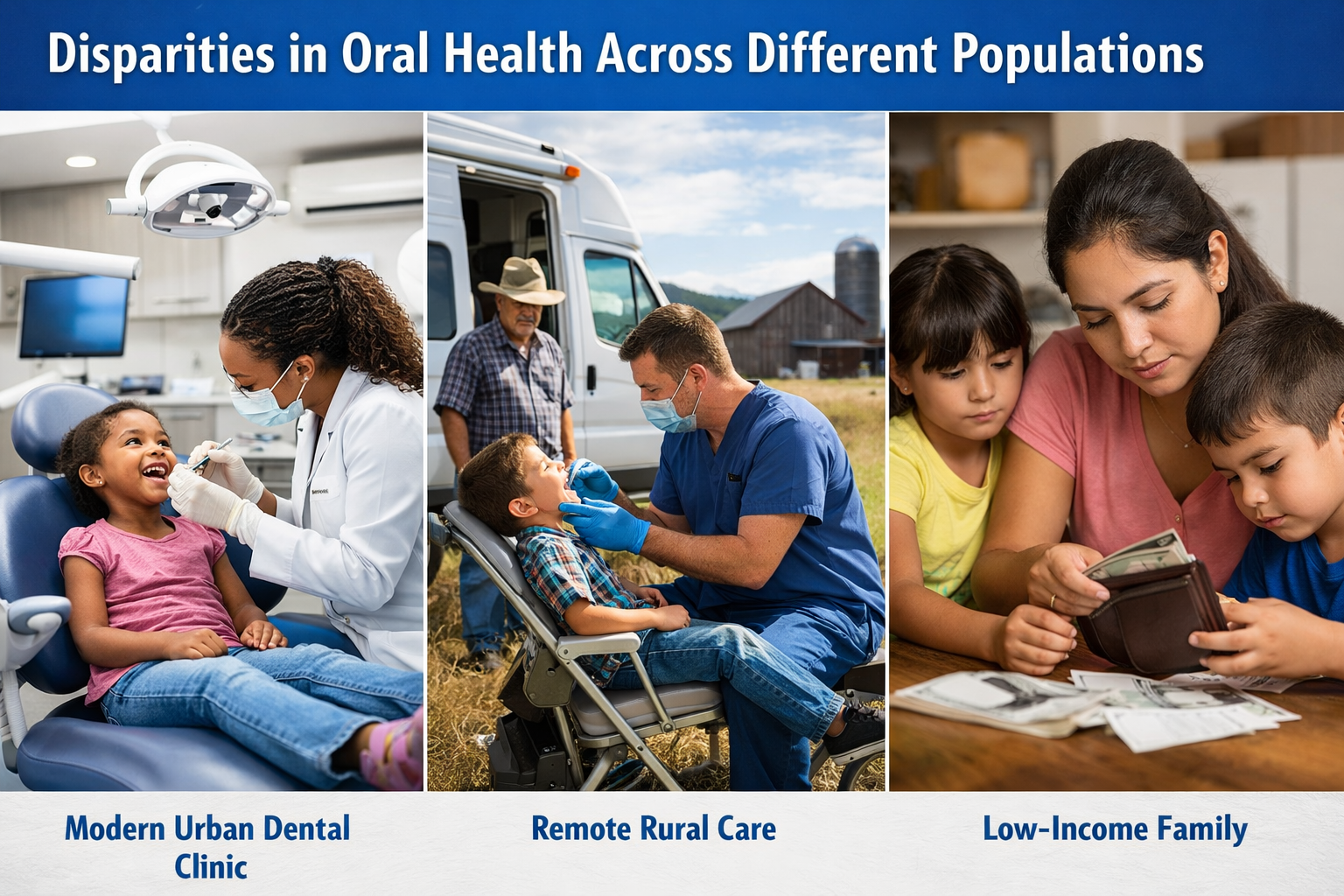
Oral health is an essential aspect of general health, and there are still serious oral health inequalities in various populations all over the world. These disparities are not arbitrary, they are conditioned by a complicated interaction between socioeconomic, behavioral, and environmental variables. Epidemiology- the science of the distribution and determinants of health in populations is vital in the process of discovering, comprehending, and resolving these differences.
When used in epidemiologic approaches, researchers and practising professionals in the specialised field of public health will be able to discover vulnerable populations, examine the risk variables, and develop specific interventions capable of enhancing equity in oral health. This paper discusses the role of epidemiology in the minimization of oral health disparities and the design of effective policies in the field of public health.
Overview of Oral Health Inequalities
Oral health inequalities can be defined as disparity in the prevalence, severity, and outcome of oral diseases in various population groups. Such differences are usually common in the socioeconomic status, geographic location, age, gender, and ethnicity.
To illustrate, people living in low-income communities are prone to having untreated caries, periodontal diseases, and losing their teeth more than their high-socioeconomic counterparts. Equally, rural people are prone to few dental care services, which leads to the poor oral health outcome.
Such oral health disparities among various populations are not biological only but highly dependent on social determinants of health. It is epidemiology that offers the methods required to conduct research in the systematic way of exploring these patterns and the reasons behind them.
The Disparities in Oral Health: The Epidemiologic Approach
Epidemiology has three main components being distribution, determinants and application. They are all important in oral health disparity.
Distribution: Who Is Affected
The distribution of the oral diseases in the populations is the first step in epidemiologic investigation. This is where the frequency of the disease is measured by estimating it by the indicators of prevalence and incidence.
Epidemiologists are enabled to define the most affected groups by oral diseases through surveys and surveillance systems conducted on a population basis. An example is that statistics can indicate an increase in dental caries prevalence in children in low-income families or periodontal disease prevalence in elderly people.
Such information is critical in identifying trends and ranking the health concerns of the population.
Determinants: Why Do Inequality Exist?
After identifying the disparities, it is followed by analyzing the causes of the disparities. These determinants can generally be classified into socioeconomic, behavioral and environmental determinants.
Socioeconomic Factors
The determinants of oral health outcomes are income, education, and occupation. Patients who have low income might not be able to afford dental services, whereas those who are not fully educated might not know how to take care of their mouths.
Behavioral Factors
Lifestyle behavior, that is, diet, oral hygiene, tobacco use, and alcohol consumption are significant to oral health. To give an example, high intake of sugary foods is a risk factor of dental caries whereas smoking is a significant risk factor of periodontal disease.
Environmental Factors
The environmental factors are the access to clean water, fluoridation, dental service accessibility, and living conditions. Societies that lack fluoridation of their water or do not have sufficient dental clinics tend to have an increased incidence of oral diseases.
Epidemiologic research which includes cross-sectional surveys and cohort studies can be useful in establishing relationships between these variables and oral health outcomes.
The Role of Epidemiologic Research in bringing out Inequalities
Epidemiologic studies are solid pieces of evidence that inform our knowledge on oral health disparities. Through the analysis of large data, researchers will be able to measure the level of inequalities and determine high-risk groups.
A further discussion of the research results can be seen in this paper on oral health disparities and their causes, which emphasizes the importance of social and environmental factors as determinants of oral health disparities.
This type of research does not only record the disparities, but in addition insight is given on the factors that may have led to the disparities and thus one can come up with focused interventions.
The Inequality of the Oral Health
In order to tackle the disparities, they should be measured. There are several tools and indicators that epidemiologists employ to measure inequalities, and they include:
- Ratio of prevalence to compare prevalence.
- Odds ratios to determine the relationships between risk factors and outcomes.
- Inequality measures like concentration index and the Gini coefficient.
- Measure of burden of disease such as Disability-Adjusted Life Years (DALYs).
Such measures enable the researcher to see the change of time and assess the usefulness of interventions to decrease disparity.
Planning Customized Interventions
Among the most significant contributions of epidemiology is that it helps in designing the intervention to be used in creating interventions that would benefit the population. Epidemiologists can assist in creating the strategy that is specific to the needs by recognizing the high-risk groups and the determining factors.
Community-Based Programs
Community-based oral health programs, including school dental screening, fluoride varnish application, and oral health education, can be developed based on epidemiologic data.
Preventive Strategies
Epidemiologic evidence usually informs preventive interventions, such as water fluoridation and encouragement of good oral hygiene behaviors. These measures will help in the prevention of oral diseases.
Access to Care
Another important area is to improve access to dental care services. The epidemiologic research can help to determine the underserved regions and populations so that more resources can be allocated through policymakers.
Public Policy of Informing Public Health
Epidemiology is crucial in helping to formulate policies that would help curb oral health disparities. The results produced through epidemiologic studies are used to make decisions at the local, national, and international levels.
Policy Development
The policymakers use the epidemiologic data to come up with policies that will encourage equitable access to oral health services. As an example, the high prevalence of caries in children may be evidenced and therefore school-based dental programs may be introduced.
Resource Allocation
The epidemiologic results assist in deciding the point of greatest necessity of resources. Governments are able to focus on funding and developing infrastructure due to the identification of high-burden areas.
Monitoring and Evaluation
Epidemiology can also be applied in monitoring and evaluation of the health programs of the people. Monitoring the evolution of oral health outcomes over a long period allows researchers to measure the effects of interventions and make relevant changes.
Solving Social Determinants of Oral Health
In order to adequately decrease the oral health disparities among the various populations, the general social determinants of health must be met. The model of the impact of these determinants on the outcome of oral health is furnished by epidemiology.
Education and Awareness
Enhancement of oral health literacy is one of the strategies. Epidemiologic research is able to determine a knowledge gap and educate people about healthy behaviors.
Economic Policies
Oral health can be greatly affected by policies which are designed to alleviate poverty and make healthcare more accessible. As an example, people with low-income should receive dental care services through subsidized programs.
Environmental Improvements
The availability of clean water and fluoridation can significantly decrease the rate of dental caries. There is epidemiologic evidence demonstrating the effectiveness of these interventions in enhancing oral health of the population.
Difficulties in Overcoming Oral Health Inequalities
In spite of the importance of epidemiology, a number of issues are still encountered in managing oral health disparities.
Data Limitations
In most areas, particularly low- and middle-income nations, oral health data is not reliable. This complicates the process of fully evaluating the level of inequalities and coming up with effective interventions.
Complex Interactions
There are various interplaying factors that cause oral health disparities and it is difficult to single out certain causes. These complexities should be taken into consideration by epidemiologic methods in order to make insightful contributions.
Implementation Barriers
Despite successful interventions being determined, the implementation may be challenging because of the lack of resources, political influences, and culture.
The Future of Epidemiology of Oral Health Equity
Recent developments in the field of epidemiologic techniques and technology are improving our capacity to deal with oral health disparities. Digital health records, geographic information systems (GIS), and big data analytics are some of the innovations that are offering new research and intervention opportunities.
Precision Public Health
Precision public health is intended to offer interventions that are specific to particular groups of people based on the finer details. Such a practice will enhance the efficiency of the programs as it will serve the distinct needs of various groups.
Global Collaboration
To deal with oral health disparities globally, the international cooperation is necessary. Data and best practices can be shared to enable countries to learn with each other and apply the strategies that work.
General Health Integration
It is very important to acknowledge that oral health is related to the health of the entire body. Oral health should be integrated with other health programs or efforts to support the overall health thus improving the success of interventions.
Conclusion
The epidemiology can be very helpful in combating oral health disparities. It offers the basis of tackling oral health disparities in various groups by establishing trends, assessing determinants and guiding actions.
Epidemiology identifies the underlying causes of inequalities by utilizing evidence-based research to formulate specific measures that can be used to enhance equity. It has an extensive effect on community-based programs up to national policies and is instrumental in enhancing oral health outcomes.
Nevertheless, to deal with these disparities, a holistic solution is necessary beyond the field of healthcare. Addressing socioeconomic, behavioral, and environmental issues, and capitalizing on the information that epidemiology has to offer, we can jump to a stage where oral health will become accessible and equitable to everyone.