Introduction
The payroll calculations is among the most crucial functions in any organization yet it may appear to be a complicated and daunting process. Regardless of whether you are an owner of the business, an HR professional or an employee who attempts to comprehend your pay slip, it is important to have a proper understanding of how payroll is calculated. Payroll is not only about paying salaries, but also entails keen calculation of gross earnings, deductions and net pay but also in adhering to legal and statutory provisions.
This paper simplifies the payroll computation into clear cut steps that are easy to understand. It describes the calculation of the gross pay, the various forms of deductions and also how the net pay is calculated. It also makes a point as to why accuracy in payroll is important both to the employer and employees.
What Is Payroll?
Payroll is the term used to describe the method through which employers compute and compensate salaries to their workers. It involves recording of the number of hours worked, earning and deductions and making sure that the employees are paid the right amount.
Basic payroll process consists of:
- Determining gross earnings
- Statutory deductions applying statutory deductions.
- Voluntary deductions should be accounted.
- Calculating net pay
- Issuing pay slips
Understanding Gross Pay
Gross pay refers to the sum of money an employee earns before deductions have been deducted. It is the basis of payroll calculations and carries all types of remunerations.
Components of Gross Pay
The gross earnings usually consist of:
- Basic salary or wages
- Overtime pay
- Bonuses and commissions
- Housing, transport, meal, etc. allowances.
- Holiday pay
As an illustration, when the employee has an annual salary of N150, 000 and allowances of N20,000 with overtime at N10,000, then his or her gross salary will be:
Gross Pay = N150, 000 + N20, 000 + N10, 000 = N180, 000
The establishment of the gross earnings is also important since all the deductions are made according to this amount.
Techniques of Calculating Gross Pay
The calculation of gross pay is determined by the approach of remunerating the employees.
1. Salaried Employees
Salaried workers are paid a fixed salary in a month or a year. Their base salary is typically direct without any extra wages in the form of bonuses or overtime.
Example:
Annual salary = N1, 800,000
Monthly gross pay = N1, 800,000 / 12 = N150, 000
2. Hourly Employees
The hourly workers are remunerated in terms of the hours worked.
Formula:
Gross Pay = Hours x Hourly Rate.
Example:
Hourly rate = N1, 500
Hours worked = 40
Gross Pay = N1, 500 x 40 = N60, 000
3. Overtime Pay
The overtime is usually paid at a higher rate; which is usually 1.5 times the usual hourly rate.
Example:
Overtime rate = N1, 500 x 1.5 = N2, 250
Overtime hours = 10
Overtime pay = N2, 250 x 10 = N22, 500
Understanding Employee Deductions
Deductions are then made after the gross pay has been determined. These reductions lower the gross pay to get the net pay.
The deductions can be divided into two categories:
- Statutory (mandatory by law)
- Voluntary (at the choice of the employee)
Statutory Deductions
Statutory deductions are mandatory and have to be deduced by the employers.
1. Taxes (PAYE)
Pay-As-You-Earn (PAYE) tax refers to the amount of tax which is deducted on the income of the workers according to the rules of taxation. It varies depending on income level and rates of tax.
Tax in most systems is progressive i.e. higher income earners pay higher tax rates.
Example:
When an employee earns N180, 000 and the tax is meant to be paid is N20, 000, this is directly subtracted on the gross pay.
2. National Provident Fund (NPF)
The National Provident Fund (NPF) is a scheme of retirement savings. Employers and employees make contributions towards the earnings of the employee each in a percentage form.
Example:
Employees contribution = 8 percent of gross salary.
Employer contribution = 10 percent (depends on the policy)
If gross pay = N180, 000:
Employee NPF = 8% x N180, 000 = N14, 400
This is reduced off the salary of the employee and paid to the fund.
3. Pension Contributions
In most of the countries, contributions to the pensions are compulsory. These are like NPF contributions and geared towards financial security on retirement.
4. Health Insurance Premiums
Other payroll systems have health insurance deductions as mandatory to extend healthcare cover to the employees.
Voluntary Deductions
Voluntary deductions are not compulsory and this is based on the choices of the employees.
Examples include:
- Loan repayments
- Union dues
- Savings schemes
- Insurance premiums
- Charitable contributions
The employee should approve these deductions.
Calculating Net Pay
The net pay also referred to as take-home pay is the amount an employee is paid after all the deductions.
Formula:
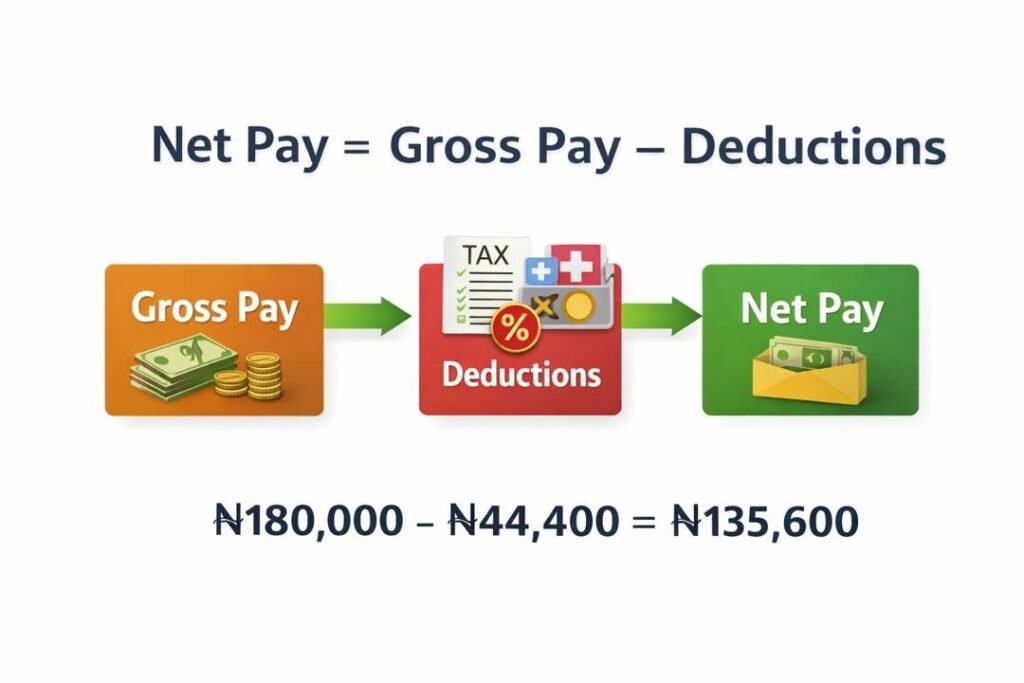
Net Pay = Gross Pay-Total Deductions.
Example Calculation
Let’s assume the following:
Gross Pay = N180, 000
Deductions:
- PAYE Tax = N20,000
- NPF Contribution = N14,400
- Loan Repayment = N10,000
Total Deductions = N44, 400
Net Pay = N180, 000 – N44, 400 = N135, 600
This is the real amount that is paid to the employee.
Importance of Accurate Payroll Calculations
Accuracy in Payroll is very vital due to a number of reasons:
1. Legal Compliance
The employers must adhere to tax laws and statutory contribution regulations. The wrongful calculation may result in penalties, fines, or even legal problems.
2. Employee Satisfaction
The salaries of the employees are based on the fact that they are paid correctly and on time. Payroll errors may cause dissatisfaction, mistrust, and lack of morale.
3. Financial Planning
The net pay is used by the employees to budget on expenses, savings, and investments. Proper payroll means that they are able to make proper budgets.
4. Business Reputation
Regular payroll inaccuracies will tarnish the reputation of an organization and it will be hard to get and keep talent.
Common Payroll Errors to be avoided
Payroll is also likely to be subject to errors despite its importance. Common errors include:
- Miscalculating overtime
- Incorrect tax deductions
- Not updating information of employees.
- Doing away with bonuses or allowances.
- Statutory contributions errors.
To prevent these problems, employers should put checks and balances to avoid these problems.
Payroll Managing tools and systems
Payroll programs have been made to ease calculations and minimize errors in modern business.
Benefits of Payroll Systems
- Automated calculations
- Accurate tax computation
- Easy record-keeping
- Adherence to legal regulations.
- Time-saving
Cloud-based payroll systems are examples of payroll tools that can be used together with accounting and human resource software.
Payroll Record Keeping
The payroll records must be maintained to ensure compliance and audits.
Key Records to Keep:
- Employee details
- Salary structure
- Tax deductions
- Pension records (NPF, pension)
- Pay slips
These records are supposed to be maintained by employers over a given time as mandated by the law.
Payroll Process Step-by-Step
The step-by-step work process of payroll is as follows in a simplified version:
- Gather employee information (hours worked, salary information)
- Calculate gross earnings
- Implement legal expenses (tax, NPF, etc.).
- Apply voluntary deductions
- Compute net pay
- Generate pay slips
- Disburse salaries
- Make remittances to the appropriate authorities.
Payroll and its Role in Employee Trust
Payroll is not just numbers but it directly has an influence on employee trust. This gives confidence in an organization when the employees are remunerated properly and at the right time.
Conversely, when errors are frequent, it may result in frustration and lack of productivity.
Compliance and Regulations
The payroll laws vary across different nations. Employers have to keep abreast with:
- Tax laws
- Contribution rates
- Labor laws
- Reporting requirements
Lack of compliance may lead to fines and legal action.
Tips on Making Payroll Computations easier
The following are some tips in order to simplify payroll:
- Use payroll software
- Maintain the record of the employees.
- Understand local tax laws
- Double-check calculations
- Payroll train employees on a periodic basis.
Conclusion
Payroll calculations might appear complex to start with, but when applied in simple parts, they can be easily managed. It is important that employers and employees know how to compute the gross pay, deductions made, and the net pay.
It starts by computing the gross earnings which is then subjected to statutory and voluntary deductions and the result is obtained in net pay. All the steps should be approached with caution to avoid breaking the laws and also to avoid losing trust of the employees.
Proper payroll is not only a financial liability but also an important element of success in organizations. When properly performed it will guarantee that the laws are adhered to, the employees become satisfied and it will help create a good working environment. Learning how to compute payroll, businesses become efficient, and employees have assurance in the correctness and justice of their payment.
Get more well researched information about Payroll calculations here.