In software development errors are not avoidable. Programs communicate with the external systems and accept user input and perform complicated calculations, so the issue of runtime errors is quite frequent. These exceptions are known as errors in Java and the code offers a very powerful means of managing them effectively. Handling exceptions properly will make sure that a particular application is reliable, does not crash, and will give users an excellent experience. This paper discusses Java in addressing runtime errors using try-catch blocks, finally clauses and custom exceptions and the reason why developers should apply best practices in writing resilient programs against errors.
What Are Exceptions in Java?
Java has an exception known as an event which interrupts the normal execution of a program. There could be exceptions because of a number of factors such as invalid input, file handling errors, network errors and arithmetic errors. In contrast to syntax errors, which are detected during the compile time, exceptions are runtime problems, which must be resolved to avoid the crash of the program.
Exception Java has three broad categories of exceptions:
- Checked Exceptions
- Unchecked Exceptions
- Errors
Exception Checked and Unchecked
Exception handling would not have been possible without understanding of the difference between checked and unchecked exceptions.
Checked Exceptions
Checked exceptions are those that the compiler will need a programmer to explicitly address. They are mostly external elements that are not within the control of the program e.g. file I/O or database access. An error occurs in the event that a checked exception is not dealt with.
Example:
import java.io.File;
import java.io.FileReader;
import java.io.IOException;
checked public class CheckedExample.
static void main(String)
try {
File file=new File(example.txt);
FileReader reader = new FileReader(file); // May throw IOException.
System.out.println(File opened successfully);
} catch (IOException e) {
System.out.println: something went wrong: e.getMessage);
}
}
}
Exception IOException in this case is a checked exception. The compiler will make sure that it is either contained in a try-catch block or the throws keyword is indicated.
Unchecked Exceptions
Unchecked exceptions, alternatively called runtime exceptions do not necessarily have to be explicitly handled. They frequently point to logical errors within the code, including division by zero or use of an invalid index into an array.
Example:
public UncheckedExample.
Main()
int[] numbers = {1, 2, 3};
System.out.println(numbers[5]); // Throws ArrayIndexOutOfBoundsException
}
}
The ArrayIndexOutOfBoundsException is an unchecked exception, i.e. the compiler has nothing to compel you to catch this, but not doing so can lead to the crash of your program.
The Try-Catch Block: Exception Handling Basics
The basic form of dealing with exceptions in Java is the try-catch block. It also enables you to test a block of code and capture any exceptions that can arise, and is a means to enable you to deal with errors gracefully.
Syntax
try {
// Exception prone code.
} catch (ExceptionType e) {
// Code to handle the exception
}
Exceptions of different types can be dealt with by different catch blocks.
Example:
class MultipleCatchExample is public.
main (String[ ] args )
try {
int division = 10 / 0;
int[] array = new int[3];
array[5] = 100;
} catch (ArithmeticException e) {
System.out.println( “Can not, divide by zero: ” + e.getMessage);
} catch (eArrayIndexOutOfBoundsException) {
System.out.println(“Index out of bounds: in the array: ” + e.getMessage);
}
}
}
In this example, various exceptions are handled individually, and it is possible to have exact error messages.
Using the Finally Clause
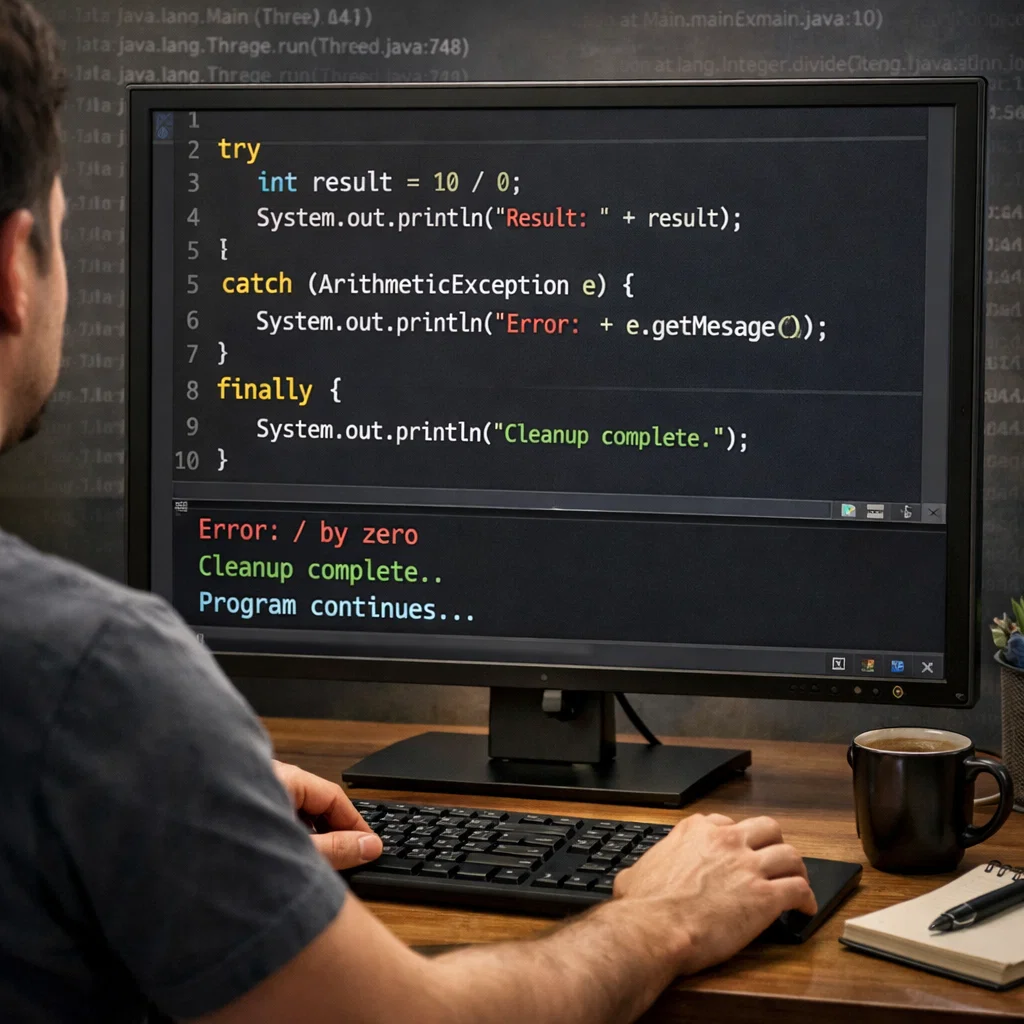
Finally clause performs code regardless of the occurrence or non-occurrence of exception. It is usually employed in cleaning up of resources, including closing down files, network connections or database connections.
Syntax:
try {
// Exception throwing code.
} catch (ExceptionType e) {
// Handle exception
} finally {
// Code that always executes
}
Example:
import java.io.File;
import java.io.FileReader;
import java.io.IOException;
FinalExample public class FinalExample.
statics void main(String[] args)
FileReader reader = null;
try {
File file = new File(“example.txt);
reader = new FileReader(file);
System.out.println(File opened successfully.);
} catch (IOException e) {
System.out.println Ureading the file: error: + e.getMessage);
} finally {
if (reader != null) {
try {
reader.close();
System.out.println(“File closed successfully.<|human|>System.out.println(File closed successfully).
} catch (IOException e) {
System.out.println: there was an error closing the file: ” + e.getMessage);
}
}
}
}
}
In this case, the last block makes sure that even when there is an exception when opening the file, it will still be closed. This discourages leakage of resources which may cause performance errors.
Creating Custom Exceptions
There are occasions when constructed exceptions are not applicable to your application. Java gives you the opportunity to tailor your own exceptions by deriving them out of either the Exception or the RuntimeException classes.
Example:
class AgeException is an extension of Exception.
public AgeException (String message) {
super(message);
}
}
class CustomExceptionExample.
static void ageCheck(int age) throws AgeException.
if (age < 18) {
throw new AgeException(age should be 18 or above);
} else {
System.out.println(“Access granted.”);
}
}
static main(String,args)
try {
checkAge(15);
} catch (AgeException e) {
System.out.println(Custom Exception: +e.getMessage);
}
}
}
The exception in this case is the AgeException that is a checked exception and the compiler makes it also caught or declared. Exception handling Custom exceptions help to make your code more readable and specific, enhancing the maintainability.
Exception Handlers Best Practices – Java
Exception handling goes beyond placing code in try-catch blocks. Practices: Best practices guarantee sustainable and sustainable programs:
Catch Specific Exceptions
Always include special exceptions instead of general Exception. This eliminates bug concealment and error handling becomes easier.
// Bad practice
catch (Exception e) {
System.out.println(“Error occurred.”);
}
// Better practice
catch (IOException e) {
System.out.println(e.getMessage); System.out.println(e.getMessage);
}
Avoid Empty Catch Blocks
A blank catch block does not handle the exception and complicates the process of debugging. Never ignore the exception.
Finally Use or Try-With-Resources
It is imperative to always release a resource in a finally block or try-with-resources (Java 7) to automatically release the resource.
try (FileReader reader = new FileReader(“example.txt”)) {
// File operations
} catch (IOException e) {
System.out.println(Error: e.getMessage);
}
No finally required, resource automatically closed.
Never Use Exceptions to Control Flow
An exception is to deal with extraordinary cases rather than ordinary logic. Exception programming is slow because it requires exceptions to be used in the normal flow of the program.
Document Exceptions
Indicate methods signatures with the throws keyword to record exceptions that may be thrown by a method. This enhances API and readability.
Efficiently Dealing with Multiple Exceptions
Java 7 support multi-catch blocks, where it is possible to use a single block to deal with multiple exceptions.
try {
int[] numbers = {1, 2, 3};
int division = 10 / 0;
System.out.println(numbers[5]);
} catch (ArithmeticException | ArrayIndexOutOfBoundsException e) {
System.out.printing “Exception happened: ” + e.getMessage);
}
The practice minimizes redundancy in code and exception handling brief.
Live Demo: User Input Checking
We would like to develop a little program illustrating how exception handling should be done in a real-life situation:
import java.util.Scanner;
class UserInputExample public.
public static void main(String[] args) {
Scanner scanner = new Scanner( System.in);
try {
System.out.print: type in your age:
int age = scanner.nextInt();
if (age < 0) {
new IllegalArgumentException age can not be negative.
}
System.out.println: Your age is: + age);
} catch (IllegalArgumentException e) {
System.out.println(Error:) + e.getMessage);
} catch (Exception e) {
System.out.println(“Invalid input. Please enter a number.”);
} finally {
scanner.close();
System.out.println(“Scanner closed.”);
}
}
}
This program is very graceful as it takes care of invalid input as well as logical errors and this is why thorough exception handling is essential.
Java Integration Capabilities
Java exceptions do not conflict with the other features of the language, so your programs are more trustworthy:
- Collections and data structures: When working with data structures available in Java, one can have an exception such as NullPointerException or IndexOutOfBoundsException in case of misuse of collections. Safety leads to prevention of crashes.
- File and network operations: IOException is a checked exception that requires developers to be careful with resource-dependent operations.
- Custom structures and APIs: Most Java structures like JDBC used to connect to databases use excessive use of exceptions in reporting and recovery of errors.
The Benefits of Exceptions Handling
- Better Reliability: Applications run fewer chances of dying after receiving unforeseen inputs or system-related problems.
- Improved User Experience: There are meaningful error messages and not generic crashes to users.
- Maintainable Code: Exception handling should be done out of the error management and the normal program flow.
- Less complicated debugging: Stack traces and exception messages allow one to quickly locate a problem.
- Resource Management: Ensures the administrations such as files, streams, and connections are released correctly.
Common Pitfalls to Avoid
- Hiding Bugs: exception swallowing with empty catch block statements causes latent bugs.
- Excessive use of Generic Exceptions: Catching Exception or Throwable will cover up the actual cause.
- Excel Checked vs. Unchecked: Misuse will ensure that no extra code is created that is not necessary.
- Exception Control: Exception should not be used to control regular logic.
Conclusion
Exception management is one of the fundamental characteristics of Java, which is required to create strong and resilient applications that are easy to use. Knowing the difference between checked and unchecked exceptions, the use of try-catch blocks, finely statements as well as the development of custom-made exceptions allows developers to foresee errors and handle them in the best way possible. Adhering to the best practices, including the ability to catch certain exceptions, provide documentation of the possible errors, and rely on automated resource management, makes sure that the applications are not merely operable but can be maintained and remain stable as well.
Java programs can gracefully handle any unexpected conditions, protect resources and offer users a seamless experience with proper exception handling; exception handling is not only an essential requirement to handle technical needs but also a foundation block of good software development.